In Ukraine, all of the smaller, corner stores work much like markets did in the United States fifty or one-hundred years ago. You'll go in and see that all of the goods are on shelves or in cold cases only employees can reach or access. Consequently, if you want some cheese, you'll have to go up to the dairy counter and speak with a blue-aproned продавщица (prodavschitsa/saleswoman) who will call out, Я слушаю! (ya slushayu!/I'm listening!) and take your order. If you want some meat, or some dry goods, you'll have to repeat the process, seeing two more Blue Aprons.
There is certainly a benefit to this system: a drastic reduction in theft. But the problem is, if you don't speak Russian, or if you speak a little Russian but are too shy to test it in public, you will likely starve, especially if you haven't yet discovered one of the western-style supermarkets, of which there were several in Kharkov.
Anyway, all of this is a long introduction to the fact that I wrote an essay about my experiences trying to scrape together a few good meals in Ukraine during my first couple of weeks in-country back in the fall of 2005. A while back I pointed you to the journal that published it, NOÖ Journal, which subsequently nominated the essay for inclusion in the Best of the Web 2009 anthology.
Now I'm writing to say you can find an audio recording of the essay below. Fourteen minutes long, it should prepare any traveler for a trip to the Former Soviet Union. Tell me what you think. And Приятного аппетита!
Friday, December 19, 2008
Notes From an Underground (a recording)


Monday, May 26, 2008
How to Make Chicken Kharkiv
During my first month or two in Kharkov, I reported that I wasn't eating so well. Now the full story can be found in the latest issue of NOÖ.

Sunday, January 28, 2007
Swink

Swink's long-anticipated third issue is now out, and as expected it's filled with work from a host of great writers: Karl Iagnemma, Daniel Alarcon, and Ron Currie, to name just a few. You'll also find an essay of mine in there, one that details my experiences teaching English literature -- and being gently censored for including too many sexual stories on my reading list -- at a Ukrainian university.
To read a short excerpt of "A Literary Purge," go here.
For those looking for more, there's also Pete Jensen's Unhooking the Secret, about the author's experiences applying for work at a Victoria's Secret. A fun read.
Tuesday, November 14, 2006
The Notary
Few people in Ukraine or Russia hold a position of greater authority than the notary. Even a mafia boss might not believe an underling has performed a hit if he doesn't report back with the proper documentation.
When I was living in Kharkov, a professor at the university where I taught was trying to start a marriage agency with a lawyer he knew. He approached me when he learned I was an American, and asked if I would write a letter on his behalf to the owner of an American-owned agency. He was seeking a business relationship, maybe a little advice, and so I dashed off a letter, thinking that would be the end of it. But my Russian-speaking Ukrainian friend received it, he said, "Should we get it notarized, do you think?" This was a man out of a Kafka novel. Slight and thin, mousey face, chain smoker, a nervous laugh and bureaucratic voice. "No," I told him, I didn't think we needed to get it notarized. But he was quietly persistent, sure it would probably be best if a notary was present to see me sign beneath my printed name. "The guy we're writing is from Houston," I tried. "He's not going to know the difference."
But it was a losing proposition. A few nights later, I met my friend on the corner of Pushkinskaya and Bazhanova, piled into a cab with him, and was driven deep into the night to a part of town I didn't yet know. When we arrived, we stood outside in the cold, waiting for his partner to arrive. My friend smoked cigarettes, apologizing for the delay. Then his future partner, the lawyer, was pulling up in a chauffered Lada, and the three of us were moving inside.
The notary was not yet available. Either she wasn't here or she was in a back room. A secretary showed us to a waiting area. Plush leather furniture. Magazines on a glass coffee table. Flowers everywhere. A TV going. We waited. My Ukrainian friend held the documents in a plastic folder: one copy in Russian, another in English. "We'll need them both notarized," he said.
Then the notary appeared, a regal woman in her fifties with chamber of commerce hair and flecks of gold on her neck, wrists and lobes. She looked at our paperwork. Spoke with the two people I'd come with, looked at me not once. No, no, no, she said. This was the jist of it. No, no, no -- she couldn't possibly notarize this, as it was a personal letter. My friends argued. They stated their case. This letter was supposed to initiate a business relationship. It was very much not personal business which was being conducted on this page. But no, I was an individual, not a business, she and they and even I could very clearly see that, and so she could not give us her stamp. "Tell her I'm a professional writer," I said, liking the sound of that. "Would that help? Say the letter is part of my work." But no, it didn't matter. The lady stood. The court was cleared. We had to go.
My Ukrainian friend and the lawyer were crushed. They took me apologizing back to the cab, and it was only a week or two later, at the lawyer's office, that we met with a second notary to try again. This time, tea was served all around, and the notary was offered chocolates. Everyone wore black leather but me. The notary looked at the documents. He had required that the letter be in Ukrainian, not my friend's native Russian. "This is an official document," he had explained over the phone. But now in the office he pointed out mistakes in my friend's use of the Ukrainian language. He could not stamp the letter until this was fixed, and this, and this here. My friend worked hurriedly on the computer, trying to rectify the mistakes. I sat with the pen, waiting to give my signature. More tea was served. The lawyer begged my patience. The notary said he would be back. I was given more chocolate. And then fifteen, thirty minutes later, the new sheet was printed out and the notary was back and I was moving my pen across the page. The notary observed it all, then moved his ledger book before my face. He pointed his finger here, then here; my signature followed.
~
I was reminded of this the other morning, when my wife asked if she should get a letter of recommendation notarized. I said her boss' signature would be enough, but after sending the SMS message I felt a shudder of anxiety -- my god, she's right, that needs to be notarized. Evidence I've lived in Ukraine.
Then this evening, while browsing the Russian Women Discussion message board, I came across this, a list of things a poor man must do in order to have his divorce certificate recognized by the Uzbek government:
1. Have a local notary public notarize the document (divorce certificate).
2. Have the county clerk certify the notary's authority.
3. Have the Secretary of State of the appropriate state certify the county's authority.
4. Have the State Department's Certification Division certify the State's authority.
5. Have the Uzbek Embassy or U.S. Embassy in Tashkent certify the State Department's authority.
As the man cannot legally marry in Uzbekistan until he proves that he is free and unencumbered by any previous marriage, number six in this list could very well read, "Marry a woman from Tennessee. It'd be easier."
And number seven? "Couldn't hurt if she's a notary."

Wednesday, November 01, 2006
The Political Coming Out of Sacramento's Slavic Community
Organizers of the annual Rainbow Festival were prepared for trouble.
The Q Crew, a local "queer/straight alliance," distributed cards telling people what to do if approached by hostile demonstrators. Sympathetic local church groups formed a protective buffer along the festival ground's cyclone fence. Mounted police were on patrol.
Jerry Sloan manned a table for Stand Up for Sacramento, a recently formed gay self-defense organization.
"So far, so good," he said. "No Russians."
Russians, as is so often the case in America, here means anyone from the Former Soviet Union, and in particular those Ukrainians in the Sacramento area who arrived ten or fifteen years ago but only recently have started to show an interest in local politics.
Numbering between 80,000 and 100,000, Sacramento's Slavic community isn't Jewish or Orthodox, but largely evangelical -- Baptist and Pentecostal. (The Pentecostal church was introduced into Ukraine in the 1920s by missionary and martyr Ivan Efimovich Vornaev.)
That the community chose to settle in Sacramento, making it the largest non-Jewish, non-Orthodox destination for Russian and Ukrainian immigrants, can be explained by the Cold War.
Before emigrating, many of the refugees learned about Sacramento from two sources: a short-wave fundamentalist religious radio program, "Word to Russia," that originated here, and a Russian-language newspaper, Our Days, that was printed in Sacramento and distributed to underground churches in the Soviet Union. A local Russian Baptist church persuaded several Sacramento evangelical churches to sponsor the refugees.
...
Michael Lokteff, 69, is a former high school teacher who was the voice of the "Word to Russia" broadcasts into the Soviet Union. A cheerful, white-haired lay Baptist who takes a glass of wine with his meals, Lokteff said that many of the immigrants were unprepared for culturally laissez-faire California.
In part, Lokteff blames his own broadcasts, which he said left the listeners with the impression that America, and particularly Sacramento, was a Christian bastion.
"They even thought my program was government-sponsored," Lokteff said. "They came here expecting a Christian commune, and all of a sudden the first thing they see is a gay parade."
An interesting article. Read it while you can. Read More......
Thursday, June 29, 2006
My Adidas
I arrived in Odessa this morning, after traveling through the night from western Ukraine in a train compartment that included one friend, one veteran of the Red Army, and one muscular young man in black Adidas sweat-pants, the last of which, I'm told, is the apparel of choice for Ukraine and Russia's young Mafioso set. (It is also pronounced Oddy-dos, the last like the computer language, which completely, you know, ruins the Run DMC song.)
Anyways, maybe an hour or two into our journey, after my friend had stepped out into the hall, the Army veteran tapped me on the shoe and asked if I could leave him and Mr. Adidas alone for five minutes. It took me a moment to process the words in Russian, but then I was nodding and slightly afraid, wondering what in the hell they'd be doing alone and how I might have insulted them earlier. There had been one inappropriate laugh, when I'd thought I'd heard Mr. Adidas tell a joke, only to have him turn a stern and stoney face in my direction to suggest otherwise. I got up and went into the corridor.
My friend was looking out a window, watching the green fields of western Ukraine blur by. I told him what had just transpired. We discussed our concerns and analyzed various scenarios. Were our bags in danger? I had some valuables, some cash, some electronics. What could they be doing? "My passport's in there," my friend said. "Did you see he's wearing Adidas?" I said. "What does that mean?" he said. I told him. "Is that right?" he said. I said it was.
The provodnitsa, whose job it is to take tickets and hand out linens and clean the wagon's toilet, came by and opened our compartment's door, looking to give someone their change for a cup of coffee or tea. Before realizing her mistake -- wrong compartment -- and closing the door, I saw the army veteran standing with his back to us, Mr. Adidas hidden behind his body. What were they doing? Going through my bags?
Maybe three minutes later, my friend said it was five minutes. I stepped toward the far window. "Open the door if you want," I told him, "but I'm not with you. You work alone."
He gave the door another look, then turned his face back to me. "Five minutes has got to be up, hasn't it?"
I shrugged. "What is time?" I said. "What are minutes?" I asked.
We waited. The fields blurred by, cows and peasants. The sun moved in a downward direction. Then the door opened and Mr. Adidas stepped out of the compartment and stuck his hand out the window, to the side of my friend. Whatever he'd been holding inside was soon scattering out over the green fields near the Moldovan border.
Minutes later, all four of us were again back in the compartment, with me and my friend sitting there silently like people who didn't quite get the joke. With no parting statement, Mr. Adidas got up and went with the Army Veteran to a compartment at the end of the wagon, to which the provodnitsa, a young woman in modest heels and a crisp blue cap tilted jauntily atop her head, soon followed with a plate of fried eggs and cut tomatoes.
Have you ever seen a catered meal on a Ukrainian train? My friend, after four years in the country, had not. After almost a year, neither had I. The same for the empty compartment at the end of the wagon being used as a private dining room. But then Mr. Adidas, who was journeying to Odessa, Ukraine's capital of Shady ... well, maybe he had some kind of relationship already built up. What's your name? he'd asked the provodnitsa when she'd come to take our tickets. "Lena," she'd said. "Pleased to meet you, Lena," he'd answered, and now she was giving him eggs?
Mr. Adidas was the last to make his bed that night. He kept going in and out of the hall. I slept with one eye open, waiting for him to jump up to his bunk. He didn't. He made his bed at last, but he then left ... and remained gone ... for a very long time. In fact, I never saw him asleep. And he was on his feet, first one up, when I awoke to the sound of his and the Army veteran's banter.
The provodnitsa, usually a solid middle-aged woman with all the charm of Brezhnev, had her own compartment at the end of the hall, the four beds made up with fancy sheets to give her and the train's other attendants a place to catch some sleep, if necessary. I have heard stories. Of provodnitsas who sell more than coffee or tea. "Coffee, tea or me?" the old saying goes.
In the morning, my friend asked for tea and coffee, the first for him, the latter for me. But after maybe twenty minutes, still nothing. I said enough's enough at that point, I can stand many things but not missing coffee, and left to see the provodnitsa, a rather touchy-feeling young woman come to think of it who'd reached for my hip-bone, and then another time my forearm, while sliding past me in the hall.
The provodnitsa followed me back to the compartment a minute or two later to ask more specifics about my order -- one sugar or two? -- and then, with a look that lingered just a beat too long, she asked Mr. Adidas what he wanted.
"Tea, Lena," he said. "Thank you, Lena."
I had coffee.
More on the squat
I just learned that the Kiev Train Station was recently built at a cost of billions, meaning some administrator saw it fit to make sure people would be squatting well into the future. Interesting. Because for billions and just a few dollars more, we could all be sitting. But enough on the squat. There are more important things in this world. How are you helping?
Read More......Tuesday, June 27, 2006
Western Ukraine
I've been traveling enough of late to not only have seen The Worst Toilet in Ukraine (on the train to Kherson), but also its closest challenger. Today, I took a picture of the latter, a pit toilet out back of a bus station in the Carpathian town of Yaremche. Perhaps I'll post the photo later, with a disclaimer like those voiced before the more especially disturbing segments on the evening news: I must warn you, these images are graphic and may not be suitable for young children.
In other news, after almost a year of hesitation, I braved my first squatter last Friday after arriving to the Kyiv train station with what can only politely be described as some small degree of gastrointestinal urgency. Like most things long avoided, it wasn't as bad as I'd imagined. But I won't go into the details here. That sort of writing requires, and I believe I'm paraphrasing Wordsworth here, a period of quiet contemplation more appropriate to a book than a blog.
Tonight, I'm in very comfortable surroundings, at the On The Corner bed and breakfast in Kolomyia, a town nestled amidst the Carpathian Mountains in western Ukraine. Why am I in western Ukraine? I'm not really sure. I haven't quite scared up a marriage agency connection yet, though I have found great accommodations – the best I've yet seen in Ukraine. After checking into On The Corner this afternoon, I was almost immediately served a home-style Ukrainian dinner. Last night, in Rakhiv, another Carpathian town, my host was no less accommodating, giving me the best room I've yet rented in Ukraine – and for a price of only $10. I should write more about these places later, when I have time and computer access (both have been scarce of late).
Wednesday, June 21, 2006
Lines in Ukraine
Thursday, June 08, 2006
Napkins
Mr. Pink would like Ukraine. You're not expected to tip. Some places have 10 percent built into the bill, but this is rare. And if you're at a place where the tip isn't included, you can sound extravagant to the other members of your dinner party if you suggest that you tip, say, 7.4 percent.
"I don't think the service was that good."
"Maybe five percent."
"It's these Americans. They get a little money and they want everyone to know."
"Seven-point-four percent!"
"Maybe I'd go four."
You'd think the service would be bad, but for most eating out is still an extravagance, so restaurants are far from full. Or there are many people in the restaurant, but you're the only one who didn't finish his food more than an hour ago. I can only presume this leaves the wait staff looking for something to do.
I find one element of the over-service a little disturbing. I can't keep a napkin. I take one out of the little dispenser on the table. I wipe my mouth. I crumble it up in my palm. I set it down. And then in swoops the waitress to take it away. I started to think it must be where I placed it on the table -- off in the middle, too far away from my plate. Perhaps there was a demilitarized zone, I told myself, into which Ukrainians set their refuse and empty coffee cups. But no, I moved it closer to my plate and still it disappeared.
Yesterday, I sat in a four person booth, furthest to the wall. I placed the napkin on the far side of my plate. The waitress took it no more than five seconds after I set it down. She lunged across the table to reach for it. She took my dinner companion's plate, but that was just her cover, I'm sure of it. What she wanted was the napkin.
Friday, June 02, 2006
Band-Aids
People sell things on the Metro. I recognize the faces of some of the vendors. It must be a full-time gig. One guy came in one day with a glass cutter and some glass. He held up the knife, spoke loudly, then proceeded to cut strips of glass off one by one, lifting each up to show the precision of his cut. A man with either little awareness of, or little need for, that phrase, "The world changed on 9/11."
Today, while taking the Metro to my tutor's apartment, a guy came in and pulled a handful of Band-Aids out of his duffel bag. They come in finger-long cardboard boxes, not very thick, maybe a few Band-Aids to the box. I've been seeing these things sold for a couple weeks now. Maybe a crate fell off a truck somewhere. The first time I saw them, I thought they were syringes. The box looks about that size. But then I saw they were Band-Aids, twenty-some cents a box. I thought, Who wants to buy a Band-Aid in a Metro? Maps of the city, yes. Phone books. Directories of restaurants and theaters. A World Cup 2006 poster to hang on your wall, complete with places to fill in the winner of each match -- I almost bought that. But Band-Aids? Apparently, they must be pretty good. Today after giving his sales pitch, five people around me dug into their pockets and coughed up a Griven bill. Two people on each side of me and one staring me in the eye. I thought, You're all some clumsy Ukrainians. I think I'll just let you go first, maybe ride through to the next stop, make sure you don't trip me up on your way down.
Wednesday, May 31, 2006
Graduation Day
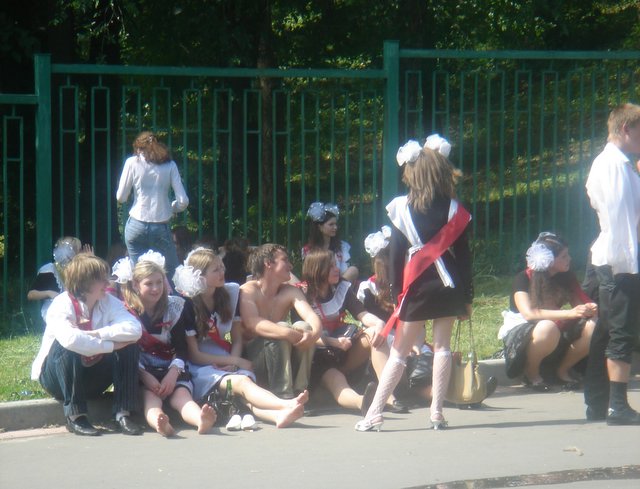
As Alice Cooper once so aptly sang, School's out forever. At least it is for some kids in Kharkov, who apparently celebrate the end of the academic year by donning old Soviet-era school uniforms that, in a pinch, could outfit a French maid.
Lugansk: Working for a living
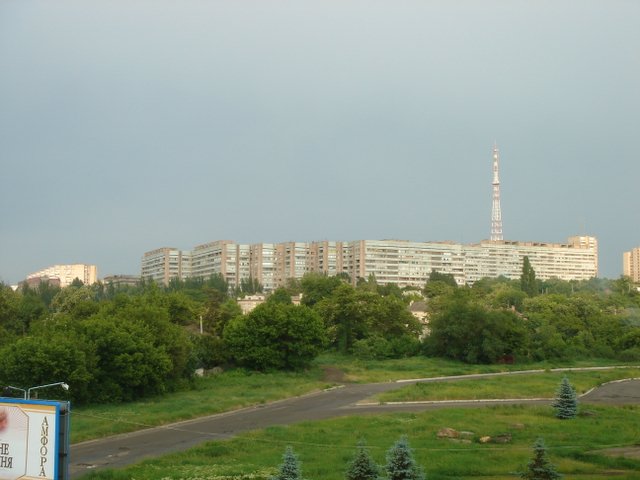
When I arrived by train in Lugansk Monday morning, I was met by a Fulbright Scholar who was nearing the end of his ten-month stay at that city’s medical university.
“Any other Fulbrighters been out this way to visit?” I asked.
My Man in Lugansk, a southerner with a warm Kentucky accent, smiled shyly and admitted I was the first. “If you’re here, you’re here for a reason,” he said, “because it’s not on the way to anywhere.”
Located at the far eastern edge of Ukraine, a good eighteen hours by train from the capital, Lugansk is indeed isolated, a city of some 400,000 that has long served as a center of heavy industry.
On the drive away from the train station, my fellow Fulbrighter pointed to two apartment complexes facing the vokzal – one a massive, meandering Soviet-era structure dubbed The China Wall (picture above) for its resemblance to the Great Wall, the other a new apartment tower going up across from it. Units in the latter were being advertised as “elite apartments,” My Man in Lugansk said, making quotation marks in the air, and the price was 900 Griven a square meter unfinished (or approximately $180) which puts Lugansk well ahead of where it was a few years ago, when you could have expected to pay $300 per square meter for a place to live, but well below the prices in Kyiv, which are apparently on a rocket ship to the moon, perhaps three times the level in Lugansk.
With jobs in the region scarce, average monthly salaries closer to $150 than $600, and a value added tax of twenty-percent at the newly open Metro – a sort of Ukrainian Costco – I had to wonder just who could afford such a place. My man in Lugansk nodded knowingly and followed all the rules of southern nicety by putting it this way, “There’s lots of money out here, it’s just not well distributed.”
In other words, you wouldn’t surprise anyone on the streets of Lugansk if you said there was corruption in the halls of government or mafia money behind the tinted windows of that black BMW racing down Sovietskaya Street.
I find it ironic. When it was a republic of the Soviet Union, Ukraine was, in essence, a union, but now the gap between rich and poor is wider than ever, the poor are more economically disenfranchised than before, and the wealthy, while once simply well off, are now filthy with it.
The man I’d come to meet, a northern Californian with a dating agency based in Lugansk, told me he had to warn his customers not to expect a quick reply to ever e-mail.
“These women sometimes work six days a week, ten or more hours a day, and when they come home they don’t necessarily have the energy to write an email.”
It was a familiar story. A banker once told me she joined a bank hoping for banking hours only to learn her office was often as full at nine a.m. as it was at nine p.m. and that an announcement came over the PA system every night at ten: “You must go home now.” There was no one forcing you to stay long enough to hear that message, but if the guy next to you is, and the girl on the street gladly would, it’s kind of hard to leave that chair.
Maybe this is the reason, while walking the streets of Lugansk, I saw Lenin still standing and flowers at the base of the statue honoring Felix Dzherzinsky, the founder of the KGB. With numerous other monuments still standing to the glories of Communism and its leaders – to say less of the tall grass along the city center’s walkways and the scarcity of new construction – this city was more visibly Soviet than any other I’ve yet visited in Russia and Ukraine.This story will continue. When and how I don't know. Been having all sorts of trouble with Blogger. Can't access it at home or the usual internet cafe. So I'm here, where all the young Neos hang out and the foreigners are viewed as an amusing oddity. Seems to work here, though now I can only add one photo. We'll see. It's been like this for two weeks or more, so that's why there've been fewer posts than envisioned.
Monday, May 15, 2006
Dead Souls
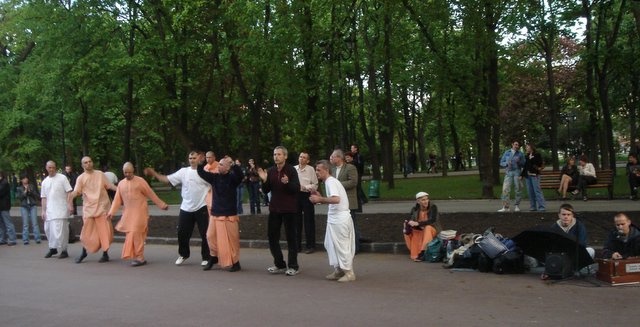
Almost as soon as The Wall fell, they came looking for dead souls. Mormons, Evangelical Christians, and the Hari Krishna pictured here. The former Soviet Union, officially atheist until 1988, must still be considered a great growth market by the world's snake-handlers and mantra-chanters, because there was a crowd a hundred strong in Schevchenko Park watching this group on Saturday night.
The guy at the far right of picture chanted and played his squeeze box, while the women were segregated and dancing off to his other side, this group dressed in saris and comfortable shoes. I kept looking at these shoes -- plastic sandals and Birkenstock-like things, all sadly blurry in my other photo -- and wondering how they expected to win over the hearts and minds of Ukrainian women looking like this. This is the country of the four-inch heel, the stiletto in the snow-storm. If you are a man with a foot fetish, this is both the country for you and the country you should avoid at all costs, as you might find yourself unable to be a productive citizen of the world surrounded by so many knee-high boots and calves wrapped in elaborate ribbons.
Thursday, May 04, 2006
Invest in Ukraine
Tonight while procrastinating I came across a directory of Ukrainian companies, grouped by region and city, that are looking for investment partnerships in the English-speaking world. I know not all of you are interested in dumping thousands of dollars into a former Soviet state. Perhaps you'd rather spend your money on your golf game, a new sports car, or a good divorce. But just in case this might be of interest to one person, I'll give the link.
Personally, if I had the money to ante up, I'd partner with The Kharkiv Biscuit Company:
This Open Joint Stock Company, has 900 employees, with 70 to 80 in their retail operations.
The company sells mainly to retail shops in the Kharkiv area and they export some products to the CIS, mainly to Russia. They also export a little to Italy and Austria, but the Ukrainian currency and customs regulations make it difficult to export in volume.
The company is the only one in the Kharkiv area that specializes in baking assorted biscuits. There are 33 other enterprises in Ukraine that make crackers, but this company is the only one to produce both biscuits and crackers. They have a production capacity of 150-160 tons per day and produce a full range of products at each price level. They do not make biscuits with sugar or chocolate icing. They have seven biscuit lines and their product quality is very high and competitive with products from Europe and Russia.
They make damn fine chocolates and sweets, a wonderful Kyivesky Tort, and there main shop downtown is beautiful. I'll be sure to take a photo the next time I stop in -- and I do stop in often.
One more in line with the interests of some people I know stateside is Wood World, a company that makes prefabricated homes, like the one in the picture.

The company was established in December 1999 when foreign equipment made in Germany , Holland and Poland began to be shipped to Ukraine . Currently the enterprise is growing very intensively due to aggressive marketing policy and advantages in quality, prices and assortment of products and services. In 2003 they employ 80.
The company participated in a Marshall Plan type study tour of the US in 2000 and as a result entered the pre-fabricated home market.
The company is looking for a joint venture partner to take advantage of their market opportunities.
Wood World has a website in both Russian and English. Read More......
Sunday, April 23, 2006
A Walk in the Park
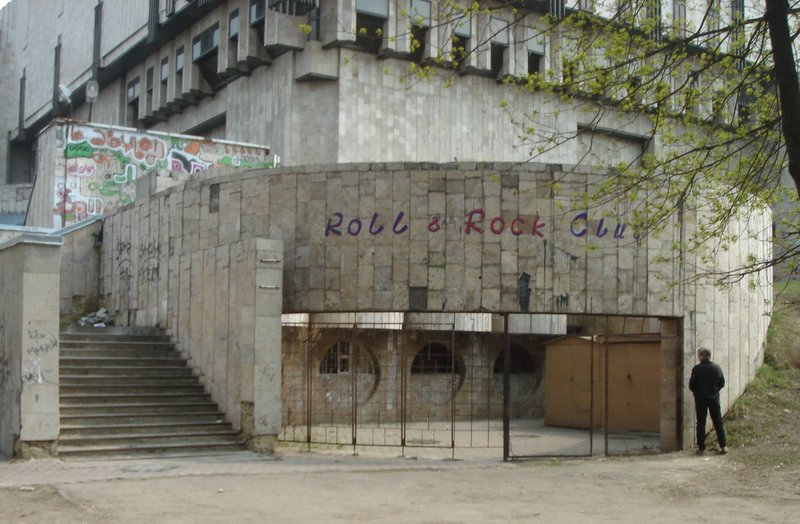
Took this picture Saturday while walking behind the Opera House to Schevchenko Park. Had meant to only take a photo of the closed night-club (an interesting take on an American legacy, not the Rock & Roll Club but the Roll & Rock Club), but then this man stepped into frame and all but lifted a leg on someone's spray-painted "Clapton is God!"
Otherwise, from Schevchenko Park to Gorky Park, all of Kharkov on Saturday seemed to be pushing a baby stroller or teaching a four-year-old hold to get up on those training wheels. Bikes and babies, babies and bikes -- that's all I saw, save for the nauseous ten minutes I spent in the Gondola that carries you (much further and much higher than I expected) from the 23rd of August Metro Stop to Gorky Park. 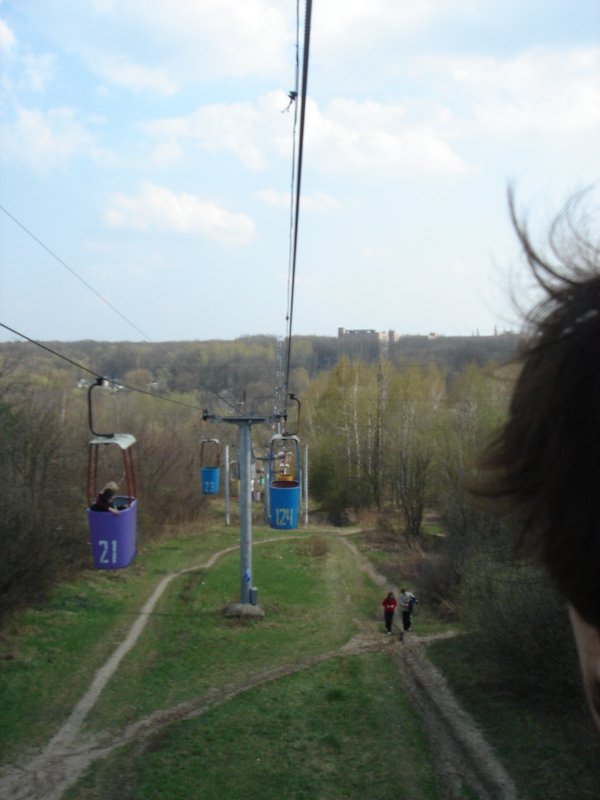
Before exposing my vertigo here, I was able to finally take in the huge, huge monument commemorating the Soviet Army's victory over the Germans in WWII (our history books prefer Nazis, here -- fascists).
Other than that, I spent the last two weeks writing like crazy, trying to finish a draft of my novel. I got everything but the ending done. Now for about two weeks, I'll take a step back. Visiting Volgograd soon, I hope. So perhaps pictures of it (formerly Stalingrad) in the next week or two.
Monday, April 10, 2006
Euro Sport
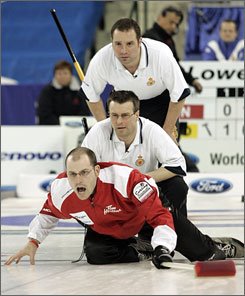
While golf fans in America (and much of Western Europe) were watching Phil Mickleson win the Masters on Sunday, I was flipping through my 50-some channels, hoping to find an azaela bush, a green jacket, maybe a cut-away to Hootie Johnson's face. Instead, I got live Euro Sport coverage of The World Curling Championship, held in Lowell, Massachusetts. Scotland beat Canada, apparently avenging a blow-out loss at the worlds last year. I tried to get into it. Picked Scotland early, taunted the Canadians every time they appeared on the screen. But I don't know. Even if I were involved in the World Curling Championships, I'd still probably rather watch the Masters.
Photo by Ryan Remiorz, AP/CP
Sunday, April 02, 2006
Fireworks
During the run-up to the New Year, I determined that Kharkov has more fireworks displays than any other city in the world. Entirely unscientific of course, but this is how I determine things. Just about every night, sometimes two or three times an evening, I'd hear loud booming crashes that'd send me scrambling to my window. Sometimes it'd just be a faint illumination over the tops of apartment buildings, a flash and then gone. Street to street fighting -- that's what it reminded me of, especially when the latest pwoo-pwoo-pwoo coincided with a car racing by beneath my window. But slowly I began to realize it was just fireworks. A splatter of light would spread across the sky, a red burst, a green one, maybe blue, and then it'd be gone. Sometimes full fireworks shows would be heard and seen in the periphery, coming from Svobody Square or Karl Marx -- something I'd see out my bedroom or living room window.
Last night, I caught one at Svobody Square, formerly Dzherzinsky Square, where Lenin still stands, of course, as I've shown in many photographs before. The show caught me and my friend off-guard. We were just walking through Schevchenko Park, thinking there really was quite a crowd. It was the first weekend of spring, we decided, so we figured everyone was just glad to have the opportunity to be out and about. There was light drizzle in the air, puddles on the ground, mud beneath the feet -- but all but a few dirt-blackened piles of snow were cleared, and the weather was plus 7 or plus 8.
This thinking began to change a little when we got to the square and saw a huge crowd of people standing around enjoying the music. I looked for some tents, some sign of a carnival or a bazaar, maybe a stage, but nothing. Just people standing, drinking, talking, everyone vaguely facing in the direction of Lenin and the music. A pony passed, a child in the saddle. I looked more closely for the source of the Russian pop songs: a small blue bus bearing the name of the state telephone monopoly, Ukretelecom. It had four old-style speakers mounted on top. On the side of the bus, a neat painted message: Zbukova Reklama. Essentially, radio commercials.
A few minutes later, the fireworks filled the sky, majestic burst of every color you could mate with a pile of gunpowders. Reds, yellows, blues, greens. The crowd ooh'd and ah'd as the fireworks shot up, spread out, seems to come raining down right on top of us like the special effects for warp speed in some science-fiction movie. I began to revert to US-thinking, insurance hazards, municipal codes, because these fireworks were shooting up into the air from right behind Lenin and going off low in the skies. Some fireworks sent a line of five or six glowing dots floating through the air on the hold of a little parachute. They drifted toward the Kharkov Hotel, the old Military University. They came down in trees and onto buildings, these and other fireworks, the lights streaming down still afire as they hit the ground.
It seemed to go on forever, one percussive boom after another. The woman with the pony calmed her animal, stroking its face, and then all eyes went to a hanging display of sparkling fireworks that were drawn out against a wire background and kept aloft by a crane. It lit up in front of Lenin, while a voice from the old propaganda bus announced the name of the political party now sparkling lit up in the sky for all to see, spelled out in sparkling yellow and blue: Party of Regions. And then lighting up above, Victory, as the bus announced the same, and the crowd continued to ooh and ahh.
Thursday, March 30, 2006
Ukraine Elections: Who Kharkov Voted For
During last weekend's parliamentary election, Victor Yanukovich's Party of Regions won the majority of votes in Kharkiv -- a little more than 51 percent, according to The Central Election Commission (the website offers English or Ukrainian webpages, but not those in Russian, which earlier this month was made the official second language in Kharkov Oblast).
Overall, Yanukovich got 32 percent of the vote, including roughly three-quarters of the vote in Lugansk and Donetsk, the two most eastern of Ukraine's regions. Yanukovich's party was followed by the Yulia Timoshenko Bloc (22 percent, 12 in Kharkov) and Victor Yushennko's Our Ukraine party (14, 5 percent in Kharkov).
The Communists, fifth nationwide, came in fourth in Kharkov, with 4.56 percent of the vote. The Socialists, who sell themselves as Swedish socialists, placed fourth nationwide with almost six percent of the vote, but were only the seventh most popular party in Kharkov. Suppose this is no town for Swedes.
The Green Party didn't even get one percent of the vote north of Kiev, in the region that includes Chornobyl. But maybe that speaks more for the need for coalition than anything else. There were 45 parties on the ballot, including three other environmental parties and The Party of Putin's Politics, the last of which got .12 percent of the vote (those voters, I suspect, who don't think Yanukovich leans toward Moscow quite enough -- voters who'd rather just jump right into President Putin's lap).
Almost two percent of voters took advantage of a box that allows people to "vote against all."
Spring
A week ago Monday, I awoke to snow, fat white flakes that were relentless and depressing, speaking as they did to a post-Soviet weather cycle run amok, permanent revolution replaced by permanent winter. But then, inexplicably, a little after noon, the clouds parted and the sun appeared – the stuff of religious calendars, the stuff of May or June or July, with only the sound of a harp missing in the background – and like that the line was drawn and spring had arrived.
It’s been ten days without snow, and with the temperature now not falling below freezing, the white stuff that for so long was piled up along the sidewalks has thawed and melted and trickled away, with the pace of this process accelerated by the ladies who sweep the roads in the summer and throw sand in the winter and chip the ice to pieces in the spring. (What do they do in the fall? Sweep the leaves.)
Last Wednesday, writing as usual in the morning, I found myself pulled away from the keyboard around 10:30, drawn by the sun and the blue skies to the street outside. I walked for two hours, easily and freely, sticking to the sides of the street that got the sun all day, leaving winter for the shadows on the other side. Such a pleasure to be able to walk with sure feet, to be able to look up and around, to gaze absent-mindedly at this or that, the writer’s natural pose, without the threat of hitting a slick patch of black ice and tumbling, ass over ankles, in front of a sure-footed babushka. It had been months since I had wandered aimlessly. When it’s minus thirty, you think only in trips that start from Point A and end at Point B, the shortest distance a straight line.
But now it was different. The young ladies were already wearing short skirts and wide-gauged fish-net stockings. Outside the metro stations, people were willing to stand around and drink a slow beer, to mention Lukashenko’s name and discuss a quick point of politics. At McDonald’s, the one restaurant in town where I don’t feel uncomfortable eating alone, people sat at the tables outside, some of them enjoying the season’s first ice cream. The women no longer went about in jackets so thick with insulation they looked like walking rolls of carpet. White jackets appeared, bright scarves designed more for fashion than warmth. Spring shoes. Umbrellas (it's not summer). Men with jackets unzipped. Such optimism, such changes.
In olden times, there were celebrations that heralded the approach of spring. People got crazy on honey mead and ran into the fields, throwing clothes from their bodies, frolicking, fornicating, running to the hills and singing the death of winter. In California, the Indians may have done something like this. But I don’t think they got carried away. In Ukraine, up here away from the warming bubble of the Black Sea, I think people emptied the drinking barrel and warmed themselves en masse in ways that had nothing to do with the fireplace. They must’ve been crazy with joy – after three or four months of freezing, of staying close to hearth and home, at last they could brave the outdoors.
I see something of that in the people today. I spoke to an Australian yesterday who said he spent $200 on the internet during the coldest month of the winter, when it never got warmer than -10 below. To keep warm, he had to stay in bed, wearing three or four layers of clothes, huddled under his blankets, even the computer's warming purr a needed defense. But now he and everyone else is out and about, doing the plotting that comes with spring. Let’s go here, let’s do that, do you want to meet an American coming into town today to see about a mail-order bride?
Winter is dead. Long live spring.


