Monday, January 25, 2010

New Blog


I kept this blog to document the year I lived in Kharkov, Ukraine as a Fulbright Fellow. It concerned itself with the so-called mail-order bride trade, the struggles facing couples brought together through it, as well as a variety of things slavic, soviet or post-soviet.

Because this site isn't representative of the full range of my writing, I've created a new website, more general in nature. Find it at www.stephanclark.net or just click here.

For those who enjoyed this blog, thanks for reading. And keep in touch.

Finally, special thanks to  Snowy for all the work he put into the redesign.

Read More......

Friday, December 19, 2008

Notes From an Underground (a recording)

In Ukraine, all of the smaller, corner stores work much like markets did in the United States fifty or one-hundred years ago. You'll go in and see that all of the goods are on shelves or in cold cases only employees can reach or access. Consequently, if you want some cheese, you'll have to go up to the dairy counter and speak with a blue-aproned продавщица (prodavschitsa/saleswoman) who will call out, Я слушаю! (ya slushayu!/I'm listening!) and take your order. If you want some meat, or some dry goods, you'll have to repeat the process, seeing two more Blue Aprons.

There is certainly a benefit to this system: a drastic reduction in theft. But the problem is, if you don't speak Russian, or if you speak a little Russian but are too shy to test it in public, you will likely starve, especially if you haven't yet discovered one of the western-style supermarkets, of which there were several in Kharkov.

Anyway, all of this is a long introduction to the fact that I wrote an essay about my experiences trying to scrape together a few good meals in Ukraine during my first couple of weeks in-country back in the fall of 2005. A while back I pointed you to the journal that published it, NOÖ Journal, which subsequently nominated the essay for inclusion in the Best of the Web 2009 anthology.

Now I'm writing to say you can find an audio recording of the essay below. Fourteen minutes long, it should prepare any traveler for a trip to the Former Soviet Union. Tell me what you think. And Приятного аппетита!

Read More......

Tuesday, November 25, 2008

Manure

Just discovered this website that allows you to view magazines online -- and I found the second story I published had already been uploaded by Dave Housley, one of the editors of Barrelhouse. My story, "Manure," about my trouble with credit cards, begins on page 19.

Read More......

Monday, May 26, 2008

How to Make Chicken Kharkiv


During my first month or two in Kharkov, I reported that I wasn't eating so well. Now the full story can be found in the latest issue of NOÖ.

Read More......

Tuesday, October 23, 2007

Geography of the Heart


The Geography of the Heart
How US immigration law divides families
By Stephan Clark

One Sunday almost four years ago, Thomas Carson, a 50-year old electrical engineer with corporate commendations from Nabisco and General Electric, parked his KIA Sportsman near the US-Mexico border and waited.

It was after dark in Las Milpas, once the largest colonia – or border settlement – in South Texas. Since being absorbed by the City of Pharr to the north in the late-eighties, this community of low- and very low-income Hispanics had almost doubled in size, reaching a population of 17,000. It had also received the type of things most Americans believe lacking in only the third world: running water and electricity, sewer service and paved roads. With such improvements, the community no longer laid claim to the state’s highest incidence of tuberculosis, Hepatitis A and leprosy, and it had even attracted the development of a Jack in the Box.

But one thing about Las Milpas remained unchanged in July 2003: its close proximity to the border. It was that which brought people like Carson here, just as the North American Free Trade Act (NAFTA) had brought business to the Pharr-Reynosa International Bridge, then not quite ten years old.

Carson parked near the intersection of Highway 281 and East Dicker Road. Beside him in his SUV was his son, 11-month-old Thomas Alexander, secure in his baby-seat. Further south was the boy’s mother, Carson’s girlfriend of five years, one Lucia Ramirez Hernandez. This night, she wouldn’t be traveling over Pharr’s celebrated bridge.

Hernandez had attempted that crossing in Jan. 1999, just a few months before a fire at a maquiladora in Reynosa would send Carson south of the border on work. Her crime that day was simple: after being stopped in a car with Texas plates, she made a false claim of U.S. citizenship.

Since 1996, when Congress last overhauled immigration law, this act has drawn a punishment as severe – a lifetime ban on entering the United States – as it is permanent. Hernandez cannot appeal or seek a waiver. She is no different than the terrorists, communists and practicing polygamists also singled out by law. She has no means of appeal.

“It wouldn’t matter if someone had a pistol to your side and you drove up to the border crossing and said, ‘I’m a US citizen,’” said Carson. “That’s it. You’re inadmissible. You don’t have a case.”

And so that night four years ago, while Carson and Thomas Alexander waited in the dark, Hernandez stepped into the river that runs along the Texas border between the Gulf of Mexico and El Paso. It is a tributary President Bush knows well. Going back to his days as Governor of Texas, he has frequently said family values do not end at the Rio Grande.

After emerging on the other side, Hernandez got into a car and continued toward her family. Carson spotted her passing the little strip plaza where they’d agreed to meet. He followed her to an area home, where Hernandez changed clothes and got into Carson’s SUV. The three then drove north – father, son and mother – toward the secondary inspection point at Falfurrias.

Eight months previous, Carson, a US Navy veteran, had imagined a reunion of another sort, petitioning for an immigrant’s visa on behalf of Hernandez and her two children from a previous relationship. But the false claim of U.S. citizenship derailed that effort, and so the descendant of five American veterans of five different foreign wars had been left with only what he’d been taught in the military: if you are captured, you must try to escape.

“We were desperate,” he said. “I don’t know what else to tell you.“

Parts 2-8 of this story can be purchased at Amazon.

Read More......

Tuesday, May 22, 2007

Vladimir's Mustache (and an electrocuted elephant)

Not much to report around here. Though I hope to be posting more frequently in the future, more than likely at a different url (can you believe someone's already bought StephanClark.com?), and probably in a more general way (though with continued interest shown to all things Former Soviet Union).

For the time being, I'll leave you -- if there is any "you" left, and not just the occasional passer-by from an obscure Google search -- with links to two stories of mine, both recently released.

The first, Vladimir's Mustache, tells the story of an actor during the run-up to the Great Patriotic War. Tired of playing peasants and factory workers -- the conventions of socialist realism -- this actor learns the dangers of Method Acting -- of following the teachings of Stanislavski rather than Stalin -- when he's cast as Hitler in a propaganda film.

The story, a companion piece to Kamkov the Astronomer, published in Vol 3.1 of The Cincinnati Review and excerpted in that magazine's archives, can be found in Ninth Letter, which mixes great design with a cast of contributors I'm more than happy to join. The publication was recently named best new literary magazine in these United States.

The second story, Topsy the Elephant, was published in this week's LA Weekly. Dushan Milic contributed some great artwork to the story, but you'll have to follow the link to see it because it apparently can't be downloaded to your hard-drive -- at least, I can't figure out how to do that.

Read More......

Sunday, January 28, 2007

Swink


Swink's long-anticipated third issue is now out, and as expected it's filled with work from a host of great writers: Karl Iagnemma, Daniel Alarcon, and Ron Currie, to name just a few. You'll also find an essay of mine in there, one that details my experiences teaching English literature -- and being gently censored for including too many sexual stories on my reading list -- at a Ukrainian university.

To read a short excerpt of "A Literary Purge," go here.

For those looking for more, there's also Pete Jensen's Unhooking the Secret, about the author's experiences applying for work at a Victoria's Secret. A fun read.

Read More......

Monday, September 11, 2006

Drunken Boat Launches

A very brief story of mine, set during the Soviet purges of the 1930s, can be found online at Drunken Boat. The piece is entitled "Yagoda's Bullets" and was originally intended to serve as the preface to Kamkov the Astronomer, which can be found in the current issue of The Cincinnati Review. But Kamkov already had a preface, so instead of having a preface to a preface, something even Don DeLillo might have difficulty pulling off, I hacked it away and gave it a life of its own.

"Yagoda's Bullets" was one of two pieces given special mentioned in the inaugural Pan-Literary Awards, judged by Sabina Murray.

In other news, my neighbors -- or a large group of people congregating in some neighbor's apartment -- are clapping and chanting in unison, singing in a way, the words not English but not discernable as any other language, maybe just nonsense syllables all members of a cult are forced to know. I will report back here, with pictures, if virgins are sacrificed or Kool Aid served.

I did say I'm living in Los Angeles, didn't I?

Read More......

Monday, August 07, 2006

Harping on Harper's

Before I left for Ukraine last fall, I sent a query letter to Harper's magazine, describing the research trip I was embarking upon and asking if they would be interested in reading something based on my findings. I thought they'd at least respond to me, if not because of the credentials of my Fulbright, then because, as I noted in my letter, their fiction editor had recently praised my work. Still, I never did get an answer to my query. Which isn't to say that the editors weren't interested. A feature on "The Great Ukrainian Bride Hunt," by Kristoffer A. Garin, ran in the June issue.

Not surprisingly, the feature focuses on a romance tour, which introduces a large number of Ukrainian women to a small group of western men at socials in one, two or a handful of cities. Some Americans I met in Ukraine said they'd never been on one (or only one) because they'd learned it was closer to sex tourism than anything that might help them find a wife. (One American said this while also singing the praises of that one tour.) In short, the great majority of people who go on these tours, at least these days, after the publication of many salacious articles, know what they're signing up for, and it doesn't even lead to a paper anniversary.

Still, rather than looking at something more mainstream and representative -- the men who drop into Ukraine or Russia by themselves -- the romance tour does have its obvious editorial advantages: it brings the greatest hue of yellow to the page, and it is also very convenient, in that it allows a journalist to parachute into the country, bounce between two or three cities, and then leave with the ability to say he is an authority on his subject.

I'm not going to get into a drip-by-drip analysis of Mr. Garin's article. He's written a book about the evils of the cruise industry, which means we think alike in some ways. But his Ukraine piece is predictably condescending to the men who look to the internet to find a wife, if only because he starts it by saying it's surprising that this is not a "fringe" movement. I'm not alone in finding something wrong with his tone:

"He writes nasty and surreptitious notes about folks who are involved in that most difficult of endeavours: looking for love. He holds out their weaknesses and says, Look, aren't we lucky we're not them?"


Beyond that, Garin's insights seemed to go no deeper than the index cards he no doubt prepared before his trip ("This, then, was globalization’s answer to the mail-order brides of the Old West") while his comments on Ukrainian women ("I had the distinct impression that many were wearing their one nice outfit for the occasion") can only be read as being as informative as his stay in the country was long (two weeks).

But then again, I am the guy who wrote the query to Harper's, not the article, so I'm obviously biased.

As for the agency profiled in the article, A Foreign Affair, I think it operates like all the other big agencies, Anastasia Web, for instance, in that it makes its money by selling high-priced tours to men who know little about Ukraine (or are repeat-customers uninterested in marriage, only the possibility of a sex spree). Those interested in actually meeting a woman and pursuing a marriage would be better suited finding a small, privately-owned company which has an American owner-operator living in Ukraine. I won't go so far as to recommend any agencies (several readers have written to me asking for just that, but I don't think it's my place), though I will say that I met two people who impressed me with their honesty and friendliness.

The first is Allen at Beauty Abroad, in Lugansk. The first thing that impressed me about his agency were the photos. You see women, young and old, captured in normal, everyday-life. Take a look at this one. Just a girl, off the street, interested in trying something new. You only have to look to A Foreign Affair to see the difference. Look at this girl and her Leave it to Beaver-era pornography poses. Say Cheese? No, the guy behind the camera said, "Now stick out your butt a little more and arch the small of your back -- that's it."

While in Odessa, I actually met a man who dated the girl in the photo above -- and right off, this man said, he could tell she was only interested in being a professional dater, getting the dinners and nights out, the presents, but not the wedding ring at the end of it all. Not surprisingly, this young beauty, a true fisher of men, appears on the front page of the Foreign Affair website, just like another Odessa-based stunner that the man I met dated while on his first visit to Ukraine.

If this man had gone to Lugansk, I'm sure Allen and his staffers would have helped him find someone more suitable, as they know all the women who use their agency's services (they're local to Lugansk) and seem genuinely intersted in making good matches, rather than just throwing people together.

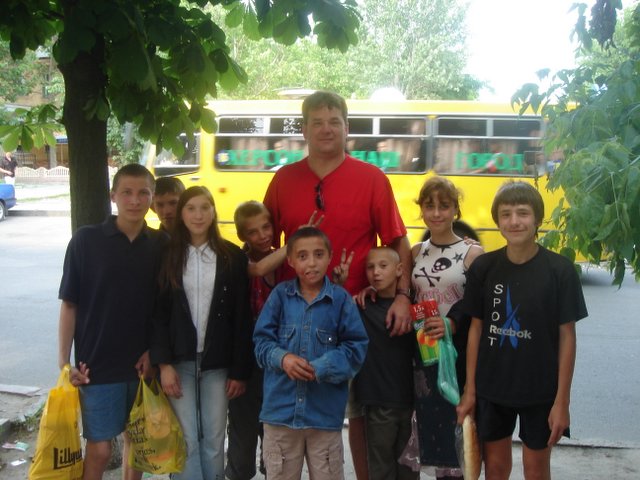
Kevin at Kherson Girls was equally friendly and open, and his work with the homeless and impoverished children in Kherson (he budgets $10 a day to feed those who come to his office, and works closely with an area orphanage) was something only the cynical could find fault in.


I mean to write more about Kevin and my visit to his part-time home of Kherson in the coming weeks, though his mother-in-law and wife, both from the city and active in the day-to-day operations of the agency, will probably hope I can't read whatever notes I made while addressing their treatment of me. Both were cynical about my visit, perhaps because Kherson Girls has hosted several other "journalists" in the last three or four years, all of whom have promised -- and failed -- to produce word one about Kherson Girls. Repeatedly, the mother-in-law wanted to know what I really wanted -- dates with their girls? Even after I assured her I was engaged to be married, she still seemed unwilling to accept the fact that I was simply interested in stories, in learning about Kherson and Kevin. So yes, if this is a recommendation -- or Word One, if you will -- it is one that says Kevin was a good guy, one who does his best to eliminate the scammers from his agency, while also mentioning that the leaders of his support staff left a lot be desired. I'm sure not all of his customers get treated like journalists approaching the Politburo for an on-the-record interview about the horrors of the 20th century, but if one or two don't get banged up along the way, I'd truly be surprised.

Read More......

Thursday, May 25, 2006

Kamkov the Astronomer


The Cincinnati Review's summer issue has just been released, and my short story Kamkov the Astronomer can be found in its pages. Several readers of this blog may be interested in reading the story, as it's set against the backdrop of The Great Terror of the late-thirties and offers a fictionalized account of one man's involvement in the purge of Leningrad's Pulkovo Observatory (English and Russian website).

The story begins:

One night at his dacha in the country, Stalin looked up from his meal of bread, sausage, and smoked carp to consider a matter of celestial importance. With him in the study were Comrades Kaganovich and Molotov, who stood at the far window, arguing about a constellation. The one said it was Cassiopeia, the other Orion. Stalin wiped the crumbs from his mustache, eager for the debate. Such matters had fascinated him since his youth in the seminary, when he’d often tilted back on his heels to puzzle over the stars. He never had been able to make sense of the heavens. Where others saw bears and scorpions and chained ladies, he saw only a messy splatter of light.

Molotov returned to the low table around which they had gathered, while Kaganovich circled the room, defending his position at great length and with great volume. He provided Molotov with Cassiopeia’s mythological origins and drew meaning between each of sky’s bright dots. He gestured. He laughed at perceived errors in logic. He even touched on phrenology, a philosophy he refused to endorse in the end but one he still found worthy of mention, considering Molotov’s limited grasp of the sciences and the flat spot on the back of his head. Stalin was impressed. He grunted and gave short nods of approval. But Molotov could not be so easily swayed, just as he could not be bothered to fortify his defense. “It is Orion,” he said, simply and completely, before smiling as if only a fool would believe otherwise.

Kaganovich could not tolerate such impudence. He spun and lunged at Molotov’s throat, causing Stalin to shake with laughter and Molotov to rise fighting to his feet. The two men scuffled. The one pushed at the other, and the other pushed back, and then the legs of the two were knocking into the table, shaking the many pieces of china and silver set there. Among the items displaced was Stalin’s tea cup. It jumped, sending its contents across a pile of papers. This ended the argument. It turned Stalin’s laughter into a bark and caused Kaganovich to release the foreign minister’s throat.

Stalin snatched his papers from the table. The top one had received a messy brown splatter, but the names were still legible, the list still intact. He frowned, grimly satisfied by this, and then pressed the top sheet into the chest of his high-collared green tunic, absorbing what had been spilled. “The matter can be very easily settled,” he said. “We will call the astronomers. The astronomers will decide this.”


You can purchase a copy of the magazine at the Cincinnati Review's website. I don't know what they charge to ship a copy overseas, but they've been kind enough to send the last two issues to me here in Kharkov.

If you find you want to read more about the Great Terror after getting my story, you should pick up a copy of Stalin by Edvard Radzinsky. It's where I got the inspiration for my story -- and it's the liveliest read on the subject that I've found.

Read More......

Wednesday, May 17, 2006

Dear, Central Committee of the Communist Party

I came upon this via two sites and thought I'd post this here. It is the suicide note of Aleksandr Aleksandrovich Fadeev, Soviet author of the The Rout and Young Guard. I haven't read him, but after reading what follows, which was written almost 50 years ago to the day, I feel I should.

To the Central Committee of the Communist Party of the Soviet Union:

It is impossible for me to live any further since the art to which I have given my life has been destroyed by the self-confident, ignorant leadership of the Party and can no longer be corrected. The best cadres of literature--in number far more than the tsarist satraps could even dream of--have been physically exterminated or have died thanks to the criminal connivance of those in power. The best literary people died at an unnaturally young age; all the rest who were, even to the smallest degree, capable of producing true works of value died before reaching 40-50 years of age.

Literature--this holy of holies--was handed over for extermination to bureaucrats and the most backward elements of the people, and from the highest tribunals--such as the Moscow Conference and the XXth Party Congress, came a new slogan: "Onward!" The path by which they intend to correct the situation provokes indignation. They gathered together a group of ignoramuses, with the exception of a few honest people who find themselves in exactly the same situation of persecution and therefore are unable to speak the truth--and their conclusions are deeply anti-Leninist because they arise from bureaucratic habits, accompanied with the threat of the same cudgel.

With what a feeling of freedom and openness my generation entered literature during Lenin's life; what unbounded strength was in our soul, and what beautiful works we created and still might have created!

After Lenin's death they brought us down to the level of children; they destroyed us; they threatened us ideologically and called this "the Party spirit". And now, when everything might be corrected, primitivism and ignorance--along with a disgraceful share of self-assurance--manifest themselves in those very ones who are supposed to correct everything. Literature has been placed under the control of untalented, petty, rancorous people. Those few individuals who have retained the holy fire in their souls find themselves in the position of pariahs and--because of their age--will soon perish. And there is no longer any stimulus in the soul to create...

Born for great creative work in the name of Communism, connected with the Party for almost sixty years, with the workers and peasants, endowed by God with an unusual talent, I was filled with the most lofty thoughts and feelings, which can only be given birth by the life of the people, united with the excellent ideas of Communism.

But I was turned into a horse pulling a broken-down cart ...

To read more, go here.

Read More......

Thursday, March 30, 2006

The Novel


Since the first of the year, I've been chin-deep in writing, thanks in part to the shipment of index cards I received from my parents. These cards, something I took for granted in the states, are unavailable in Ukraine and Russia, and without any, I found myself unable to collect all the various scattered fragments from my novel and organize something like a polished draft (call it a mental block, or procrastination and fear of failure). Now I'm rolling, at the halfway point of my novel, I believe, and am even utilizing the colored cards on top of the standard white ones to differentiate between past and present story-lines.

Now if only my lap-top will hold up. I've been using Mozilla's latest browser because it says it includes anti-virus software (yes?) and I was unable to renew my old service from Ukraine. I don't know. Maybe I don't have any anti-virus software, and my computer, like a British sailor of old cast adrift without any limes, is now parched and weak, gums bleeding, completely lacking in Vitamin C. Blue screen, an inability to shut-down, sudden and unexplainable glitches -- I get it all, but am backing up everyday.

Read More......

Tuesday, January 17, 2006

What is your novel about?

Whenever someone asks me this, I either 1) politely try to say nothing at all, because, like Flannery O'Connor first announced, if I could reduce it to one line, I wouldn't have needed to write all those extra pages, or 2) go on at great length, tiring out myself and the person listening to me, until I feel like a fool for talking so much and/or the other person finishes off their drink and with a tight smile slips away.

The problem is, oftentimes I have a hard time explaining what the novel's about because I have a hard time knowing myself. It's so many things at once, it's wild and it's woolly, it's A Big American Novel, it spans generations, it goes from Hitler's Bunker to the Animal Testing labs of Goldstein, Olivetti and Dark, there's 9/11 and a northern California cult, latter-day pilgrims who refuse all food additives and wear clothes no more modern than the 50s -- American Fundamentalists, the press calls them. On and on like this I can continue, unfurling one loose strand of narrative only to tie it down and let go of another, but now I've discovered a way to succinctly give my pitch, a way to boil it down to the simple and most basic truths: respond to the question -- "So what's the novel about?" in a language I only half-ass speak. Like tonight when my new Russian tutor, a 70-year-old woman who teaches me how to make my consonants soft more for the company than the profit, asked me, "What is your book about?"

This was our second meeting. She'd known I was writing a novel since first we met. Still, I hadn't expected to get into this. I only half-ass know Russian, she knows that and I know that. I speak it well enough to get back and forth in a cab, into and out of the French bakery; in no way am I equipped to discuss the finer points of narrative. So after looking at her dumbly, a look I'll call Gorbachev-in-Retirement, I at last managed this simple sentence, "An American family."

I thought to add more. I thought to describe the timing of the novel -- Y2k to 9/11, with flashbacks from 1940 on up -- but already she was interrupting me, correcting one of my endings.

So. My novel is about an American family. There. That simple.

Read More......

Friday, January 13, 2006

Everybody I Love You: The Book


Before coming to Ukraine, I read Culture Shock! Ukraine, a book so woefully out of touch (the author is Meredith Dalton) it actually advises non-drinkers not to travel to Ukraine. Do not buy this book. It's outdated and just plain dumb. Shortly after I sold that book on the internet, another title was published, Lonely Planet's first guidebook dedicated solely to Ukraine (before it had been lumped together with Belarus and Russia or all of Eastern Europe). This is a much better book, though it favors the tourist cities of western Ukraine and the destinations of the Black Sea.

Something seemed wrong about that. After all, 50 percent of all tourism to Ukraine is based on the marriage agencies, as this article from last August suggests, and tourism is up at least 15 percent since the Ukrainian government rolled back the visa requirement, thereby making it an impulse buy for Americans, Japanese and Western Europeans to come to this corner of the former Eastern Bloc.

If anything, Lonely Planet should have written their book with the marriage agency traveler in mind. For starters, it should've dedicated more than five (mostly textless) pages to Kharkov, which for many people is their main destination in Ukraine. (Kiev, in comparision, was given 30 pages). Granted, Lonely Planet is the first group to acknowledge Kharkov in any substantial way. In all the other travel books I looked through while browsing the stacks at the Book Barn in Davis, I saw maybe a handful of lines dedicated to the city of 1.5 million -- and many books didn't even mention it at all.

The smaller cities of Eastern Ukraine, many of them home to thriving marriage agencies, receive even less attention in the pages of Lonely Planet. So ... yeah, I couldn't help but think the book people needed wasn't available. Traveling here for most people is an adventure, something that represents a great change in their behavior, a new risk in their life, but it shouldn't be like entering the jungles of 19th Century Siam. What times do the trains run between Kharkov and Kiev, you know? And can I stop off in Poltava? Should I take the bus instead? And why is it wrong to think I can rent a car?

Nothing too deep, this, but for many people pretty valuable information. And so yes, seeing as how I'm learning all this stuff anyway, and will be learning even more with all the travel I have planned for the spring and early summer, I thought I should bring everything together under one cover (two if you flip the thing over).

Originally I had planned to write an expose of the marriage agency scene. But without an advance of some kind, some interest from a publisher, I just don't want to commit the time and energy to the project. I've got other things to write. My novel, for one, and my short story collection, the last of which will contain some stories set against the back-drop of the marriage-agency scene. The book I now have planned won't be literature, for the most part, it'll be information. So that's something I can handle and probably something more people would want anyway.

What will Everybody I Love You: The Book look like? Well, it'll probably have a different title. Beyond that, this is what I'm thinking at present:

* It'll profile the forgotten cities and the marriage agencies in each.
* It'll tell you where to stay, what to eat, how to find a decent cup of coffee or a tall glass of beer.
* Give information about the trains and buses.
* List internet cafes and phone banks, so you can always get online or make a phone call or place a fax.
* I'll include storiestoo, because I can't leave the writing side entirely behind. So stories like this one of Bill in Odessa will appear to give you an idea of those who've gone before you. These won't be romances. They'll be stories that share real experiences, good and bad.
* And no doubt I'll also include some of my commentary on local customs and whatnot, like I so often do on this blog.

Because the marriage agencies often come and go, I think I'll focus my interviews on those companies that've been around for at least two or three years. That way, for each city profiled, there'll be at least one good profile of a marriage agency from that city, along with a profile of its owner/operator. If there's one that interests me more than another (because I'm still researching this stuff for my short fiction), I'll search that one out. But if an agency contacts me, I may agree to profile that one. We'll just have to see.

If nothing else, I'll list all the marriage agencies I know of. I'll also accept ads from any that choose to contact me. This won't influence the editorial side of things, if only because I'm too stupid to get rich that way. And in the end, once a journalist, always a journalist.

I don't know. This is an announcement. I wanted some feedback, but then too I wanted to hold my feet to the fire, to do this publicly so I couldn't just turn my back and wave my hand and walk away. Tell me what you think. Tell me what you'd like to see.

Thanks -- Stephan.

Read More......

Monday, January 09, 2006

Big Lonesome No More


One of the things I've realized over here is how dependent I am on magazines and the like. Just to read something that I don't intend to follow from cover to cover -- that's what I've been craving. Something for the bathroom, bedroom and boudoir. Well, today the cavalry arrived (or the Navy, I should say) in the form of a shipment of magazines from Jim Ruland, formerly of the United States Naval Academy (or at least one of its more far-flung vessels), now a resident of Los Angeles.

Though his debut collection of short fiction, Big Lonesome, didn't arrive with the reading material (it's in the mail, I'm told) you all should all rush out to the local Book Barn and buy a copy (or stay in, eat another bag of chips/pint of ice cream, and do it like this). Having read Ruland's fiction before, along with his non-fiction, I know you'll enjoy what comes your way. And if credentials are what you need, know the man has a grant from the National Endowment of the Arts. If that isn't enough, look at the picture above. The man's got so much ink it spills off his pen and onto his skin.

Okay, now that your 'pass the mic' moment is over, see more things Ruland by visiitng his Big Lonesome blog. That, or attend one of his Vermin on the Mount fiction readings, which have only failed to excite the LAPD into action because of their Chinatown location. "Forget it, Gittes. It's Chinatown." Ruland emcees these affairs, I'm told, and though it hasn't happened yet, he may just bite off the head of a live bat at the next staging, this Saturday. He's just that type of guy. The type not to be scared off by all this bird flu stuff.

Read More......

Monday, December 19, 2005

The White House Goes Red


Whenever one company takes over another, it absorbs those products or techniques that are profitable and discards those that are not. The United States, which governs more and more by the corporate model than the civic version, is no different. When it triumphed over Communism, it might as well have been a corporate takeover. Overnight, the world went from being dominated by two brands to one. Markets expanded for American and western companies. McDonald’s came to Moscow, German supermarkets opened in Kyiv. The politics in Washington, now unchallenged on the world stage, also began to change, pushing out to fill in its new, roomier boundaries. My short story "The Secret Meeting of the Secret Police," which came out in Night Train magazine a couple years ago, talked about where this might lead, saying how easy it'd be for the KGB -- or any other government agency -- to spy on you in the age of the Internet and the mobile phone. Now we have the payoff.

President Bush has authorized the National Security Agency to spy on American citizens without the oversight of even one of the Patriot’s Act hastily-assembled secret courts. I can only imagine what the talking heads are making of this on cable TV back in the states, but if it surprised anyone, I can’t see how it did. Anyone who bothered to read the Patriot Act, either before it was signed or in the months afterward, knew that such a thing was bound to happen. If you’re suspected of being a terrorist (and there’s no evidence needed to justify that suspicion, just the suspicion itself) the government can send the police or its own agents into your house or apartment to perform a “sneak-and-peek” inspection, all without your ever knowing it. This isn’t even limited to terrorism; the powers are granted for the investigation of any criminal offense. So while Supreme Court Justice Anton Scalia insists that the US Constitution should be viewed as it was intended when it was written, I find it hard to believe that he and his fellow conservatives can support laws that pervert America's most sacred legal document. Notification is required in these "sneak-and-peek" intrusions, but it can be delayed indefinitely. That's like saying, "We believe in the Fourth Amendment, but only tomorrow, or next week, or better yet the day before you're dead."

When Ronald Reagan was first promoting his ideas for a laissez-faire Washington, he made a joke about the Democrats’ hands-on, overly-regulated form of governance. With that winning smile of his, he had people imagine the Democrats going door-to-door. “I’m from the Government,” he joked, “I’m here to help.” And yet now I’m sure the same people who laughed at this line continue to believe that the government only serves to protect you, that it should even be able to reach out beyond the borders of the Constitution because it’s just doing what’s good and right and proper.

That's what Condoleezza Rice believes. She defends the President’s right to act without any external oversight, because it's a different world and all. Faster and spookier, full of email and cell-phones and the devices of the Evil-Doer.

Just listen to her.

Under the Foreign Intelligence Surveillance Act of 1978, or FISA, the Federal Bureau of Investigation and the National Security Agency must obtain search warrants from a special court before conducting electronic surveillance of people suspected to be terrorists or spies. Ms. Rice said the administration believed that it needed greater agility in investigating terrorism suspects than was possible through that process.

"These are stateless networks of people who communicate, and communicate in much more fluid ways," she said. But several national security law experts and civil liberties advocates note that government officials are able to get an emergency warrant from the secret court within hours, sometimes minutes, if they can show an imminent threat.

– From the New York Times.


Maybe there was more evidence that all of this was coming. In 2004, then-Attorney General John Ashcroft reversed the ban that kept the FBI from spying on American organizations. It won’t be abused, he promised. But then J. Edgar Hoover promised the same thing when Martin Luther King and other civil rights workers were brought under small government’s version of Big Brother, COINTELPRO, a secret and blatantly illegal government organization that aimed to “disrupt, misdirect, discredit, and neutralize” groups and individuals the FBI found objectionable.

Which today would be just about anyone, what with your either being for or against the guy in the Oval Office.

But again, it's only natural that it's come to this. After acting unilaterally on the international front, by bypassing the United Nations in Iraq, the President is now acting unilaterally on the domestic front. “Unilateral” is a very clean word, isn’t it? If this unilateralism was happening inside the Soviet Union, or in present-day Belarus, we might be using a word more easily associated with one of those leaders who used to stand atop Lenin’s tomb, his breast heavy with medals and red stars. Dictator. That's the word we might inch toward. But if I suggested there were shades of that word moving into DC, it'd just be more evidence of the contemporary caterwauling that is politics.

At some point you have to turn your back on a President. If you don’t like the United Nations, that’s one thing. But Congress is a pretty sacred institution, cherished in my book, as it, along with an independent court, keeps us from the age of kings. If President Bush needs to act more quickly, he should talk to the country, he should talk to Congress -- hell, if he has to he should watch that Saturday morning cartoon about bills on Capitol Hill and do something about it. Because he's not God's Holy Warrior, sent here to protect us with his great wisdom and valor. He's just another guy in a cowboy hat who walks a little funny.

And remember, for every one crime that is reported, another nine go left unsaid. Do you know what's happening in Washington?

Read More......

Thursday, November 03, 2005

The Cincinnati Review

Some very well-received news came the other day: The Cincinnati Review will be publishing "Kamkov the Astronomer," which I've always seen as the title story in my current collection of short fiction. The piece may be of interest to some readers here: it tells the story of the purge of Leningrad's Pulkovo Observatory during the madness that preceded The Great Patriotic War. I'll be sure to post another link when the magazine is released (in the spring, I suspect) but you may want to look into it now: a good friend, Ronald F. Currie Jr., is in the just-released fall issue, which also includes fiction by Antonya Nelson.

Read More......

Thursday, October 06, 2005

How to Make Chicken Kharkiv

When you learn you’re going to Ukraine for a year, become less of a fundamentalist. Don’t insist on being a vegetarian. You already eat fish, but that isn’t enough. Go to the In ‘n’ Out Burger and order the #2, then sample the lamb when you find yourself at that Indian buffet your family really likes. Practice. Get used to it. Know that you’ll need to bend a little so you don’t break. You won’t be in California anymore. This will be Ukraine. And so you’ll eat the beef and the lamb and even the occasional piece of chicken, despite all the hidden camera footage you’ve seen on the PETA website. You will do this because you think it will keep you away from the national dish, salo. You don’t do pork. Never have. As for cured pork fat, you can’t believe an entire country could rally around this. So yes, eat everything, the beef, the lamb, even the chicken, hoping this will allow you to show your host the flat of your hand and say, “Actually, I don’t eat pork fat. I have an allergy. My doctor told me – or rather my priest said, I mean my rabbi – well, the long and short of it is the chicken’s so good I think I might just have some more.” Prepare for the day. You know it’s coming. Be polite but firm. Show you have limits. Tell yourself this. You have limits.

Eat pizza your first afternoon in town. Have it at the restaurant near the university, knowing you can’t eat here everyday. You didn’t travel halfway around the world to eat pizza everyday. If you did that you would be a failure, even in the eyes of your Italian friends. So yes, eat the pizza, but consider it a decompression chamber. It will take you from Marin County to Kharkiv. Remember to eat the crust.

At the market across the street from your flat, you will find six aisles. One is given over to hard alcohol, another is dominated by mayonnaise. Inspect the milk. Some is in a box, some a bag. Of course there’s no soy. Don’t even look, certainly don’t ask. Instead, decide which brand of milk to put in your basket. Choose like an American. Find the one with the best packaging. A grandmother, a cow grazing on a green pasture, a mountain in the background. Feel like more of a local. You already have a consumer preference.

Quickly learn to redefine “average daily requirements.” Eat muesli and milk for breakfast, maybe some yogurt if you remembered to check the “made on” date, then go out into the world and see what else you can drum up for lunch and dinner. Stop at a kiosk window. Get your money ready. Practice how to say, “I would like ...” Move forward in line. Do not act frightened when the lady’s face appears in the little window. You are not buying a Playboy. This is not your first time getting condoms. You are hungry, that is all. So speak calmly, as if it’s no big deal. Piroski s kapusta. Sloika s gribami. Say it again if she says anything. That probably means she didn’t understand. Be conscious of where you hold your tongue, how you move your lips. Speak as if the words are little boys on the diving board for the first time, unwilling to jump off. Push them if you must. And then marvel at how little it costs: fifteen cents, forty cents. Walk away with your bounty and try to make this your lunch. The sloika are like pastries, and the piroski donuts. Only both have something healthy inside. Potato, mushroom, cabbage. Eat these until you discover varenniki, which give you the same choices inside the shell of something you consider a ravioli. Do not cover these ravioli with that pasta sauce you bought at the best supermarket in town. It does not taste like pasta sauce. It tastes like ketchup, spicy ketchup, and not even good spicy ketchup. Wonder again if it’s gone bad, or if that’s just what goes for popular here. Tell yourself: No more pasta. This is not Italy. And forget the pizza. You're not here for that.

(To read the full short story, send me an email. It's an internet/copyright thing.)

Read More......

Wednesday, September 21, 2005

It's settled

Call in your arguing uncles, let Cain once again sit at the table with Abel: the argument is over. Creative Writing cannot be taught.

Such are my feelings at least after my first class yesterday. Eight students, all lined up in chairs across from me, each looking as if his family were being audited because of something they had done the previous night, while drunk, with the police chief's daughter or Mercedes, depending on where his allegiances may lie.

I explained the course: we will read stories from the perspective of an author, we will discuss what makes a story work, character, voice, plotting, and in the end we will all produce a story to present to the class. "Tuh!" A student sighed, audibly, without even trying to hide the fact that she was sighing, audibly, and turned to the student to her right. I kept my eyes steady. Is there a problem? "But I am not a writer! You must be born for this!"

I had anticipated a problem. After all, in the states I taught only those students who expressed a desire in writing. Here, it's a foreign language class. "I'm sure we'll adjust things here and there as we go," I said.

As for the reading list, it too is in flux, though I was promised I'd have complete control over the syllabus. "About this Stalin story," my faculty advisor said, and I pursed my lips, lifted my brow. "Oh? Something wrong with the Stalin story?" I'd thought not to include it, but then I kept hearing no, no, the Fulbright experience is meant to bring new ideas and approaches into the university, we should welcome this, and so in the end I thought it would have been rude to mention the Stalin story (one of my very favorites, The Twenty-Seventh Man by Nathan Englander). So yes, Stalin was purged from the reading list, a little poetic irony there, and other stories were shuffled around (TC Boyle's "Drowning" was too shocking to start the course, for one). All of this is proving interesting enough to me for me to write an essay about it. Perhaps I'll post an excerpt in the days to come. For now, I'm off to twenty-seven students -- repeat, twenty-seven students. Maybe I'll keep it simple today, focus on the difference between lie and lay or something. Though of course, with my course reading list having already been called very sexual (if you want young people to read, give them stories about love, I say), lie and lay may be the wrong lesson entirely.

Read More......

Friday, September 16, 2005

Why I Majored in English: An Essay


When anyone asks that inevitable question, “Yes, but what can you do with an English degree?” I will now tell them only one thing: In Kharkiv, where I went to teach on a fellowship after earning my Master’s degree in English, my class, in a historic, co-ed state institution, was comprised entirely of young women, all of them as beautiful as the rumors of Ukraine. The men were off studying math and science, I'm told, their lives given over to hard lines and facts, not the curves and angles of the literary arts.

The classroom I was shown to was short and narrow and filled with pews, giving it the look of an old Southern church. A portable square blackboard, its color streaked by chalk that after so many years wouldn’t entirely go away, sat on the desk up front. The girls occupied the pews to the right, all of them attentive and with their eyes facing K., their teacher. It was hot. Suffocatingly so. K. introduced me and went over some homework, then turned to me and asked if I would say a few words. Nothing prepared, I stood and fumbled through a brief bio – raised in England, brought to America – and then did the one thing I wasn’t supposed to do: speak broken English. “So I was taught both Englishes.” Englishes? “Both versions – or variants, I should say. American-English and English-English. There are different spellings, you know.” Idiot, idiot, idiot. “Did I say I was a writer?”

I don’t know if it was my performance (I am the first native English speaker all but two of these girls have known) but K. rose at the end of my speech and said we had better leave, it was just too hot and this room too small – it was the worst one, she assured me – and so off we went, K. and I leading the pack, the girls to the murmuring rear. K. had any number of things planned for me, the significance of which I did not understand. I couldn’t keep up. I’d been meeting people all day, being shown into offices to shake hands with men who spoke no English, being stopped on the stairs to lobby for various university memberships and privileges, being given names I just as promptly forgot. Spacibo. Ochen priyatna. And still there was more, it seemed (perhaps a session with the dean, who’d been on the phone when we first tried her) but I wanted a mobile phone, needed one in fact, so I mentioned this and she stopped and turned to face the girls (K. is a precise woman with a need to control her time, teaching as she does 22 hour per week) and said, “Class, okay, class? Today is not normal. Today your task is to go with Stephan and find him a mobile phone. I have told him you are all experts.” Giggles. “No skipping,” she said, “and no Russian – it is rude to speak Russian in front of our guest, English only please.”

And like that I was released, out the doors and onto the streets of Kharkiv, first led to this store, then to that one, with the girls surrounding me the whole while. It was dizzying. As we walked, I would speak with one girl (Had I been to Arkansas? I was an exchange student there.) and then she would fall away from my side and another, like a member of the Blue Angels, would move forward to take her place. “In our country, we address someone in a position of seniority with respect. How do you say it?” “With a patronymic.” “Yes, a patronymic. What is your father’s name? So you would be Stepan Robertovich. I like this very much.” Friendly, I had expected. But with a sense of humor? No, hadn't seen that coming. I had expected something closer to the brooding stoicism you usually see on the catwalk and given to Eastern European characters in western movies and TV; instead I was met with laughter and the sort of easy-going, let’s-have-fun attitude that I’d more easily associate with people who grow up in a reality-free suburbia.

By the time we returned to the English Philology Department on the seventh floor, a phone was in my pocket and a smile must have been on my face. “How has your day been?” asked G., a department administrator. “You do not need to tell me. I can see you have enjoyed yourself.” Yes, I should have said. I’m glad I never learned how to build a bridge.

And of course, though I'd only agreed to teach two classes, by the end of the week I was in G.'s office agreeing to a third.

Read More......