Two years after receiving your conditional Green Card card -- the first you will receive after marrying a U.S. citizen -- you must apply to have its conditions removed, using form I-751. If you do not do this, you will not be allowed to live legally in the United States. If you do, and you're successful in your application -- meaning, your marriage is not ruled to be a fraud, entered into only to circumvent immigration laws -- you will be rewarded with a 10 year Green Card.
Can you guess how much it costs to file the I-751?
$545.
That includes $80 for a biometric finger-print.
Please, do not write USDHS on your personal check or money order. Write it out in full: The U.S. Department of Homeland Security.
Some of you may say this is perfectly fine. You choose to marry a foreigner, you pay the price. But we do not parse out the costs of the nation in this way with other things. We all pay for the military. We all contribute to Social Security, MediCare, etcetera. Yes, homeowners support education. But do only drivers support the cost of building and maintaining new roads? Etcetera, etcetera.
For a previous entry on the Foreigner Tax see here.
Sunday, August 31, 2008
The Cost of Marriage (Part Two)


Tuesday, October 23, 2007
Geography of the Heart
The Geography of the Heart
How US immigration law divides families
By Stephan Clark
One Sunday almost four years ago, Thomas Carson, a 50-year old electrical engineer with corporate commendations from Nabisco and General Electric, parked his KIA Sportsman near the US-Mexico border and waited.
It was after dark in Las Milpas, once the largest colonia – or border settlement – in South Texas. Since being absorbed by the City of Pharr to the north in the late-eighties, this community of low- and very low-income Hispanics had almost doubled in size, reaching a population of 17,000. It had also received the type of things most Americans believe lacking in only the third world: running water and electricity, sewer service and paved roads. With such improvements, the community no longer laid claim to the state’s highest incidence of tuberculosis, Hepatitis A and leprosy, and it had even attracted the development of a Jack in the Box.
But one thing about Las Milpas remained unchanged in July 2003: its close proximity to the border. It was that which brought people like Carson here, just as the North American Free Trade Act (NAFTA) had brought business to the Pharr-Reynosa International Bridge, then not quite ten years old.
Carson parked near the intersection of Highway 281 and East Dicker Road. Beside him in his SUV was his son, 11-month-old Thomas Alexander, secure in his baby-seat. Further south was the boy’s mother, Carson’s girlfriend of five years, one Lucia Ramirez Hernandez. This night, she wouldn’t be traveling over Pharr’s celebrated bridge.
Hernandez had attempted that crossing in Jan. 1999, just a few months before a fire at a maquiladora in Reynosa would send Carson south of the border on work. Her crime that day was simple: after being stopped in a car with Texas plates, she made a false claim of U.S. citizenship.
Since 1996, when Congress last overhauled immigration law, this act has drawn a punishment as severe – a lifetime ban on entering the United States – as it is permanent. Hernandez cannot appeal or seek a waiver. She is no different than the terrorists, communists and practicing polygamists also singled out by law. She has no means of appeal.
“It wouldn’t matter if someone had a pistol to your side and you drove up to the border crossing and said, ‘I’m a US citizen,’” said Carson. “That’s it. You’re inadmissible. You don’t have a case.”
And so that night four years ago, while Carson and Thomas Alexander waited in the dark, Hernandez stepped into the river that runs along the Texas border between the Gulf of Mexico and El Paso. It is a tributary President Bush knows well. Going back to his days as Governor of Texas, he has frequently said family values do not end at the Rio Grande.
After emerging on the other side, Hernandez got into a car and continued toward her family. Carson spotted her passing the little strip plaza where they’d agreed to meet. He followed her to an area home, where Hernandez changed clothes and got into Carson’s SUV. The three then drove north – father, son and mother – toward the secondary inspection point at Falfurrias.
Eight months previous, Carson, a US Navy veteran, had imagined a reunion of another sort, petitioning for an immigrant’s visa on behalf of Hernandez and her two children from a previous relationship. But the false claim of U.S. citizenship derailed that effort, and so the descendant of five American veterans of five different foreign wars had been left with only what he’d been taught in the military: if you are captured, you must try to escape.
“We were desperate,” he said. “I don’t know what else to tell you.“
Parts 2-8 of this story can be purchased at Amazon.

Wednesday, January 17, 2007
Matchmaker, Matchmaker - Los Angeles Edition

Last year, I spoke with two US Embassy officials who each day interview a slew of visa applicants from a certain Eastern European country. They were the first to tell me about the idea of "piggy-back immigration," through which one person, already admitted to the United States, goes back to his or her former country and brings another person over, either an immediate or close family member or a new spouse. I don't see anything wrong with the idea; on the contrary, it's a time-honored tradition to bring the Old World to the New, to have no limits placed on your life, to hold as many rights as the next man or woman in the Ten Items or Less line.
And now I'm here to play my part in this process. My wife has a friend, a beautiful young woman in the South of Russia, recently estranged from her long-term boyfriend. She's intelligent, a good cook, she cleans and sews, and she's very feminine, my wife says. What she isn't is actively looking for an American husband. But my wife believes she'd be willing to listen if the right man came calling.
Could she listen right now? Not entirely, not without some help or hesitation, maybe a good dictionary between the two of you, as her English language skills have slipped since leaving college and taking an administrative job with the gas company. "But it's not like she doesn't know it at all," my wife said. "She just forgot it. She had an 'A' in college."
And yes, before I go on too far, that is her in the picture, up there on the top left, the one that will be much larger if you click it. The photo is taken on the day of my wedding. The girl in the foreground is Anya. A friend of animals, especially cats, a petite twenty-six year-old who wants children and prizes the idea of having a family.
"I think she's the nicest person I've ever met," my wife said. "She's my nicest friend."
And that, dear reader, is why we're here today. My wife would like to see her friend in her life again, so if you're in California, preferably Southern California, and most especially Los Angeles, perhaps you'd like to make yourself known. Would others be considered? Perhaps. But if you're from Saskatchewan, you have to ask yourself: which is easier to get to from LAX? Moscow, or Saskatoon?
Interested? Then find a picture of yourself, write a few words about who you are, how you live, and if you're ready to make a lifetime commitment to borsch, and then send it all off to this email address. My wife will consider the responses, and we'll proceed appropriately from there.
A word of clarification. This isn't The Bachelor or Joe Millionaire. We won't be inviting fourteen of you to Russia, and then sending one of you home each week. Nor will we follow you around with a camera here, capturing the reactions of friends and family (to say nothing of a few awkward confessions). We're just trying to heed the call, however faint, that's been sent from a friend in Russia, a call you might have also heard in that film The Fiddler on the Roof:
Matchmaker, matchmaker make me a match
Find me a find, catch me a catch
Matchmaker, matchmaker look through your book
And make me a perfect match
Or some such.
Sunday, December 31, 2006
Are you European?
Okay, the story about Latvia. On the second morning my wife was in town, I took her to the T-Mobile store to get a phone. I already had an account through T-Mobile, it only made sense we get rolled over into a family plan. But when we got to the store, my wife didn't like any of the phones. She looked all around, looking suspiciously at each model, finding one too clunky, the other without style, a third without the right features. "God," she said. "This is all they have? In Russia, we may not be rich, but at least we have lots more phones to choose from."
About this time, one of the two clerks who worked at the store had finished with a customer and come over to us. She sort of leaned forward, to see more than my wife's profile, to get a look at her face, and asked if we needed any help. My wife said no, briefly explained the situation, still looking at the phones. Then the clerk, an ice-blonde with a sharply drawn face, asked another question. "Are you from Europe?" I'd spotted her the moment we walked in. She's from Finland, I'd thought. Gotta be. That hair, the face. But after my wife smiled, said no, she was from Russia, the T-mobile clerk said hello in perfect Russian, "Zdrastvuy," and went on to conduct the rest of their dialogue in what she said was a shared native language. She was from Latvia, had come here a little over a year ago, and was in her mid-twenties, like my wife. They quickly fell into laughing and smiling, walking around the store together. Occasionally, they broke off from their Russian to include me in the conversation. The clerk did this at one point to say, "Since we are neighbors, I will give you a deal. You can take a phone for free, and that way you can have one until you find another, in Russia perhaps, where they care more for fashion and style."
I didn't argue. The phone they'd settled on was supposed to be free only with a two-year contract, and we were signing up for only one and supposed to pay more than $100. So: my wife and I followed the clerk over to the counter, where we called up my account and my wife began to supply the information needed to put her onto it. The clerk and my wife got to talking in Russian again. I sat there, just biding my time. Then I heard something. The clerk had said something, making a motion with one hand that seemed to suggest a bouncer looking at a fake ID, turning it this way and that to check the holographic seal. She walked away to retrieve a print-out of our contract, and as she did, I asked my wife, "Did she just ask if you married for love or the card?" My wife said something like, "Gosh, you're getting good," and thank god she didn't have a reason to worry about any further translations, because I'd heard her answer -- "po lubvi" -- and it was the right one.
As for the clerk, her motives seemed more dubious. She'd come here on a fiancee visa, a little over a year ago, but already she was in the process of getting a divorce. "Won't you have to leave?" my wife had asked. But this clerk seemed well-versed in the many nuances of immigration law. "No, there are ways," she said. "We'll have to get coffee, I'll tell you everything."
It was kind of funny. I'd once defended Latvia to my wife, who would, perhaps jokingly, suggest she didn't want to visit the Baltic states, like I, because "they hate us there, especially in Latvia," a country which is anything but an openly multi-cultural state, requiring ethnic Russians to speak Latvian just as Russians once insisted Latvians speak the lingua franca of the Soviet Union, Russian. And then what happens when we finally meet a Latvian together? She's everything I should fear, like the filing a false abuse claim, a new option for the desperate or impatient (and the truly abused) which eliminates the two-year waiting period for a Green Card, and a quick friend to my wife.
One thing's for certain. There are lots of Russian-speakers in Los Angeles. I see magazins everywhere, then shops selling books and videos and gifts too. I can move out in any direction of the compass and find kefir within a mile or two. For tvorog and canadckaya smetana, I needn't go such a great distance.
So it seems like there will be plenty of Russian-speakers for my wife to befriend. I can only hope that if one is a Latvian, she provides me with a case study and nothing more.
Thursday, October 26, 2006
Stop the Clock
Today at 5 p.m. Moscow Standard Time, my wife's immigration visa, expiring in April of 2007, arrived by DHL, just two days after her interview.
That's thirteen weeks and two days after we filed our paperwork to announce our marriage and request her visa. The Green Card, we've been told, should arrive no later than four months and be shipped here to the US. The stamp in her passport indicates her to be a permanent resident, so even without the Green Card she should have no problems getting a social security card and entering the workforce. I imagine, but can't say for sure, that she could even come and go as she pleased on that visa until its expiration. The Green Card certainly allows such freedom of travel.
The point being, I have some words of thanks to the Embassy staffers involved, who didn't add any undue burdens on either myself or my wife. I can't thank some staffers by name, because they are in the type of profession that likes to meet journalists in darkened parking garages and whisper, "Follow the money." But through both my Fulbright research and my personal experiences, I can say I've got no reason to do anything but praise the people with whom I've come in contact. Everyone I dealt with in Kiev and Moscow were very helpful, and my wife didn't have a single problem during any one of her trips. So: an 'A' for effort, an 'A' for performance. No horror stories here, just a note that the system works as well and as efficiently as it should. In other words, if you'll allow me a Charlie Brown moment, "Good job, US Foreign Service. Good job, US Citizen & Immigration Services. You have a happy customer."
For those keeping score at home, I didn't need to hire an immigration attorney. I simply downloaded all the forms from the internet and did what they said. It took some time, some effort, some concentration, but it wasn't any harder than the SAT or filing your taxes. Just don't go out and get drunk the night before. You should be fine.
As for the cost, let me give a final recap of that as well, if only so the information is known to those who want it. Since last writing about the foreigner tax, the following costs have been incurred: $380, for my wife's immigration visa, $40, for the shipment of the visa by DHL, and approximately $125 for two more trips to Moscow, one for her to receive medical clearance, the second for her visa interview. That brings the total cost of bureaucracy, between two governments, both Russian and American, to $1395. If you included lost days of work, as I imagine any good economist would do, that figure would very possibly double.
To be able to marry a foreigner and bring him or her into the country, you have to earn at least 125 percent of the povertly level, or $16,000 (more if your household size exceeds the two of you). That means someone might have to spend 10 percent of their annual income to bring their husband or wife into the US. I'd like this cost to be a little more democratic, i.e., anyone should be able to do it, but hey, there's a lot wrong in Washington, I think, and this isn't anywhere near the top of the list.
I guess US soldiers are the people with low salaries who are most commonly affected by these costs. So if you're out there reading this blog, buy two fewer beers tonight, and forget about getting that new Ipod. You need to save some of your money, Private.
Tuesday, October 24, 2006
Next, please!

I did imagine the worst case scenario. This is what neurotics do, writers as well. I pictured the immigration interview taking place in a back room, across a desk, with a wilting fern in one corner and maybe a framed picture of George W. on the wall. I made sure my wife understood me. "If they ask you for your political views, vis a vis the situation in Iraq, for instance, I want to know, because I've already got the letter to my Congressman started."
But the interview took place at a window, the same window where I dropped off my forms back in July, and after three minutes, it was raise your right hand and do you swear and affirm -- blah, blah, blah -- and you can expect your visa in a week or two.
In other words, she passed the terrorist test, and we scored well in anti-fraud, and somewhere near the four-month mark of our marriage, we should start living with each other under the same roof.
There were seven others with her at the embassy Tuesday morning, including three men, one of whom was trying to get to the US of A on a fiance visa. The two other men were married, as were the two other young women alongside my wife. That left two older women, one of whom was trying to get to the US on an immigrant's visa, because she'd been denied already for a tourist's visa and she'd like to see her son, a Russian living in the US for 20 years.
We may like to recite the words on the Statue of Liberty -- Bring us your tired, your poor -- but we sure as hell don't live by them, and haven't for god knows how many years. I hope you don't buy into the fantasy. It's just wrong-headed.
What'd they ask my wife? Just what The Ranger, in the comments of the post below, said they would. How'd you meet, when you'd get married, and do you have any pictures? My wife didn't even get to finish telling the lady the charming story of how we had a mutual friend in Davis, one who'd put my wife up while she was there on a business internship and invited me to dinner when I'd called to return a book. "She said, okay, that's enough," my wife told me, and the interview quickly moved on to the pictures. "I have more," my wife quickly put in. But apparently our New Year's trip to Kiev was enough, because then it was on toRaise your right hand and Do you swear and affirm that all the information included in these documents is true and correct ...
Now let's just hope Old Lady #1 gets to visit her son.
Monday, October 23, 2006
And the answer is ...
My wife is on the train to Moscow, probably being awoken right about now by the provodnitsa's knock. The rush for the bathroom will follow, with everyone standing in the corridor with their little hand-towel and their toothbrush and toothpaste. The sun will come up, instant coffee will be served, and then the train will pull into the capital, and off my wife will go to the embassy for her interview.
"What did you buy your husband for his last birthday?"
"Where were you married?"
"What color were the walls?"
"Did you say you would sleep on the left side of the bed?"
"And you don't know his astrological sign?"
"How did you meet?"
"Did you send his mother a birthday card?"
How long will the questioning continue? I don't know. I suspect there will be another handful of women there, maybe eight or ten. One will go, then the other, and at some point it'll be my wife, with the purpose being to prove that our marriage is true, that we are two people in love, that she is deserving of her immigrant's visa and Green Card and I should not be investigated for fraud.
Two days ago, it was three months since we were married. Tomorrow, it'll be three months since we filed our paperwork and initiated the immigration process.
I will keep you posted.
Thursday, September 28, 2006
Give me the shot

My baby just got her rubella shot, another one of those things the guv'ment requires before letting her in the country. She's not spinning yet, but she was told to expect to feel dizzy all day.
It must be love. No one's gotten a rubella shot for me before.
What's next, Cupid? Polio? Rabies? Dip that arrow, sling that bow -- we'll take everything you've got and get up and ask for more.
Wednesday, September 27, 2006
I pledge allegiance (and 125 percent of the federal poverty line) ...
When you marry a foreigner and want to live with her in the United States, there are a lot of things required of you that are not required of American-on-American newlyweds. You have to prove your relationship's validity, for one, a process that I imagine entails correctly answering such age old questions as "Boxers or briefs?" and providing photographic evidence that shows beyond all doubt that you're in it for love, not a green card. "And here's one of my wife and I kissing, one of us on vacation, then kissing in front of a historical monument ..." My wife's interview is next month. The time is nigh.
The other big demand on you is a pledge of financial support. The guv'ment doesn't want any immigrants coming to the United States to enjoy the benefits of the modern welfare state, which so far as I can tell has been reduced to not having to feed the meter on Sundays. So yeah, you have to show that you are capable of providing for your loved one at 125 percent of the federal poverty level, even if your spouse, if simply given the opportunity to enter the free market, will no doubt out-earn your garden-variety writer of literary fiction in a matter of months.
The affidavit of support is eight pages long, and is enough to terrify someone not employed in investment banking. You're asked to provide three years of tax returns, evidence of any assets, stocks, bonds, savings certificates, old and new W2s, 1098-T's and 1099s, certified banking documents, notarized forms -- I've never bought a house, but I imagine it's a little something like this. And that one year when I took some time off to work on my novel? The one that's still not done? Oy vey, a writer considers a year productive if he produces a lot of words, not if he's able to visit Target and Wal-mart everyday.
Enough. The meter's ticking.
Friday, September 22, 2006
The Bachelor Husband
I went out the other night, caring little for matters of grooming or personal hygiene. The event was a fiction reading at the Mountain bar in Chinatown. It was a student thing -- student organizers, student readers, students in the audience -- meant to showcase the talents of the writers in the creative writing program at USC.
I'd been working all that day, rewriting the opening of my book on Ukraine in preparation for sending it out to agents. I didn't really want to go -- thought I might still have a few productive hours left in the day -- but two of my classmates were reading, and I knew I might one day be the one on stage, so I went -- only right, I thought.
But I was either the distracted writer, or the bachelor husband. Maybe both. I've been the one before, but only since leaving Russia -- and, more importantly, my wife -- have I become the other, and maybe the combination is extreme.
I was running late, so whereas before I might have spent my final few minutes changing clothes, shaving, running some water through my hair, I instead opted to eat. Had apparently forgotten to do that much of the day, and it felt like I was carrying an anvil around inside my belly, the nagging weight of hunger. So I ate: beef chorizo and eggs, some bread, then a quick look around (nowhere) for an Altoid.
When I got to the bar, there were already maybe twenty-five or thirty people there, so many of them hip and clean, their eyes roving, turning, locking, the language of being single and heat-seeking missiles. I approached the bartender, conscious of my appearance. Jeans and a linen shirt, the latter pulled out of the former and wrinkled by use, the sleeves rolled to the elbows, the buttons not high against my throat. A two-day beard: that stage of facial hair which is not yet full of purpose, not yet soap-opera sexy. Then of course the lack of a shower and the searching self-examination, How about yesterday?
But as I sipped on a Pellegrino and looked around at all the others, I wondered what I was supposed to do? A single man dresses up and goes out. A married man is no slob. He at least throws himself together and joins his wife for a night on the town. But a married man, whose wife is seven thousand miles away due to the vagaries of the immigration system (the one thing not made more efficient in the age of computers and the global economy) this man is neither here nor there, a bachelor husband who doesn't feel at home out on the town or at home in the bedroom.
So if you bump into me, on the Metro, say -- yes, I'll be the other rider that day -- you might want to keep your distance, just in case it's one of those days when I'm proving my love without a razor and reminding myself I really should buy a bar of Irish Springs, because taking a shower with liquid soap only takes you so far.
Tuesday, September 05, 2006
Countdown
We have a date. In October. For the interview at the embassy.
Everything seems much better now.
Wednesday, August 23, 2006
The Cost of Marriage (or, The Foreigner Tax)
Most young couples need every dollar they can scrape together. Car, home, new furnishings, maybe air fare to see the folks -- it all adds up. But for an American citizen marrying a non-American citizen, it all adds up a lot more quickly. Call it the Foreigner Tax.
Consider the costs of marrying in Russia and then filing all the necessary paper-work with the US and Russian governments. For us, that meant travelling twice between Belgorod and Moscow, in a four person-sleeper compartment. Cost: Approximately $280.
Once in Moscow, we had to get a marriage letter notarized by the US Embassy stating that I was unencumbered and free to marry. After paying my $30 at the cashier's window, I raised my right hand before a Foreign Service Officer, swore and affirmed that the information in the marriage letter was truthful and accurate -- at least according to the best available intelligence at the time -- and then received a raised stamp on the bottom of the page.
The next step was to get this sucker translated, along with my passport. That took another $40.
Finally we had to take the document to the Russian Federation's Department of Legalization, where it costs $30 to have the piece of paper embellished with a messy signature and a shiny sticker like those you see on a credit card. Our fee was bumped up to $130 -- call it a $100 bribe to receive same-day service -- and then we were out the door, done for the day.
When we came back, after our marriage in Belgorod, we had to feed another bureaucracy, not Russia's this time but America's. That meant a handful of documents, but primarily the I-130, a petition for Alien Relative, or -- the way you can bring your wife to America and get her a Green Card before coming. Cost of filing this document: $190. Do I swear and affirm? You bet your ass.
Add in $10 to get around on the Metro both days, $150 for miscellaneous taxi fees and a single round-trip train ticket back and forth between Kiev and Belgorod (so my wife could see me off, when ideally we both would have been leaving together) and the grand total so far is roughly $820, not including time lost on the job (wasn't I writing a novel?) so you can figure out all the forms you need and just how in the hell you fill them out. (For this, many people pay thousands of dollars to an immigration lawyer.)
Tuesday, July 25, 2006
What Napoleon and Hitler Couldn't Gain
Victory in Moscow. It was ours yesterday, when the US Embassy accepted the I-130 I submitted on behalf of my wife. It wasn't as hard as anticipated; in fact, I think the anticipation -- and the expectation of the worst -- is the hardest part. But for me, no, not too difficult. They required the I-130, which is a petition for permanent resident status and a Green Card, and a biographical form both the petitioner (me) and the beneficiary (her).
The hardest part might have been finding the place. I went to the American Citizens services door, expecting to be served at window 4 or 5, between 2 and 4 p.m., as indicated online. But when I got there, I found only four windows, the last one darkened and closed. The lady working #3 directed me to another entrance, but when I left the building and tried to gain access there, the guarding working the door told me it was an exit, not an entrance. Through a third door, and a second security check -- phones off, electronic equipment checked in -- My Wife and I moved through an empty maze of seats and waiting areas, passed through a room crawling with adopted babies -- "What's your child's name?" "Anton." "Anton! How cute!" -- and then finally arrived at DHS, where one lonely woman was pecking at a keyboard, just waiting for someone to serve. It ended up that person was me (and an Orthodox priest looking to emmigrate).
So yes, Hitler, Napoleon -- you wanted what I have, success. Now, just more waiting, and a second interview for my wife. Then ... what every couple has: the freedom to choose.
Monday, July 24, 2006
Moscow

After three days of eating, My Wife and I are on to Moscow for our second visit to the capital in a little over a month. We'll be going to the Department of Homeland Security Office located in the US Embassy, where we hope to file the paperwork that will culminate in My Wife's Green Card and my not writing a chapter about what's wrong with the immigration process.
Last time through Moscow, we went to the Russian Federation's Department of Foreign Affairs, the Stalin-era skyscraper pictured above, believing we had to get a form apostilled there, and even though we were sent down the street, I thought the photo well-suited to our ordeal: something rising up to block out the sun, a tower of paper-work and bureaucracy, apostilled this, notarized that.
Today, I filed form G-325A in quadriplicate, if that's a word; My Wife still has to do the same. Then I've got the I-134 to finish, which requires my collecting and photo-copying various tax and banking records (many of which are in America) and promising to financially support my wife in full for the next three years, if only so she won't become a public charge. "What's a public charge?" she asked. "What we're phasing out," I should've said. In addition to that, we've of course got the I-130, the Petition for Alien Relative -- "That's you, honey."
What else? Oh yes, we'll bring with us a stack of emails, printed out in bulk and going back over two years, to show our relationship is true and honest, not a marriage entered into only to get a Green Card. We'll support these print-outs with a stack of photos showing us in Moscow, Kiev, Volgograd, Dnepropetrovsk, Kharkov, and Belgorod. The foolish part of me only wanted to bring one photo and risk everything on the smiles and expressions captured therein. "You tell me," I could've asked the guy interviewing us. "You think we're real?" The smarter side of me says this isn't the time for games. But still, it's feels a little Soviet, having to prove that our feelings for each other are genuine.
Hopefully, by Wednesday, when we should be honeymooning in St. Petersburg, this will be behind us, leaving only a single interview to come -- one that requires only my wife's attendance in Moscow and results in her getting her immigration visa.
Thanks for all your well wishes.
Saturday, July 22, 2006
Palace of Weddings
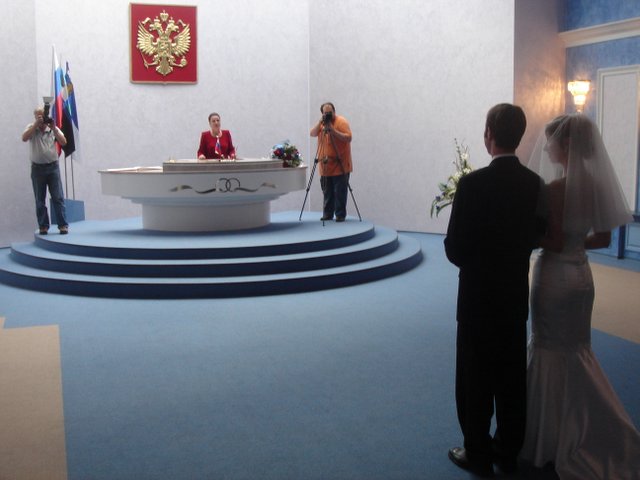
In Russia, church weddings are still unofficial, done for ceremony more than anything else, so while they certainly are performed, it's usually on the Sunday after a Saturday marriage at the Palace of Marriages. More than research brought me there on Friday. I got married.
The picture here shows me and my bride after stepping into the hall where the ceremony is performed. The lady pictured at the desk (which my father thought stolen from the Star Trek set) asked almost immediately if we were entering our marriage freely. My Fiancee answered first by saying, "Da." I didn't exactly know the details of the question at this point, but fearing a stamped foot, I said "Da" after the same string of words were directed to me.
With this formality overcome, we went up to the desk, where I deposited our rings on a silver tray that had angel wings sprouting from it, and signed our names onto a form. We then returned front and center, followed over by the lady with the tray. My fiancee and I put on our rings, I lifted the veil, and we kissed -- still man and woman, now husband and wife.
What came next? A dance. Apparently, you have to dance in Russia's Palace of Weddings. I didn't know this. Hadn't been warned about anything, so I did something that was part Texas-two-step and part Vienna Waltz. My wife, somehow, followed along, and I love her all the more for it. A bow to the parents wrapped things up, and then, with the applause of those in attendance, we were walking out the door, soon to be replaced by another couple.
Monday, July 10, 2006
Countdown
I am a short-timer in Kharkov, leaving for Belgorod on Friday. I may not return to Ukraine again until I leave on August Sixth -- at least, I'll do that if I am able to file some immigration paperwork in Moscow. The papers deal with my fiancee getting her green card and following me over to the states, and though you're allowed to file this paperwork with a US Embassy if you live abroad, I'm in a bit of a catch-22 situation. I have been living in Ukraine, so I thought to file in Kiev. But my Fiancee lives in Russia, so the people in Kiev, after accepting my appointment request on one day, said on a second day that I really should go to Moscow, because that's where the final interview, involving only my wife, will take place. "She's a Russian," they said. "We can only process Ukrainians." The problem is, Moscow only accepts paperwork from Americans living in Russia, and I ... well, no one is set-up to take us, a bi-national, living-overseas, border-town relationship kind of couple. As a result, I'll go to Moscow after my marriage, on the 21st of July, and see if the Moscow Department of Homeland Security will take me -- I will be a resident of Russia at that point, and certainly not of the US, having not set foot in the states in a year. But if they refuse me, it's back to Kiev on the first of August. A quick interview is conducted when I present my paper-work and I'm given an opportunity to authenticate my relationship with my wife. Maybe three or five out of every ten marriages between a US national and a foreigner are cases of immigration fraud, I'm told, so if on first glance your relationship is viewed as legitimate, you want the person receiving your paperwork to be around to conduct the second interview with your wife. If I drop my paperwork at Kiev, the second interview will be in Moscow -- with a person who hasn't seen my wife at the first interview. Confused yet? And there may be paper-work delays routing everything from one place to the other. But it will be a lot better than doing all this in the states, as then you just throw your paperwork into the slush pile, located for Californians in Laguan Niguel, and hope for the better, everything sight unseen. If you do it that way, it can take up to a year or a year and a half for your wife to follow you over to the states -- so long as you cross all t's correctly and dot the necessary number of i's. If you do it at an embassy, the process might only take three months. If you do it at two embassies ... I don't know. More to come on this.
Read More......Tuesday, June 06, 2006
Of proposals and paper-work
I hope to continue to file reports on my research into the various aspects of the mail-order bride industry, but in the coming weeks (and months, but hopefully not years) you should see some new content as well – in particular, posts touching on the immigration process to the United States of America.
The reason for my newfound interest is simple. First, if one in ten men coming to Ukraine ends up getting married, as I've been told, this is a process that should be of some interest to many of my readers. Consider the numbers:
Last year over 100,000 people were in the United States on a visa that had been granted to them as result of their marriage or engagement to a US citizen. 33,000 were there on K1 visas, which allow you to stay in America for up to 90 days, by which time, if you haven’t married, you must return to your home country. These are commonly called “fiancée visas.” The K3 and CR1 visas are given to spouses of American citizens and generally allow you to stay in the country for up to two years. By the expiration of that visa, you should have received the final adjustment of your immigration status, culminating in a Green Card, which awards its holder the freedom to travel (something that was not always granted to the citizens of the Soviet Union). 11,000 K3 visas were awarded during the 2005 calendar year, along with 65,000 CR1’s.
Secondly, and here is the textbook example of a journalist burying the lead, I’m getting married. To a Russian national. So writing about this may be my best way to both understand what I need to do and channel my frustrations. Do I already expect frustrations? Sure. I've been told that marrying a Russian in Russia and then getting her legally into America (rather than on a plane to Mexico City and then into a van that will take her around the wall currently being erected by the National Guard near Yuma, Arizona) can take up to a year, maybe even longer.
You have to understand. There are various government agencies to deal with, both foreign and domestic, things to sign, sometimes in triplicate, notaries to see, capitals to visit, friends to call on for advice, acquaintances to contact for help, and then, rising above it all like some grand traffic light, the Department of Homeland Security, with its many colored terrorism alert system flickering both day and night.
(Are we still color-coding terrorism, America? I've been gone so long I don't even know. What color is it today?)
But let me reel this back in.
While some people have been kind enough to congratulate me on my decision and allow me to enjoy the magic of the moment (the stuff afforded most people who drop to one knee and place the ring on the finger) others have been quick -- far too quick -- to say, "I know two people who tried this. The process was so long and arduous it contributed to their divorce. And oh by the way, Mazal Tov!"
So we're not even married and already people are imagining our divorce. But what do you do when you meet someone so kind, so beautiful, so sensible and strong you wonder if it's you that's changed or the woman you're with, because suddenly the world seems so consistently better? What do you do when you meet her more than two years ago in California, reunite in Moscow, and then have your third date in Ukraine?
I'm not a genius, but I think you go for it.
I started Monday, spending eight hours on the computer, visiting various websites and sending an untold number of emails, while My Fiancee went down to the Zapis Aktov Grazhdanskogo Sostoyaniya office(ZAGS) to see what was needed for us to get our marriage properly registered and performed in her hometown. The office was closed, so my internet searches zeroed in on the US Consulate in Vladivostok (I couldn't find information on the civil marriage process on the website for the US Embassy in Moscow).
The folks in Vladivostok said I should be prepared to present my birth certificate to the Russian officials, and as my father was traveling the next day to Norway, I told him to find it in the garage and DHL it to me in Ukraine -- a cost of $80.
The next morning I awoke to hear of My Fiancee's latest trip to ZAGS , at which she was met by a woman with wholly unremarkable intra-personal skills. This woman let it be known that all of the following would be expected:
* I would have to get my passport and visa photocopied and translated into Russian.
* Register my Russian visa in Belgorod, where the ceremony would be be performed.
*And get a marital status letter (something called a “statement of no impediment to marriage” elsewhere) which basically says I'm neither polygamous nor already more traditionally betrothed.
In her email, My Fiancee included a link to the US Embassy in Moscow. They had information on the civil marriage process after all. Five Steps to a Russian Marriage. Not six? Huh. No mention of the birth certificate. Oh well.
I focused on Step Three:
Authentication of the marriage letter is performed by the Department of Legalization of the Russian Ministry of Foreign Affairs. The procedure costs around 100 rubles for a five-day return. Fees are paid at the Sberkassa located at Department of Legalization.
Department of Legalization, Russian Ministry of Foreign Affairs
1st Neopalimovskiy Pereulok, Dom 12a (near Smolenskaya Metro)
10:00am - 1:00pm; 3pm - 5pm (4:30pm on Fridays), 244-3797
Already things were complicated. If I left too soon, I'd miss the delivery of my birth certificate, a document I hadn't wanted to leave to the people at DHL in the first place, if only because the last time my father sent a package via that corporation, they had refused to deliver it, saying the packaged spices and whole bean coffee inside was illegal contraband. But then again, if I waited till next Tuesday (Monday is a holiday, Russian Independence Day) I feared I'd be giving up valuable time I couldn't afford to lose. After all, every ZAGS office in Russia requires a 32-day cooling-off period between registration and the Cyrillic equivalent of you can now kiss the bride. And a marital status letter is only valid for 90 days. And my Russian visa wasn't yet registered in Belgorod. And while that document didn't expire until the first week of September, my Ukrainian visa, given to me last year with one month already lapsed, expired the first week in August, when I was supposed to return to the United States to join a PhD program in Los Angeles. I had 61 days left. Perhaps no man since Hitler or Napoleon has given greater consideration to his entry into Moscow.
"Let's shoot for Tuesday," I said. And hope it doesn't snow.
What else can you do? Apply for the less arduous K1 visa? Perhaps. But then you can’t get married in Russia, in front of the bride's family, and I just couldn't stomach that route because I feared we'd have an experience like the one recently reported by Paul Keegan in the Moscow Times.
Keegan, a freelance writer, met his fiancée, Tatyana, through a friend last year in New York. Tatyana, an accomplished ball-room dancer, already had a green card. The couple agreed to marry on Christmas Day (December 25th) and then tried to get a tourist visa for Tatyana’s parents so they could attend the mid-June ceremony in the states. The outcome of this effort is both disturbing and, sadly, expected:
Tatyana's parents, Viktor and Lyudmila Rybushkin, traveled 19 hours on a train from their home in Volgograd to Moscow for a visa interview at the U.S. Embassy. It lasted five minutes. The man behind the glass at Window 12 asked a few questions, glanced at our wedding invitation and handed them a form-letter refusal.
During their 15-hour bus ride home, Lyudmila wept while Viktor, 59, which is the average life expectancy for Russian men, took extra doses of the pills for his high blood pressure. For days, Tatyana was in shock, unable to cry.
The visa application fees alone cost nearly a month's salary at Viktor's factory job, at which he earns 7,600 rubles ($248) per month. Train and bus fares for the four-day, 2,200-kilometer round trip set them back another 3,000 rubles. The U.S. government requires personal interviews for all visa applicants but has only four consulates in Russia, a country that spans eleven time zones.
Why did they get turned down? The United States government assumes every person will over-stay their tourist visa, remain in the Land of the Underdog illegally, and siphon off valuable public services or otherwise be a drain on the economy. (So much for the Horatio Alger myth.) To get a tourist visa, you must have strong family and business ties tying you to your homeland, and even then you might have difficulties getting your application approved.
If you asked Paul Keegan, he'd probably say we should just be done with it and send the French their statue back. I'd like to believe the above incident was an anomaly, something that shouldn't have happened but somehow did, and that there are many more happy stories than sad ones delivered through the US Embassy in Moscow.
But maybe I'm getting ahead of myself. I have to remind myself I'm only at the start. Read More......


