If, like me, you're learning -- or, more honestly, trying to learn -- to speak Russian, you'd be well-served by visiting this blog, which is written by a Swedish literature student living in Russia. I love the word of the week feature, as well as the type of travel reportage that I enjoyed posting here. The title of the blog, Russian Blog, sounds like the result of a brainstorming session that lasted all of five seconds. But each post is obviously the work of a good deal of effort. I'm certainly reading and hoping for more.
Thursday, October 30, 2008
Great blog


Friday, August 10, 2007
Battle Continues

I was mistaken in my last post. Two people died, in separate incidents, owing to bombs planted or dropped during the Great Patriotic War.
The first death was July 29, a village woman burning trash in what had been a mine field. The second, cited below, happened on the evening of Aug. 4, behind the airport in Belgorod.
I would've expected this to be big news, the stuff of sad stories in national papers. But it seems it may be all too commonplace. Here's the brief write-up in the Belgorod paper (Russian).
The picture above is the soviet memorial of Prokhorovkoe Field, nearer to Kursk than Belgorod, where the largest tank battle took place during the Second World War. The newpaper headline references it, saying the battle continues.
The picture below is the Yelstin-era memorial, a few kilometers down the road from the Soviet structure.
Tuesday, August 07, 2007
62 Years Later, WWII Finds Another Victim
I couldn't believe what I heard just yesterday, when my wife told me how a 25 year-old father -- and the friend of her girilfriend's husband -- died in the woods behind her parents' dacha. He was doing something so Russian -- cooking shashlik, skewered meat, over an open flame. Barbecuing, if you will. And in an area I've been before myself. But there was something else there, waiting for him since well before he was born, since before his father was born, most likely, a bomb that had been put there by the German some sixty-two years ago this day. It seems implausible, but this is what I'm told. He selected a spot that was charred, darkened by a fire already, but while building his flame, the heat of the soil ignited the bomb that was juch an inch or two below -- shrapnel cut his cheek, he was dead inside of ten minutes. So young, married, with a child. There's a reason Russia still celebrates Victory Day every year, and you see signs commemorating how many years it's been since the fascists were driven off their land. It's a war that's still killing.
Read More......Wednesday, January 17, 2007
Matchmaker, Matchmaker - Los Angeles Edition

Last year, I spoke with two US Embassy officials who each day interview a slew of visa applicants from a certain Eastern European country. They were the first to tell me about the idea of "piggy-back immigration," through which one person, already admitted to the United States, goes back to his or her former country and brings another person over, either an immediate or close family member or a new spouse. I don't see anything wrong with the idea; on the contrary, it's a time-honored tradition to bring the Old World to the New, to have no limits placed on your life, to hold as many rights as the next man or woman in the Ten Items or Less line.
And now I'm here to play my part in this process. My wife has a friend, a beautiful young woman in the South of Russia, recently estranged from her long-term boyfriend. She's intelligent, a good cook, she cleans and sews, and she's very feminine, my wife says. What she isn't is actively looking for an American husband. But my wife believes she'd be willing to listen if the right man came calling.
Could she listen right now? Not entirely, not without some help or hesitation, maybe a good dictionary between the two of you, as her English language skills have slipped since leaving college and taking an administrative job with the gas company. "But it's not like she doesn't know it at all," my wife said. "She just forgot it. She had an 'A' in college."
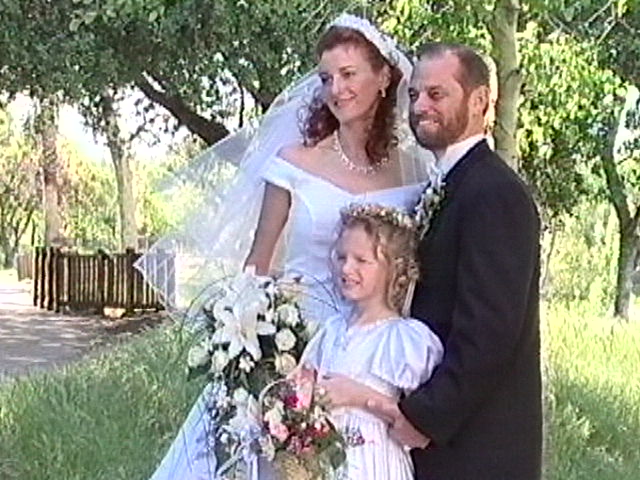
And yes, before I go on too far, that is her in the picture, up there on the top left, the one that will be much larger if you click it. The photo is taken on the day of my wedding. The girl in the foreground is Anya. A friend of animals, especially cats, a petite twenty-six year-old who wants children and prizes the idea of having a family.
"I think she's the nicest person I've ever met," my wife said. "She's my nicest friend."
And that, dear reader, is why we're here today. My wife would like to see her friend in her life again, so if you're in California, preferably Southern California, and most especially Los Angeles, perhaps you'd like to make yourself known. Would others be considered? Perhaps. But if you're from Saskatchewan, you have to ask yourself: which is easier to get to from LAX? Moscow, or Saskatoon?
Interested? Then find a picture of yourself, write a few words about who you are, how you live, and if you're ready to make a lifetime commitment to borsch, and then send it all off to this email address. My wife will consider the responses, and we'll proceed appropriately from there.
A word of clarification. This isn't The Bachelor or Joe Millionaire. We won't be inviting fourteen of you to Russia, and then sending one of you home each week. Nor will we follow you around with a camera here, capturing the reactions of friends and family (to say nothing of a few awkward confessions). We're just trying to heed the call, however faint, that's been sent from a friend in Russia, a call you might have also heard in that film The Fiddler on the Roof:
Matchmaker, matchmaker make me a match
Find me a find, catch me a catch
Matchmaker, matchmaker look through your book
And make me a perfect match
Or some such.
Wednesday, August 23, 2006
The Cost of Marriage (or, The Foreigner Tax)
Most young couples need every dollar they can scrape together. Car, home, new furnishings, maybe air fare to see the folks -- it all adds up. But for an American citizen marrying a non-American citizen, it all adds up a lot more quickly. Call it the Foreigner Tax.
Consider the costs of marrying in Russia and then filing all the necessary paper-work with the US and Russian governments. For us, that meant travelling twice between Belgorod and Moscow, in a four person-sleeper compartment. Cost: Approximately $280.
Once in Moscow, we had to get a marriage letter notarized by the US Embassy stating that I was unencumbered and free to marry. After paying my $30 at the cashier's window, I raised my right hand before a Foreign Service Officer, swore and affirmed that the information in the marriage letter was truthful and accurate -- at least according to the best available intelligence at the time -- and then received a raised stamp on the bottom of the page.
The next step was to get this sucker translated, along with my passport. That took another $40.
Finally we had to take the document to the Russian Federation's Department of Legalization, where it costs $30 to have the piece of paper embellished with a messy signature and a shiny sticker like those you see on a credit card. Our fee was bumped up to $130 -- call it a $100 bribe to receive same-day service -- and then we were out the door, done for the day.
When we came back, after our marriage in Belgorod, we had to feed another bureaucracy, not Russia's this time but America's. That meant a handful of documents, but primarily the I-130, a petition for Alien Relative, or -- the way you can bring your wife to America and get her a Green Card before coming. Cost of filing this document: $190. Do I swear and affirm? You bet your ass.
Add in $10 to get around on the Metro both days, $150 for miscellaneous taxi fees and a single round-trip train ticket back and forth between Kiev and Belgorod (so my wife could see me off, when ideally we both would have been leaving together) and the grand total so far is roughly $820, not including time lost on the job (wasn't I writing a novel?) so you can figure out all the forms you need and just how in the hell you fill them out. (For this, many people pay thousands of dollars to an immigration lawyer.)
Saturday, July 22, 2006
Palace of Weddings
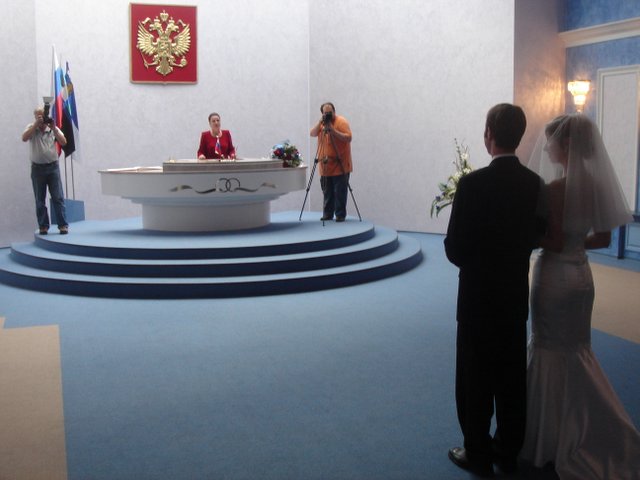
In Russia, church weddings are still unofficial, done for ceremony more than anything else, so while they certainly are performed, it's usually on the Sunday after a Saturday marriage at the Palace of Marriages. More than research brought me there on Friday. I got married.
The picture here shows me and my bride after stepping into the hall where the ceremony is performed. The lady pictured at the desk (which my father thought stolen from the Star Trek set) asked almost immediately if we were entering our marriage freely. My Fiancee answered first by saying, "Da." I didn't exactly know the details of the question at this point, but fearing a stamped foot, I said "Da" after the same string of words were directed to me.
With this formality overcome, we went up to the desk, where I deposited our rings on a silver tray that had angel wings sprouting from it, and signed our names onto a form. We then returned front and center, followed over by the lady with the tray. My fiancee and I put on our rings, I lifted the veil, and we kissed -- still man and woman, now husband and wife.
What came next? A dance. Apparently, you have to dance in Russia's Palace of Weddings. I didn't know this. Hadn't been warned about anything, so I did something that was part Texas-two-step and part Vienna Waltz. My wife, somehow, followed along, and I love her all the more for it. A bow to the parents wrapped things up, and then, with the applause of those in attendance, we were walking out the door, soon to be replaced by another couple.
Tuesday, May 23, 2006
"Stiven kak Stephan"
I spent the weekend in Russia, experiencing the best of the culture there. First some great home-made Georgian lamb-vegetable soup Saturday night (Kharcho), then some shashlik (Russian shiskabob) cooked the next afternoon at the dacha. To top this off, I spent Sunday evening at the banya, a Russian sauna (wet, not dry).
The banya treatment included a good beating with venik, dried branches, to improve circulation. This was delivered after two stints in the wooden room heated to ninety-degrees Celsius or so. I wasn’t sure what to expect, so naturally I expected the worst. I imagined a sort of Birch branch torn from a tree (a switch, a Texan might call it) and then a lashing not unlike the one applied by religious fanatics trying to atone for the death of Christ. The reality was a little different. Leafy oak branches were used (while some leafy birch was supplied for a pillow). The branches were applied on both sides of the body, from toe to shoulders, by a man who claimed to be a Walrus, a health nut (there was no vodka drinking here, just lots of tea) who’d even jumped into an icy cold river on the day of his marriage (and appeared on Channel One for the effort). He smothered my skin with heat at times, trapped it on the backs of my feet, up my spine, against my neck. Then, after instructing me to flip over a second time, he gave me a couple of good whacks, the hardest hits saved for last. A great experience -- and enough, a friend of a friend said, to complete my “extreme Russia” tour – banya and dacha.
But then the next morning, this tour unexpectedly continued – at the border with Ukraine.
Usually, the Russian passport control agents have been professional and more often than not very friendly ("You're a writer?" one asked when I arrived Saturday. "Kak Hemingway?" "Yes," I laughed, "Like Hemingway.") In comparison, the Ukrainians have been more demanding, more questioning, either puzzling over my visa (given a special cultural affairs mark) or wondering why I have it (you don’t need one if you stay in the country less than six months) or just running my address through their Palm Pilot one more time. But today there was a problem on the Russian side, and for a time I feared I might find myself locked away behind a fence, given a shovel, assigned a bunk.
On my immigration card, I had written my name as “Stephan,” just as it reads in my passport. But my Russian visa reads “Stiven” (unlike my Ukrainian visa which reads “Stephen.”)
This proved problematic.
After punching a number of buttons, staring at the screen, not looking my way for a good two or three minutes, the middle-aged woman behind the Plexi-Glass finally asked a question. “Your name?” I told her. She explained the discrepancy. I nodded, sighed, made every effort to show that I had been having this problem my whole life – in Little League, I could have said, the guy announcing the next batter always called me Stephen. I thought she was commiserating. Then I realized this to her was more than a minor frustration; it was a major clerical mistake.
She called for the control agent one line over. The two women started talking. I was the last one left from my bus of fifty or so passengers. A third woman drifted over. I asked if the bus was still there. It was. I reiterated that the difference between the two names was small. Look at my first Russian visa, two years ago, I said. Yes, there; that one has the name correct. Isn't that all that matters? That someone got it right, once? “Every time it’s different,” I said.
She stared at me as if I were speaking Greek, but it wasn't because my Russian failed me. I've been practicing. I can get some things right. This was a bureaucratic stare.
Another agent was summoned, a man in his late forties. The phone rang. He took the call, spoke with someone in Moscow for all I know. Then he hung up and asked me something in a stand-up straight voice. I answered him, suddenly six foot tall. Kharkov, I said. That's where I'm going. And because his voice commanded such respect, I gave him some more information too. I live there. I'm an English professor. (Sure, I'm not teaching anymore, but I've found this phrase opens door, hastens stamps). But he didn't listen, just looked between me and my picture, seeing a clean-shaven man in the flesh but a goateed one in the passport. He studied me again. I stood straighter somehow. Now, my whole identity was apparently in doubt.
The bus driver came in. What’s going? There’s a problem! I’ve got fifty people waiting! The customs agent tore away with my passport, striding outside, the bus driver talking at his side the whole way, me reluctantly wondering if I'd missed the command to follow him. Should I? He barked something. I stopped. The bus driver did too. The man walked away.
Didn't the State Department recommend you not give up your passport? Isn't that a bad thing? Not comfortable, that's for sure. What was he doing? How long would he be gone? Is there a complaint box? I feared a back-room, questions about the number of stamps in my passport, the back and forth between this country and that. Are you a spy? Comrade Wolf eats without listening.
Then people spilled off my bus, some smoking, others cursing, and I returned inside, where a new busload of people were filing through the two check-points.
I quickly sent text messages to someone in Russia. “Check on me in twenty minutes.” Because what if they took my phone? And really, I’m trying to leave Russia, not enter it! Is this how they fight the country’s population decline? Keep me behind for spelling practice? “They’ve taken my passport,” I wrote. “I don’t know where or for what.” Call the embassy in Moscow – I was ready to write it. But then maybe 25 or 30 minutes after it’d started with a simple shake of the head, back the man came, breezing by me to the woman in the booth who’d initially attempted to process me.
“Stiven kak Stephan,” he said.
Steven like Stephan.
The man handed me my passport. I took it and left silently for the bus, explaining to a grinning man between me and the door that it was all because of a single misplaced letter. Maybe it was really three or four misplaced letters, but he understood the point. "Extreme Russia," he said. I fell into in my seat, directly behind three new vacancies (some women had apparently walked or opted for a taxi). The bus shook to a start and we moved on to the Ukrainian side, where the control agent would tell me I'd signed my name in the wrong place on the card. "Well at least I spelled it right," I should have said.
Thursday, May 04, 2006
Volgograd

I mean to write a few words about my trip to Volgograd, which I returned from on Tuesday. But for now I've only added a few photos (of a May Day rally) to the Flickr sidebar. Until I post more, I'll leave you with this photo and let you wonder what it is.
Wednesday, February 22, 2006
The Свущ, Syringes, and Norwegian-American Pride
Last night, I watched the tail-end of what used to be one of the most anticipated matches in any sporting year, at least for me and many other Americans: USA versus Russia, hockey. I don't even like hockey, but I'd always watch this. The match had juice, sizzle, it was us versus them, tension. You could imagine the President staying up late, the first wife at his side saying, "It's just a hockey match, Ronny." But it was more than that, always it was. And now. Last night's match ended 5-4 Russia with sticks flying in front of the net and a possible last-second shot sending it into overtime, but, yeah, you know, now I really couldn't care less.
These days, the Russian fans chant Ross-see-you! Ross-see-you! just like the US fans chant U-S-A! U-S-A! (which I'm told started back at Lake Placid). Then there're the uniforms. You'll still find each country using the name they follow at the United Nations (one Russia, the other the US) but now they both share a Nike Swoosh. I'm not saying the Swoosh is the Mark of the Beast; I don't know if all the evidence is in. I'm just saying I remember a time when one country wore Nikes and another wore a pair of shoes. Or skates. You know what I mean.
Norway has a lot of medals. More medals per capita than any other country. I don't have a crack staff of interns. I don't even have one intern. But I can at least provide you with a general idea. Norway, with 18 medals as of this writing, is populated by 4.5 million people. Meanwhile, the United States of America, also with 18 medals, probably has just as many or more Norwegian-Americans.
Austria has 19 medals, but there should be an asterisk -- or hell, a transfusion machine -- by the side of that country's name. On Tuesday, after raids against the Austrian ski team yielded 100 syringes and even a blood tranfusion machine, the country's Ski Federation President said:
"I think they're going too far with the whole thing. This is not sport ... We won't live with this. We can't have our guys going through this. It's no longer about sport, it's just about rumors.''
I find this quote most enjoyable when I picture the guy, a Peter Schroeckschnadel, stepping over a pile of syringes and then side-stepping a blood tranfusion machine.
The transfusion machine, he and other Austrians politely pointed out, was found in a room without any blood. So you know, it wasn't necessarily being used. No transfusion, no foul. Perhaps it came with the rental. The Stones played Torino last year, didn't they? Maybe Keith Richards had the house last.
They should do away with the Olympic Village, all the separate living quarters, and just have one Big Brother-like house. All the athletes come in, there're cameras everywhere, and when NBC1's airing some of the events, NBC2's airing the reality show.
Thursday, February 09, 2006
Gazputin
I was going to say something about the cold. It's cold again. Below zero Farenheit, a frightening number when you go metric, -16 or -18, cold enough for the hair inside your nose to freeze. The wind is coming from the east at 10 to 15 miles per hour, a cold that's unending and relentless, from December to February, day after day after day, until even the inside of your shapka's cold when you're sitting on your sofa in the living room staring at the wall straight ahead because it's so damn cold out you don't want to move.
Cold, I'm saying. The type of cold that requires a bath, not a shower, because a good warm bath reminds you of that feeling you once knew, a sort of California gold, let's say, a radiance that could be felt way down deep in the marrow of your bones. Only in a bath do you remember that, especially on the day your mother writes to say it's sixty degrees in Sacramento, and how is it there? Cold, mom. Thanks for asking. It's cold.
I'm amazed the Ukrainian population is declining. The cold seeps through the stones in the walls and creeps into your apartment. Every few minutes, you check the radiator. Is the radiator still working? They're working on the radiator. Your radiator works? Mine doesn't. It becomes the subject of conversation, it brings people together, it takes on the sort of gravity that I'm sure the Cro-Magnon gave to the fire and charred flesh. I would think men and women would find each other over this. Forget astrology, forget what's your sign? These are the lines of the decadent west. Is your radiator working? Babies are born because of these words. I'm sure of it. How isn't the population soaring? And why do American men seeking a "mail-order bride" for the most part stay away during the winter? In the spring everyone feels good. It's warm, the clothes are coming off, there is no sense of desperation. Right now, in a winter like this, there is only one thing to do. Buy many, many blankets and stay underneath, hopefully with something more substantial than your fur-lined shapka.
~
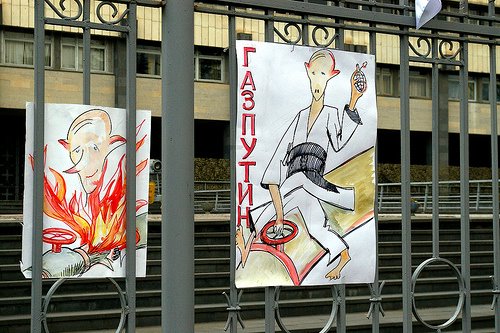
The photo above doesn't necessarily reflect my political persuasion. I think the Washington Times said it best in a link somewhere far below -- paraphrasing now: if you supported Yushenko and his calls for integrating with the west, you have to support Gazprom charging market prices to Ukraine, Georgia and all the rest. Is there a reason Russia should help prop up its former Republics? In his expansive talk to the press last week (nice site), Putin said:
The subsidizing of former Soviet republics at the expense of Russia has been going on for 15 years ... Germany spends a huge amount of money for the regeneration of its eastern territory. But they are spending it to unite their country – and what exactly are we paying for?
Do Ukrainians and Georgians consider it a matter of reparations? Do they think they should get the same deal as Minsk, if only because Belarus' buddy-buddy rate shows Gazprom isn't entirely market-driven and that's not fair? What is the reason?
Well, regardless of all that, it is cold. Did I mention it? The person who took the photo ("Gasputin" it reads in Cyrillic) no doubt agrees. She writes a blog about her experiences as a Fulbrighter in Georgia, where it's also cold and where Gazprom is believed to be behind the pipeline explosions and gas shortages that left the capital without heat or electricity for much of the last month.
Today, the blog's author wrote about other concerns:
I was whining to my Georgian teacher about the noisy neighbor kids, and she sledgehammered my complaint by pulling the Stalin card.
I guess when you live in the same apartment building as the grandson of a genocidal despot, you win the annoying-neighbor contest.
The blog is a good read. Sue writes very well. I don't know what she's going to grad school for next year, but I hope it's not for applied mathematics or some other subject that doesn't require much by way of the pen. Read More......
Monday, September 05, 2005
Туалеты
When I visited St. Petersburg last summer, I was told to bring toilet paper, nice soft American toilet paper, especially if I planned on using a public loo. Now, I don't like using the public facilities in America, so I avoided any problems in Russia by keeping my problems at home. There, in the room I rented at the Herzen University dorm, I had not only a toilet bowl but a toilet seat. Private too. This, I learned, was a luxury not to be taken for granted, for while touring St. Petersburg and its environs I saw so many seatless toilets I thought the Kappa Alphas must've followed me over and committed a rash of pranks. But no, it was more devious than that, though I learned of this only upon my return home, when my first Russian professor told me of his year studying at a Russian college. "The students stole the seats from the dormitory toilets before the first class even began," he said. These seats were then spirited away and hidden beneath a bed or inside a closet, guaranteeing the owner's bum a warm welcome on a cold winter's day.
The head may be a Communist, I thought. But the bottom is always a capitalist.
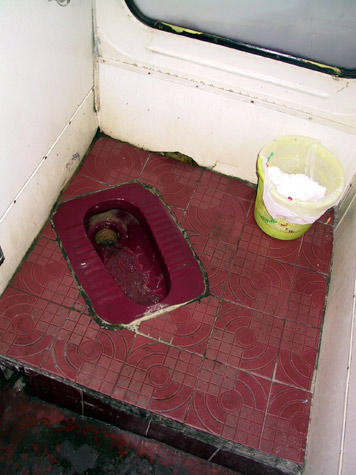
All this, I'm afraid, proved to be only half of the problem, and the less troubling half at that. For then I came upon Leningradsky Station, where Lenin first emerged from his sealed boxcar to lead the Reds in revolution. It was here that I found my first squatter, which looked only slightly better than this one from China. Now, Leningradsky Station is a place of deep historical significance, a place akin to our own Bunker Hill, and though I've never been to Bunker Hill, never even been to Boston, I think it safe to say that the Senior Senator from Massachusetts wouldn't have me setting my feet against the tread marks of even the fanciest squatter and steadying myself over its hole.
How is it that more than ten years after the fall of Communism the toilets at Leningradsky haven't been improved? And for that matter, how could they have remained that way even in the 80s? I imagine President Reagan arriving at the station and being met by Gorbachev, the Gipper saying he just needed to duck into the little boy's room, and then Gorby saying he'd do the same. And then what would happen? What would you see? Gorby and The Gip squatting over two adjacent squatters, with nary a door nor a Secret Serviceman to shield them from view.
These toilets, I'll tell ya: Few things have instilled such fear in me. This is a device that belongs in Tora Bora, hidden in a cave as it speaks calmly into the camera and describes the death and mayhem it will bring to men and women and children and small dogs. I didn't dare use it, if only because I didn't know how to use it. Was it broken? Were my hamstrings strong enough? Had someone stolen the throne? And what was that brush and bucket doing in the corner? Was that there in place of toilet paper, because I sure as hell didn't see a roll hangin yay-high with the paper facing down, rather than up. You asked the question first Lenin, now let me give it to you. What's to be done?
I'll tell ya, these toilets: Few things have left such a lasting impression on me, and so it is now, less than a week before I arrive in Ukraine, that I must confess to all and sundry: I may just hold it.
Tuesday, August 09, 2005
Say "Trust Me!" in Russian
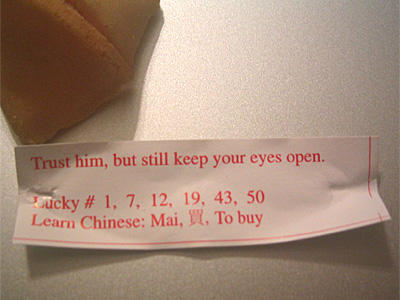
In the Russian city of Ekaterinburg, known as Sverdlovsk during Soviet times, you'll find the marriage agency Alexander's Tender Ladies. The name is not the reason I'm posting tonight, but let's linger there for just a moment. Alexander's Tender Ladies. It brings to mind both soft-core pornography that ultimately disappoints and fast food that can't be traced back to a single identifiable animal part. The guy with the phone is the man behind this enterprise, and surrounded as he is by the beautiful Natalia, Irina and Julia, he can't help but bring to mind John Forsythe's Charlie and all the many possibilities of a 70s-induced fantasy.
But enough. On to the day's point of interest, a compendium of "tender words and phrases" written by Alexander Korjev and Lilia Meighan, a Kharkovite who married an American in 1999. Over the course of seventeen online chapters, our authors teach us those "delicate words useful when you are trying to phone your lady," "tender forms of expressing your ignorance and incomprehension," and of course "how to tell your lady to marry you with tender Russian words."
Did anyone ever sing such tender words so beautifully before? Well, if Barry White had "Can't Get Enough of Your Love, Babe," Alexander and Lilia have plenty of hits of their own. Consider,
the vaguely clinical:
English: We feel so good together. Let's make a family.
Russian: Нам так хорошо вместе. Давай создадим семью.
Pronounciation: Nam tak ha-ra-shO vmEs-te. Da-vAy soz-da-dIm sem-yU.
the auto-erotic:
E: Never in my life I felt myself so good.
R: Мне никогда в жизни не было так хорошо.
P: Mne ni-kog-dA v zshIz-ni nE-bee-lo tak ha-ra-shO.
and the bloody:
E: I swear I'll give you my heart.
R: Я клянусь, что отдам тебе своё сердце.
P: Ya klya-nUs', chto ot-dAm te-bE sva-yO sEr-tse.
Before you damn me to hell for making fun of someone's second language (and before I do the same, for surely I'll be repaid in kind for this when I stumble around Ukraine with my own mangled Russian) I'll say one thing in my defense: if the shades of love are hard to understand in a shared language, how difficult is it when you have to jump an unknown divide? If that still doesn't win you back, let me offer you a glimpse at Chapter 14, which I found the least humorous. This chapter, entitled "tender words to calm and cheer up your lady," includes translations for such English phrases as "Everything is under control," "You know, it must be like this," and "Trust me."
With that, I call it a night.
Fortune Cookie photo found at Happy Go Larry
Read More......Wednesday, August 03, 2005
Осторожно! Be Careful!
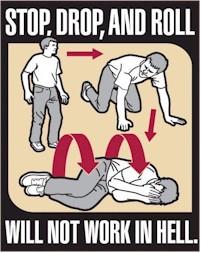
Some time back during the mid-nineties, I woke up on Christmas Morning to find Life's Little Instruction Book in my stocking. I'm that child in the family, the one who needs instructions even after he's fully house-broken and for the most part graduated from college. Learn to listen: Opportunity knocks softly ... Never cut what can be untied ... Don't pee in public.
Yesterday, my sister gave me something that reminded me of that book: an electronic translator that knows 12 languages and something like 400,000 words and phrases. Just push one button and you can learn to say, "Help me!" in Russian. Scroll down a little further and you'll be ready to master, "I'm dizzy." If things look somewhat more dire, try, "I haven't done anything!" And if that doesn't work, go directly to, "I'm calling the police!" If you wish to announce to all and sundry that you are indeed an American, deliver this line with a straight face: "I need an itemized bill for my insurance company." And if you want to show that you are indeed a calmer individual than I am, hit the down arrow once, twice, three times -- make that twenty-nine times in a row -- and then look up to calmly announce, "I've lost my son (daughter)!"
The gift should prove very useful, as it's lighter and more compact than a phrase book and dictionary. It just saddens me that the programmer didn't think to include a Cyrillic version of, "Never cut what can be untied!" Or: "Learn to listen! Opportunity knocks softly!" Because I'd say the quickest way to blend into a foreign country, the quickest way to make people think you are indeed a local, is to act like you're stark raving mad. All you need are a few simple phrases: "Don't major in minor things!" "Think big thoughts, but relish small pleasures!" And then everyone will leave you alone.
Friday, July 29, 2005
Top 50 Russian Verbs

There are 555 fully conjugated verbs in my Big Silver Book of Russian Verbs, including enough variants of "to go" to keep Rain Man occupied for much of the next decade. But it's the Top 50 verbs that caught my interest today, particularly a run of these most popular verbs at the back of the book. In a row, I found убирать(to kill), ударять (to strike or hit), умирать (to die), and then, if you haven't gotten the job done yet, уничтожать (to destroy or annihilate). These are top 50 verbs, I'm told. Up there with "to read," "to buy" and "to work." Pretty amazing. I wonder if any other language on the planet can stand toe-to-toe, or toe-tag to toe-tag, with Russian, because that's quite a run, even without throwing in the next two: устраивать(ся) (to place -- as in to place in a coffin) and finally, уходить(to leave -- as in to walk away from said coffin after lowering it into the melted tundra).


Subscribe to:
Posts (Atom)