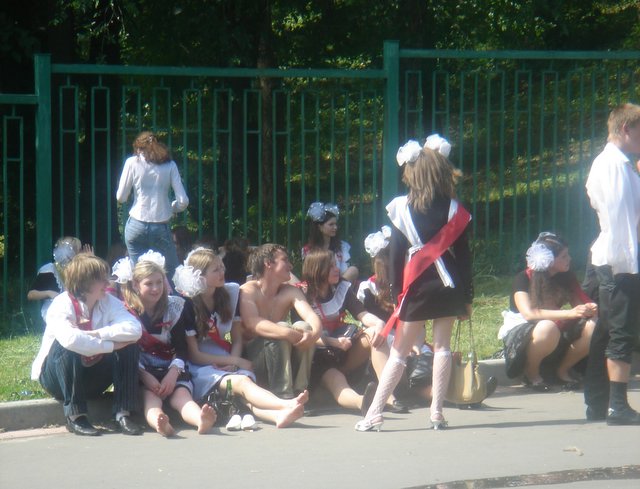
As Alice Cooper once so aptly sang, School's out forever. At least it is for some kids in Kharkov, who apparently celebrate the end of the academic year by donning old Soviet-era school uniforms that, in a pinch, could outfit a French maid.
Wednesday, May 31, 2006
Graduation Day


Lugansk: Working for a living
When I arrived by train in Lugansk Monday morning, I was met by a Fulbright Scholar who was nearing the end of his ten-month stay at that city’s medical university.
“Any other Fulbrighters been out this way to visit?” I asked.
My Man in Lugansk, a southerner with a warm Kentucky accent, smiled shyly and admitted I was the first. “If you’re here, you’re here for a reason,” he said, “because it’s not on the way to anywhere.”
Located at the far eastern edge of Ukraine, a good eighteen hours by train from the capital, Lugansk is indeed isolated, a city of some 400,000 that has long served as a center of heavy industry.
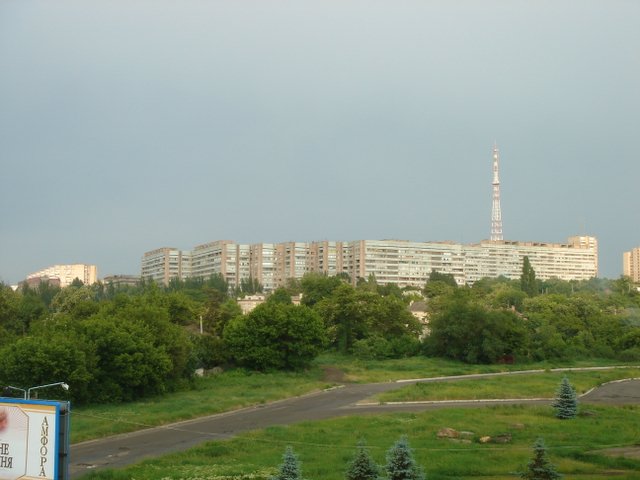
On the drive away from the train station, my fellow Fulbrighter pointed to two apartment complexes facing the vokzal – one a massive, meandering Soviet-era structure dubbed The China Wall (picture above) for its resemblance to the Great Wall, the other a new apartment tower going up across from it. Units in the latter were being advertised as “elite apartments,” My Man in Lugansk said, making quotation marks in the air, and the price was 900 Griven a square meter unfinished (or approximately $180) which puts Lugansk well ahead of where it was a few years ago, when you could have expected to pay $300 per square meter for a place to live, but well below the prices in Kyiv, which are apparently on a rocket ship to the moon, perhaps three times the level in Lugansk.
With jobs in the region scarce, average monthly salaries closer to $150 than $600, and a value added tax of twenty-percent at the newly open Metro – a sort of Ukrainian Costco – I had to wonder just who could afford such a place. My man in Lugansk nodded knowingly and followed all the rules of southern nicety by putting it this way, “There’s lots of money out here, it’s just not well distributed.”
In other words, you wouldn’t surprise anyone on the streets of Lugansk if you said there was corruption in the halls of government or mafia money behind the tinted windows of that black BMW racing down Sovietskaya Street.
I find it ironic. When it was a republic of the Soviet Union, Ukraine was, in essence, a union, but now the gap between rich and poor is wider than ever, the poor are more economically disenfranchised than before, and the wealthy, while once simply well off, are now filthy with it.
The man I’d come to meet, a northern Californian with a dating agency based in Lugansk, told me he had to warn his customers not to expect a quick reply to ever e-mail.
“These women sometimes work six days a week, ten or more hours a day, and when they come home they don’t necessarily have the energy to write an email.”
It was a familiar story. A banker once told me she joined a bank hoping for banking hours only to learn her office was often as full at nine a.m. as it was at nine p.m. and that an announcement came over the PA system every night at ten: “You must go home now.” There was no one forcing you to stay long enough to hear that message, but if the guy next to you is, and the girl on the street gladly would, it’s kind of hard to leave that chair.
Maybe this is the reason, while walking the streets of Lugansk, I saw Lenin still standing and flowers at the base of the statue honoring Felix Dzherzinsky, the founder of the KGB. With numerous other monuments still standing to the glories of Communism and its leaders – to say less of the tall grass along the city center’s walkways and the scarcity of new construction – this city was more visibly Soviet than any other I’ve yet visited in Russia and Ukraine.This story will continue. When and how I don't know. Been having all sorts of trouble with Blogger. Can't access it at home or the usual internet cafe. So I'm here, where all the young Neos hang out and the foreigners are viewed as an amusing oddity. Seems to work here, though now I can only add one photo. We'll see. It's been like this for two weeks or more, so that's why there've been fewer posts than envisioned.
Thursday, May 25, 2006
Kamkov the Astronomer

The Cincinnati Review's summer issue has just been released, and my short story Kamkov the Astronomer can be found in its pages. Several readers of this blog may be interested in reading the story, as it's set against the backdrop of The Great Terror of the late-thirties and offers a fictionalized account of one man's involvement in the purge of Leningrad's Pulkovo Observatory (English and Russian website).
The story begins:
One night at his dacha in the country, Stalin looked up from his meal of bread, sausage, and smoked carp to consider a matter of celestial importance. With him in the study were Comrades Kaganovich and Molotov, who stood at the far window, arguing about a constellation. The one said it was Cassiopeia, the other Orion. Stalin wiped the crumbs from his mustache, eager for the debate. Such matters had fascinated him since his youth in the seminary, when he’d often tilted back on his heels to puzzle over the stars. He never had been able to make sense of the heavens. Where others saw bears and scorpions and chained ladies, he saw only a messy splatter of light.
Molotov returned to the low table around which they had gathered, while Kaganovich circled the room, defending his position at great length and with great volume. He provided Molotov with Cassiopeia’s mythological origins and drew meaning between each of sky’s bright dots. He gestured. He laughed at perceived errors in logic. He even touched on phrenology, a philosophy he refused to endorse in the end but one he still found worthy of mention, considering Molotov’s limited grasp of the sciences and the flat spot on the back of his head. Stalin was impressed. He grunted and gave short nods of approval. But Molotov could not be so easily swayed, just as he could not be bothered to fortify his defense. “It is Orion,” he said, simply and completely, before smiling as if only a fool would believe otherwise.
Kaganovich could not tolerate such impudence. He spun and lunged at Molotov’s throat, causing Stalin to shake with laughter and Molotov to rise fighting to his feet. The two men scuffled. The one pushed at the other, and the other pushed back, and then the legs of the two were knocking into the table, shaking the many pieces of china and silver set there. Among the items displaced was Stalin’s tea cup. It jumped, sending its contents across a pile of papers. This ended the argument. It turned Stalin’s laughter into a bark and caused Kaganovich to release the foreign minister’s throat.
Stalin snatched his papers from the table. The top one had received a messy brown splatter, but the names were still legible, the list still intact. He frowned, grimly satisfied by this, and then pressed the top sheet into the chest of his high-collared green tunic, absorbing what had been spilled. “The matter can be very easily settled,” he said. “We will call the astronomers. The astronomers will decide this.”
You can purchase a copy of the magazine at the Cincinnati Review's website. I don't know what they charge to ship a copy overseas, but they've been kind enough to send the last two issues to me here in Kharkov.
If you find you want to read more about the Great Terror after getting my story, you should pick up a copy of Stalin by Edvard Radzinsky. It's where I got the inspiration for my story -- and it's the liveliest read on the subject that I've found. Read More......
Wednesday, May 24, 2006
Cheburashka, the Movie Star

Cheburashka, the Soviet Union's Mickey Mouse, will be hitting the big screen soon, I learned on Vilhelm Konnander's weblog, which offers another fine voice to the online coverage of things Central and Eastern European. Read the Moscow Times story here.
Tuesday, May 23, 2006
"Stiven kak Stephan"
I spent the weekend in Russia, experiencing the best of the culture there. First some great home-made Georgian lamb-vegetable soup Saturday night (Kharcho), then some shashlik (Russian shiskabob) cooked the next afternoon at the dacha. To top this off, I spent Sunday evening at the banya, a Russian sauna (wet, not dry).
The banya treatment included a good beating with venik, dried branches, to improve circulation. This was delivered after two stints in the wooden room heated to ninety-degrees Celsius or so. I wasn’t sure what to expect, so naturally I expected the worst. I imagined a sort of Birch branch torn from a tree (a switch, a Texan might call it) and then a lashing not unlike the one applied by religious fanatics trying to atone for the death of Christ. The reality was a little different. Leafy oak branches were used (while some leafy birch was supplied for a pillow). The branches were applied on both sides of the body, from toe to shoulders, by a man who claimed to be a Walrus, a health nut (there was no vodka drinking here, just lots of tea) who’d even jumped into an icy cold river on the day of his marriage (and appeared on Channel One for the effort). He smothered my skin with heat at times, trapped it on the backs of my feet, up my spine, against my neck. Then, after instructing me to flip over a second time, he gave me a couple of good whacks, the hardest hits saved for last. A great experience -- and enough, a friend of a friend said, to complete my “extreme Russia” tour – banya and dacha.
But then the next morning, this tour unexpectedly continued – at the border with Ukraine.
Usually, the Russian passport control agents have been professional and more often than not very friendly ("You're a writer?" one asked when I arrived Saturday. "Kak Hemingway?" "Yes," I laughed, "Like Hemingway.") In comparison, the Ukrainians have been more demanding, more questioning, either puzzling over my visa (given a special cultural affairs mark) or wondering why I have it (you don’t need one if you stay in the country less than six months) or just running my address through their Palm Pilot one more time. But today there was a problem on the Russian side, and for a time I feared I might find myself locked away behind a fence, given a shovel, assigned a bunk.
On my immigration card, I had written my name as “Stephan,” just as it reads in my passport. But my Russian visa reads “Stiven” (unlike my Ukrainian visa which reads “Stephen.”)
This proved problematic.
After punching a number of buttons, staring at the screen, not looking my way for a good two or three minutes, the middle-aged woman behind the Plexi-Glass finally asked a question. “Your name?” I told her. She explained the discrepancy. I nodded, sighed, made every effort to show that I had been having this problem my whole life – in Little League, I could have said, the guy announcing the next batter always called me Stephen. I thought she was commiserating. Then I realized this to her was more than a minor frustration; it was a major clerical mistake.
She called for the control agent one line over. The two women started talking. I was the last one left from my bus of fifty or so passengers. A third woman drifted over. I asked if the bus was still there. It was. I reiterated that the difference between the two names was small. Look at my first Russian visa, two years ago, I said. Yes, there; that one has the name correct. Isn't that all that matters? That someone got it right, once? “Every time it’s different,” I said.
She stared at me as if I were speaking Greek, but it wasn't because my Russian failed me. I've been practicing. I can get some things right. This was a bureaucratic stare.
Another agent was summoned, a man in his late forties. The phone rang. He took the call, spoke with someone in Moscow for all I know. Then he hung up and asked me something in a stand-up straight voice. I answered him, suddenly six foot tall. Kharkov, I said. That's where I'm going. And because his voice commanded such respect, I gave him some more information too. I live there. I'm an English professor. (Sure, I'm not teaching anymore, but I've found this phrase opens door, hastens stamps). But he didn't listen, just looked between me and my picture, seeing a clean-shaven man in the flesh but a goateed one in the passport. He studied me again. I stood straighter somehow. Now, my whole identity was apparently in doubt.
The bus driver came in. What’s going? There’s a problem! I’ve got fifty people waiting! The customs agent tore away with my passport, striding outside, the bus driver talking at his side the whole way, me reluctantly wondering if I'd missed the command to follow him. Should I? He barked something. I stopped. The bus driver did too. The man walked away.
Didn't the State Department recommend you not give up your passport? Isn't that a bad thing? Not comfortable, that's for sure. What was he doing? How long would he be gone? Is there a complaint box? I feared a back-room, questions about the number of stamps in my passport, the back and forth between this country and that. Are you a spy? Comrade Wolf eats without listening.
Then people spilled off my bus, some smoking, others cursing, and I returned inside, where a new busload of people were filing through the two check-points.
I quickly sent text messages to someone in Russia. “Check on me in twenty minutes.” Because what if they took my phone? And really, I’m trying to leave Russia, not enter it! Is this how they fight the country’s population decline? Keep me behind for spelling practice? “They’ve taken my passport,” I wrote. “I don’t know where or for what.” Call the embassy in Moscow – I was ready to write it. But then maybe 25 or 30 minutes after it’d started with a simple shake of the head, back the man came, breezing by me to the woman in the booth who’d initially attempted to process me.
“Stiven kak Stephan,” he said.
Steven like Stephan.
The man handed me my passport. I took it and left silently for the bus, explaining to a grinning man between me and the door that it was all because of a single misplaced letter. Maybe it was really three or four misplaced letters, but he understood the point. "Extreme Russia," he said. I fell into in my seat, directly behind three new vacancies (some women had apparently walked or opted for a taxi). The bus shook to a start and we moved on to the Ukrainian side, where the control agent would tell me I'd signed my name in the wrong place on the card. "Well at least I spelled it right," I should have said.
Wednesday, May 17, 2006
Dom Pavlova
A final report from Volgograd:
Dom Pavlova "was a four-story building in the city centre of Stalingrad, built parallel to the embankment of the river Volga and overseeing a large square, the '9th of January Square'. The house was attacked by the German invaders in September 1942. A platoon of the 13th Guards Division was ordered to seize and defend it. The platoon was commanded by Yakov Pavlov, a junior commander replacing his wounded superior. They were successful, although only four men survived the combat. Together they went on defending the building on their own." (from NationMaster.com)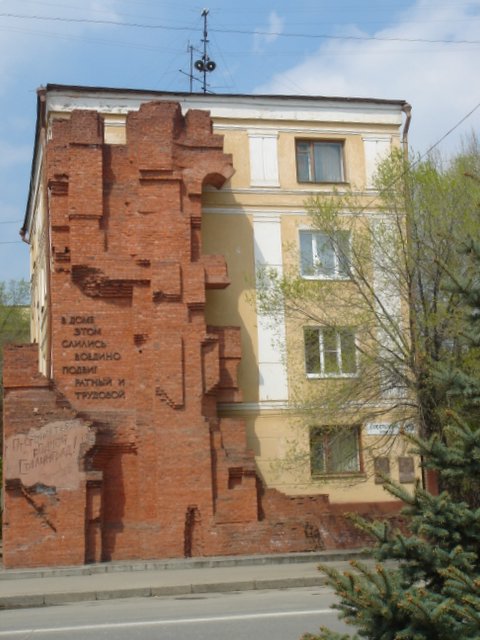
Dom Pavlova todayThe Germans attacked the building several times a day. Each time German infantry or tanks tried to cross the square and to close in on the house, Pavlov's men took them under heavy fire from within the basement, from the windows and from the roof top. Leaving behind a square covered with corpses and steel, the Germans had to retreat again.
Eventually the defenders, as well as the Russian civilians who kept living in the basement all that time, held out during intensive fighting from 23 September until 25 November 1942, when they were relieved by counter-attacking Soviet forces.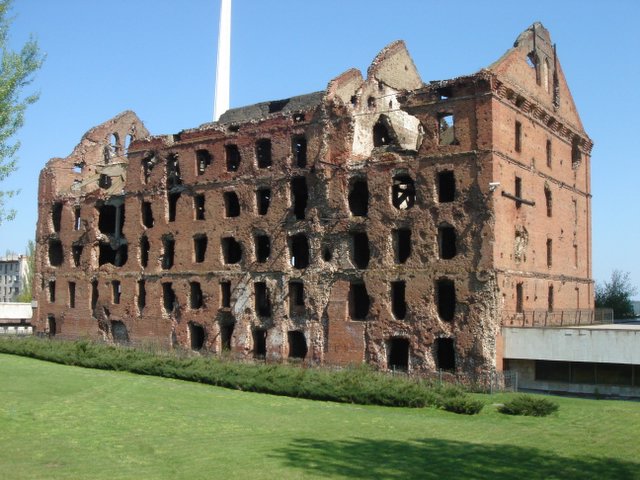
The warehouse facing the apartment building remains preserved today on the grounds of a museum that includes panoramas of the Battle of Stalingrad.
Dear, Central Committee of the Communist Party
I came upon this via two sites and thought I'd post this here. It is the suicide note of Aleksandr Aleksandrovich Fadeev, Soviet author of the The Rout and Young Guard. I haven't read him, but after reading what follows, which was written almost 50 years ago to the day, I feel I should.
To the Central Committee of the Communist Party of the Soviet Union:
It is impossible for me to live any further since the art to which I have given my life has been destroyed by the self-confident, ignorant leadership of the Party and can no longer be corrected. The best cadres of literature--in number far more than the tsarist satraps could even dream of--have been physically exterminated or have died thanks to the criminal connivance of those in power. The best literary people died at an unnaturally young age; all the rest who were, even to the smallest degree, capable of producing true works of value died before reaching 40-50 years of age.
Literature--this holy of holies--was handed over for extermination to bureaucrats and the most backward elements of the people, and from the highest tribunals--such as the Moscow Conference and the XXth Party Congress, came a new slogan: "Onward!" The path by which they intend to correct the situation provokes indignation. They gathered together a group of ignoramuses, with the exception of a few honest people who find themselves in exactly the same situation of persecution and therefore are unable to speak the truth--and their conclusions are deeply anti-Leninist because they arise from bureaucratic habits, accompanied with the threat of the same cudgel.
With what a feeling of freedom and openness my generation entered literature during Lenin's life; what unbounded strength was in our soul, and what beautiful works we created and still might have created!
After Lenin's death they brought us down to the level of children; they destroyed us; they threatened us ideologically and called this "the Party spirit". And now, when everything might be corrected, primitivism and ignorance--along with a disgraceful share of self-assurance--manifest themselves in those very ones who are supposed to correct everything. Literature has been placed under the control of untalented, petty, rancorous people. Those few individuals who have retained the holy fire in their souls find themselves in the position of pariahs and--because of their age--will soon perish. And there is no longer any stimulus in the soul to create...
Born for great creative work in the name of Communism, connected with the Party for almost sixty years, with the workers and peasants, endowed by God with an unusual talent, I was filled with the most lofty thoughts and feelings, which can only be given birth by the life of the people, united with the excellent ideas of Communism.
But I was turned into a horse pulling a broken-down cart ...
To read more, go here.
Utah Rising Part Three
Had lunch with Utah Rising today, whose story begins here and then continues directly beneath this post. He met on Sunday with the woman who wanted him to send her money Western Union, who never thanked him for his gift, and who on the day of his arrival, went to visit her grandparents. The verdict. She’s not a scammer. "She's a player," he told me. "But she's not a scammer." A paralegal by profession, she never lied, he said. She danced around the truth at times, but never lied. In the end, he liked her quite a bit, but he'd already called it off with her, and when they did meet, her looks convinced him not to reconsider.
"She's a Ferrari," he said. "I'm a Toyota truck."
Utah Rising, I realized, was like the majority of the men I'd met -- pretty realistic, not here looking to do what so many figure these men to be doing, getting someone out of their league. In many ways, however, any woman he meets is out of his league. As he told me before, he wanted to marry and he believes a marriage is only strengthened, truly bonding husband to wife, when there is a child involved. Women his age, late forties, are done having children, he told me. "And an American woman under thirty, she doesn't want anything to do with me. She wants Donald Trump."
Another thing he said made me reconsider some preconceived notions. It's often said that the men using these marriage agencies want a young wife so that they can mold them, so that they can groom them to their liking. I sensed there was a part of that in Utah Rising, though he seemed just as willing to do for his future wife what he wanted her to do for him (an example: he expected her to attend his church once a month and allow his children to be raised in that religion; to put up appearances, he'd been willing to attend her church once a month as well). But this is what really struck me. He wants a young wife, he said, because she's adaptable. Not just to him, but to the transition of moving to the states. It's like with a foreign language, he said. After thirty, your brain calcifies. You can learn a foreign language, but it's more difficult. He expect no fewer difficulties in moving from one culture to another. So he was looking for a younger woman, 22, 23, maybe 26, just as much as he was looking for a higher probability of success. Put that way, the lecherous notion -- I want a young wife -- doesn't sound so deplorable.
Overall, I've found Utah Rising quite intelligent. He holds a number of unconventional ideas on diet and science, and he's not unwilling to look at his own position (on religion, for example) from another point of view.
Currently, he's having difficulties that are unavoidable to his situation. Whom does he trust? The translator? The woman? The agency? With differences in culture, he's not sure what to believe. He's met a new woman, through the same agency with the woman described above, but when he wants to spend a quiet evening with her -- away from the paid-for services, away from the costly interpreter -- the agency says she's not available. Does he believe them after he's cut off the paid-for services with the first girl? Does he believe her when she says she's got to study? It is time for finals, I told him. And what about the interpreter? Isn't he an employee for the agency? I introduced him to one of my former students this afternoon. We'll see if her translating eases his mind any. I'll post more on him later.


Subscribe to:
Posts (Atom)
