A final report from Volgograd:
Dom Pavlova "was a four-story building in the city centre of Stalingrad, built parallel to the embankment of the river Volga and overseeing a large square, the '9th of January Square'. The house was attacked by the German invaders in September 1942. A platoon of the 13th Guards Division was ordered to seize and defend it. The platoon was commanded by Yakov Pavlov, a junior commander replacing his wounded superior. They were successful, although only four men survived the combat. Together they went on defending the building on their own." (from NationMaster.com)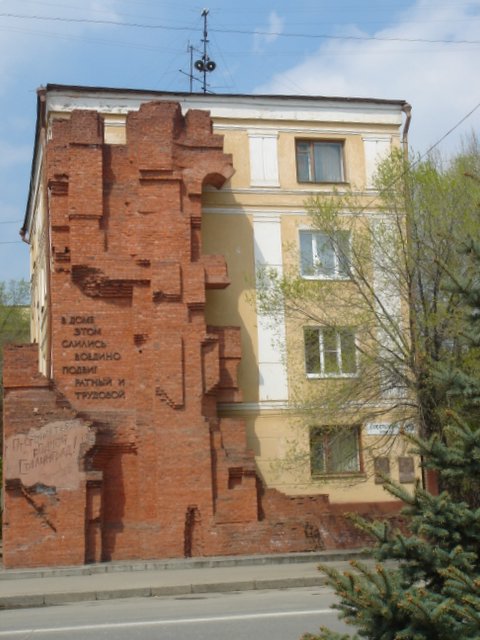
Dom Pavlova todayThe Germans attacked the building several times a day. Each time German infantry or tanks tried to cross the square and to close in on the house, Pavlov's men took them under heavy fire from within the basement, from the windows and from the roof top. Leaving behind a square covered with corpses and steel, the Germans had to retreat again.
Eventually the defenders, as well as the Russian civilians who kept living in the basement all that time, held out during intensive fighting from 23 September until 25 November 1942, when they were relieved by counter-attacking Soviet forces.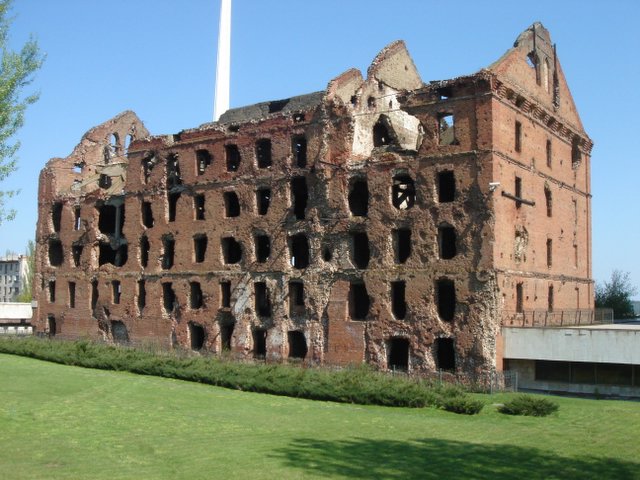
The warehouse facing the apartment building remains preserved today on the grounds of a museum that includes panoramas of the Battle of Stalingrad.
Wednesday, May 17, 2006
Dom Pavlova


Dear, Central Committee of the Communist Party
I came upon this via two sites and thought I'd post this here. It is the suicide note of Aleksandr Aleksandrovich Fadeev, Soviet author of the The Rout and Young Guard. I haven't read him, but after reading what follows, which was written almost 50 years ago to the day, I feel I should.
To the Central Committee of the Communist Party of the Soviet Union:
It is impossible for me to live any further since the art to which I have given my life has been destroyed by the self-confident, ignorant leadership of the Party and can no longer be corrected. The best cadres of literature--in number far more than the tsarist satraps could even dream of--have been physically exterminated or have died thanks to the criminal connivance of those in power. The best literary people died at an unnaturally young age; all the rest who were, even to the smallest degree, capable of producing true works of value died before reaching 40-50 years of age.
Literature--this holy of holies--was handed over for extermination to bureaucrats and the most backward elements of the people, and from the highest tribunals--such as the Moscow Conference and the XXth Party Congress, came a new slogan: "Onward!" The path by which they intend to correct the situation provokes indignation. They gathered together a group of ignoramuses, with the exception of a few honest people who find themselves in exactly the same situation of persecution and therefore are unable to speak the truth--and their conclusions are deeply anti-Leninist because they arise from bureaucratic habits, accompanied with the threat of the same cudgel.
With what a feeling of freedom and openness my generation entered literature during Lenin's life; what unbounded strength was in our soul, and what beautiful works we created and still might have created!
After Lenin's death they brought us down to the level of children; they destroyed us; they threatened us ideologically and called this "the Party spirit". And now, when everything might be corrected, primitivism and ignorance--along with a disgraceful share of self-assurance--manifest themselves in those very ones who are supposed to correct everything. Literature has been placed under the control of untalented, petty, rancorous people. Those few individuals who have retained the holy fire in their souls find themselves in the position of pariahs and--because of their age--will soon perish. And there is no longer any stimulus in the soul to create...
Born for great creative work in the name of Communism, connected with the Party for almost sixty years, with the workers and peasants, endowed by God with an unusual talent, I was filled with the most lofty thoughts and feelings, which can only be given birth by the life of the people, united with the excellent ideas of Communism.
But I was turned into a horse pulling a broken-down cart ...
To read more, go here.
Utah Rising Part Three
Had lunch with Utah Rising today, whose story begins here and then continues directly beneath this post. He met on Sunday with the woman who wanted him to send her money Western Union, who never thanked him for his gift, and who on the day of his arrival, went to visit her grandparents. The verdict. She’s not a scammer. "She's a player," he told me. "But she's not a scammer." A paralegal by profession, she never lied, he said. She danced around the truth at times, but never lied. In the end, he liked her quite a bit, but he'd already called it off with her, and when they did meet, her looks convinced him not to reconsider.
"She's a Ferrari," he said. "I'm a Toyota truck."
Utah Rising, I realized, was like the majority of the men I'd met -- pretty realistic, not here looking to do what so many figure these men to be doing, getting someone out of their league. In many ways, however, any woman he meets is out of his league. As he told me before, he wanted to marry and he believes a marriage is only strengthened, truly bonding husband to wife, when there is a child involved. Women his age, late forties, are done having children, he told me. "And an American woman under thirty, she doesn't want anything to do with me. She wants Donald Trump."
Another thing he said made me reconsider some preconceived notions. It's often said that the men using these marriage agencies want a young wife so that they can mold them, so that they can groom them to their liking. I sensed there was a part of that in Utah Rising, though he seemed just as willing to do for his future wife what he wanted her to do for him (an example: he expected her to attend his church once a month and allow his children to be raised in that religion; to put up appearances, he'd been willing to attend her church once a month as well). But this is what really struck me. He wants a young wife, he said, because she's adaptable. Not just to him, but to the transition of moving to the states. It's like with a foreign language, he said. After thirty, your brain calcifies. You can learn a foreign language, but it's more difficult. He expect no fewer difficulties in moving from one culture to another. So he was looking for a younger woman, 22, 23, maybe 26, just as much as he was looking for a higher probability of success. Put that way, the lecherous notion -- I want a young wife -- doesn't sound so deplorable.
Overall, I've found Utah Rising quite intelligent. He holds a number of unconventional ideas on diet and science, and he's not unwilling to look at his own position (on religion, for example) from another point of view.
Currently, he's having difficulties that are unavoidable to his situation. Whom does he trust? The translator? The woman? The agency? With differences in culture, he's not sure what to believe. He's met a new woman, through the same agency with the woman described above, but when he wants to spend a quiet evening with her -- away from the paid-for services, away from the costly interpreter -- the agency says she's not available. Does he believe them after he's cut off the paid-for services with the first girl? Does he believe her when she says she's got to study? It is time for finals, I told him. And what about the interpreter? Isn't he an employee for the agency? I introduced him to one of my former students this afternoon. We'll see if her translating eases his mind any. I'll post more on him later.
Monday, May 15, 2006
Utah Rising - The Western Union Edition
He was disappointed his first morning in town. After driving through the night from Kyiv, Utah Rising had expected to meet the young woman he’d been communicating with through email for several weeks. Let’s call her Natalya. But Natalya failed to call the apartment he’d rented, and her mobile phone was busy all that first day. By six o’clock, when Utah Rising finally got her on the phone, he learned, through the interpreter who spoke with her, that she wouldn’t be able to make it today, that she was leaving in an hour to visit her grandparents, but could she please call when she got back on Sunday?
Mr. Utah told his interpreter to hang up – “Just hang up,” he said. Because Natalya had known about his trip for weeks, and if she was treating him way this way now, how would it be during their marriage?
He should’ve known better, he told me the following evening. He’d sent her a dress cowboy hat in the run-up to this, his first visit to Ukraine, and she’d never even said thank you. And then too there was the incident with Western Union.
Utah Rising had been paying $6 to send this young woman an email, then another $6 to get each translated reply. All of this was done through the marriage agency that had facilitated their introduction, Anastasia Web.
Utah Rising told Natalya it’d be a lot cheaper to exchange email addresses and do this without a third party, but she resisted, saying the marriage agency provided her with a place to use the internet free of charge. If money was a factor (and in Kharkov fees run between sixty cents and $1.40 per hour at an internet café), Utah Rising said he’d be happy to send her some money. She explained Western Union would be best.
“If she was a scammer,” he said, “she was really smart, because she never asked for money.”
Whatever the case, she was smart with more than just him, as Utah Rising learned when he called up Western Union to make a $100 transfer.
“I really shouldn’t be doing this,” the operator told him, “but do you know this woman?”
The man at the call center explained that in the last two weeks, she’d received transfers from six men, each time for between $100 and $400. It was all right there on the computer screen, paid out to the same location in Ukraine, where the average monthly salary is perhaps $150 or $200 per month.
When Utah Rising reported this woman to Anastasia web (a company with offices in Maine and partner agencies throughout the Former Soviet Union) he thought the company would be quick to act. They had an "anti-scammer" policy, after all. But one day after reporting the woman's behavior, he was informed that she would remain on the website and that they didn't believe her to be a scammer.
"Did you investigate her?" he asked.
They said they didn't believe that necessary. And how did they reach that conclusion? Maybe it was the best intelligence available at the time.
"Tell me honestly," Utah Rising asked me the following evening, over dinner at a cafe near Svobody Square. "What do you think of what I'm doing? Good, bad, indifferent, I can handle it. Just tell me what you think. What are my chances?"
I should've reminded him it was a Friday night and he was having dinner with a journalist.
Dead Souls
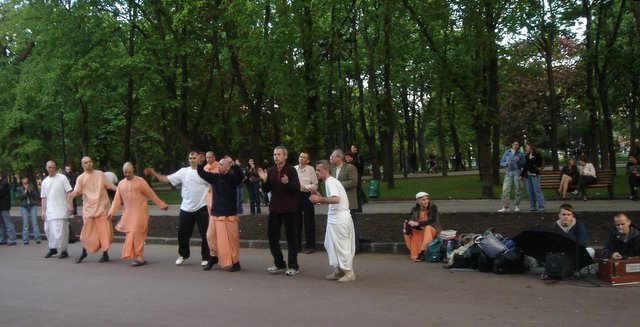
Almost as soon as The Wall fell, they came looking for dead souls. Mormons, Evangelical Christians, and the Hari Krishna pictured here. The former Soviet Union, officially atheist until 1988, must still be considered a great growth market by the world's snake-handlers and mantra-chanters, because there was a crowd a hundred strong in Schevchenko Park watching this group on Saturday night.
The guy at the far right of picture chanted and played his squeeze box, while the women were segregated and dancing off to his other side, this group dressed in saris and comfortable shoes. I kept looking at these shoes -- plastic sandals and Birkenstock-like things, all sadly blurry in my other photo -- and wondering how they expected to win over the hearts and minds of Ukrainian women looking like this. This is the country of the four-inch heel, the stiletto in the snow-storm. If you are a man with a foot fetish, this is both the country for you and the country you should avoid at all costs, as you might find yourself unable to be a productive citizen of the world surrounded by so many knee-high boots and calves wrapped in elaborate ribbons.
Friday, May 12, 2006
Utah Rising

I met an American at the front counter of the Internet Club tonight. He was pointing to an address on a piece of paper and speaking to the young woman behind the counter in a calm, controlled voice that somehow didn’t mask his frustration. “Can you tell me where Freedom Square is?” he asked. “I'm looking for Freedom Square,” he said.
And with that, I nominated him my Mail-Order Bride Seeker of the Week, for if every American man looking for love in ten days or less isn’t actually in search of freedom – freedom from courtship, freedom from worry, freedom from rejection – what does he want?
I stuffed my print-out into my shoulder bag and turned to offer my counsel. “Svobody Square?” I said. “That’s right outside the door.”
He turned to me like an orphan, his eyes full of both awe – he speaks English! – and the sort of hope that says, "Adopt me!" He was looking for an office in this building, a marriage agency it seems. I told him to come with me.
I had gathered from the Russian spoken by the girl behind the counter that the office was just next door, so in we went and quickly found ourselves at the base of the stairs -- the trailhead, I figured. We stood there a moment exchanging who are you's and why are you here's, and though his purpose was obvious, mine was more muddled. I told him I’d come for the glory of the written word – “a creative writing fellowship,” I said.
He presumed this meant intensive study at the local academy. I told him otherwise, while allowing that I had taught at the nearby university the previous semester. So they must advise you on your writing, he said. But again, I proved uncooperative. “Actually, the grant affords me complete independence.”
He was stumped. He couldn’t fathom why it was required that I be here. So I at last acknowledged my subject matter. “I’m writing about marriages.”
And thus dawn rose with her five rosy fingers, and the man from Utah invited me to follow him upstairs. I thought you'd never ask.
I stopped on one, only to have Mr. Utah remind me that Ukrainians didn’t count the ground floor – two would be on three, he said. That was right, I remembered. So he obviously wasn’t some rube just pushed off the radish truck. He’d lived in Italy before, it turns out, spoke a little Polish. And so yes, up to three we went, where we found a frosted door on one side that was embellished with no identifying features, then the entrance to a local TV studio on the other. Nothing else but a man smoking outside the entrance to the TV station. I told this man the name of the agency we were looking for and then its number.
“253?” he said. “You want the sixth floor.”
My friend from Utah didn’t believe him, but I insisted we give it a try, if only for the exercise. So we went up, and as we did he told me he’d just arrived in Kharkov, having landed in Kyiv on Wednesday and been driven from Borispol International to this city that same night by a man hired out by another area marriage agency.
But he wasn't just here chasing after a hot, young body. This divorced 47-year-old, a five-time father formerly of the police and military, had used Chinese and western astrology to look for likely matches.
"I don't believe in all that stuff," he was quick to say, and I nodded along, "but I think there's something to the month you were born in."
By the time we got to six, he was looking around for evidence of this agency, his confidence nearly gone. "They really should have a sign outside in English." But I wouldn't let his flagging spirits dampen my efforts. I led him into a darkened hallway like a modern-day Livingstone in search of the source of the Nile.
“Two-sixty seven,” I read from the first door. “It must be here somewhere.”
“Well I’ll be,” he answered.
And then there it was, CASUAL ENCOUNTERS -- or no, CONFIDENTIAL CONNECTIONS -- the words now clear on the sign as we approached it and the door at the far end of the hall over which it was hung.
The office was the size of a studio apartment’s living room. Six computers were assembled there, three facing each side. A young blonde woman sat working at the far one. My friend from Utah introduced himself as a client.
“I’d like you to arrange a meeting with Tanya,” he said. “From Sumy.”
Confidential Connections arranged meetings with girls in Kharkov, and they offered interpretive services, $50 for a half-hour on the phone. But no, the office manager said, they didn’t arrange meetings with girls from Sumy. “You would have to go there,” she said.
Utah Rising wasn’t about to go to Sumy. He asked for them to arrange to have Tanya call him, and if possible, meet him here on Sunday. “I’ll reimburse her travel expenses,” he said, after saying he thought Sunday best, in case she has to work.
The office manager said she would do this and asked for Tanya’s ID number. Mr. Utah opened a blue folder he'd been carrying and produced and a computer print-out of Tanya's profile, the data arranged to one side of a smiling photo. Age: 24. Height: 5’5”. Weight: 110 pounds. Religion: Christian.
Before leaving, Utah Rising asked for the office manager’s name and telephone number. “Elena,” she said, repeating this – “Yelena” – when she saw his confusion, and then accepting the offered pen and writing it down.To remove the black bar from the woman's face, you must become a member of the Confidential Connections website. This is not an endorsement. Utah Rising will be continued Sunday or Monday. To see more ladies with black bars across their eyes, visit this photo gallery for action shots of them in the park, at the bar, on Freedom Square, etcetera.
Thursday, May 11, 2006
Mamayev Kurgan, Volgograd
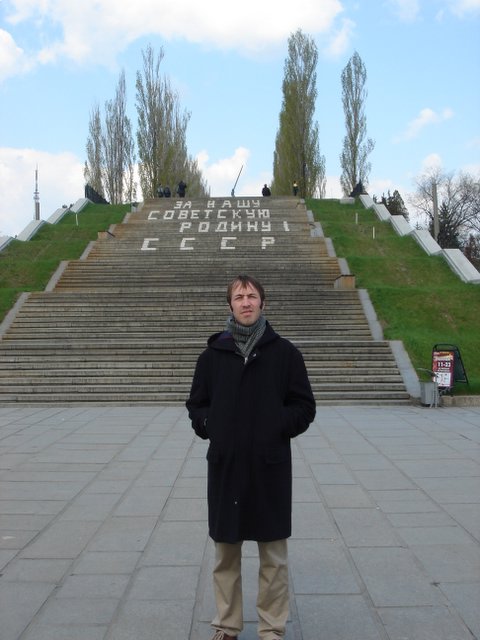
Above you'll see the entrance to the Mamayev Kurgan, the giant statue in Volgograd commemorating the sacrifices made during the Battle of Stalingrad. On the steps you'll see the words, "For our Soviet Homeland, USSR." The paint is a fresh coat, and the look on my face decidedly disturbed.
Once you get to the top of the steps, you see the statue in the distance.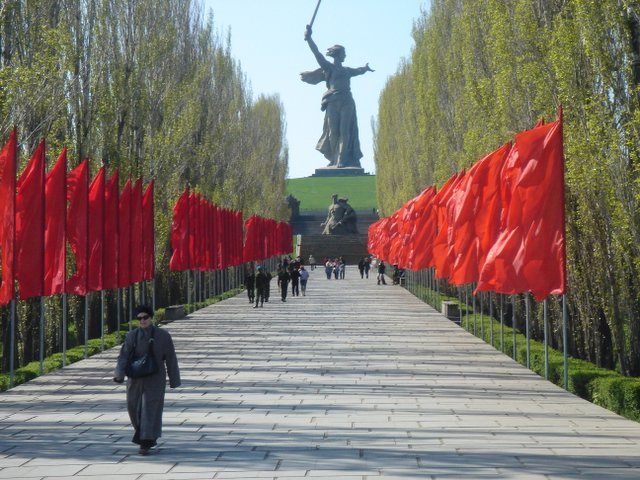
The next thing you reach is this massive soldier, who rises up to block the view of the statue, which represents Mother Russia. Hence, he's rising up in her defense, keeping you from her. In the second photo, you can see he's just a tiny figure at the end of the column of red flags.
Pass the above and you enter a corridor that depicts the defense of Stalingrad and then the move to drive the Nazis out. The walls -- one static, one active -- are covered with Russian sayings made famous during the war. Here, some rather ghostly music begins to play. 
After that, you move out onto a reflecting pool like at the Washington Mall.
Then, inside a cavern of sorts and up some stairs, an eternal flame, with the names of fallen soldiers on the walls around it (only one percent of those who died at Stalingrad; many weren't known, owing to a lack of the equivalent of a "dog tag"). In the below photo, you'll see the hourly changing of the honor guard.
And then you reemerge onto a hill that leads up to the statue, passing, along the way, a memorial to Vasily Zaitsev, the sniper made famous by the movie Enemy at the Gates.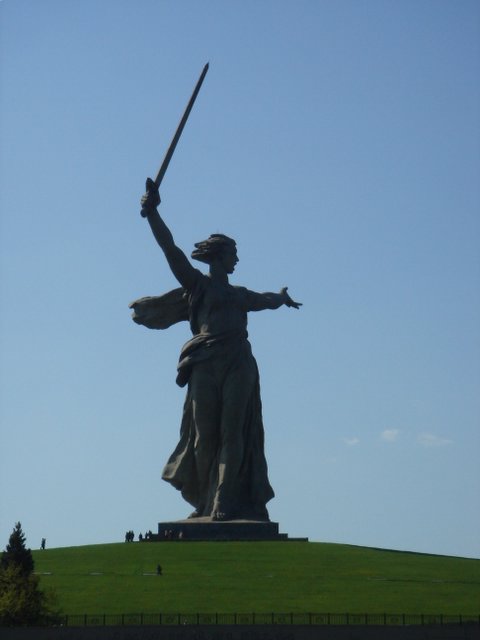
Wednesday, May 10, 2006
Brazil, the next Ukraine
Ran around town with some men from the British Commonwealth the other night. Very well traveled and just as well-healed. They were uniformly unimpressed with Ukraine. "If this was Brazil," the one said, "I would've been laid twice by now and been coming back for dessert." We were in a night-club when he said this, a very nice one, ultra-modern, but there wasn't much of a crowd for a Saturday night. Those who were there were young and attractive and monied, but apparently the last of these details (there was a $10 cover for men, $6 for ladies -- in a country with an average monthly salary of $150) kept the women from falling into the laps of these men.
Prospects for these world travelers (one of whom also professed to have come to Ukraine to take in the architecture) were better in Cuba, where the women, the lover of architecture told me, didn't even have the money to afford the type of wax job made famous by the women in Brazil. He thought it possible he might have two children there, just possible. The guy was late-thirties and the father of four, well-groomed and well-dressed, tan and fit, the type of man who looks comfortable with a shaved chest.
The other was a sort of Kevin Costner in his latter years, complete with capped teeth. "Brazilian girls just love six," the Costner told me. "Six?" "They learn to have six before they even learn to walk." It was the accent. Six, sex. From somewhere Down Under. He said these marriage agencies were popping up all over, here, South America, the Far East. We spoke for a while about the wonders of the Internet.
Both men were set to return to Brazil after their three-day stop-over in Eastern Europe. "The girls in north Brazil are black," the lover of architecture told me, "in the south they're white, and in the middle they're chocolate." He pushed his nose in when telling me what he didn't like, then spoke of skin color and European features when he talked about what he liked. He'd been going to the mid-lands of Brazil for ten years, in which he'd once come across the most beautiful woman he'd ever seen, though she'd spoken no English and he and Costner were off the beaten path at the time, in a village not accustomed to tourists. Despite his talk of many conquests, including a threesome in Thailand that included one partner filing her nails, he still remembered this lost chance, this failed encounter. "She was chocolate," he said. "She was perfect."
As for his last day in Ukraine, he planned to start it by waking up and practicing a little Portuguese.


