Tomorrow, I go to the English-Teaching Resource Center at Kyiv-Mohyla Academy to give a lecture on contemporary American short fiction and to speak about how to run a writing workshop. At first, I was asked to run an actual one-day writing workshop, but when I responded by saying, "To run a writing workshop, I'll need some participants to write a story beforehand," plans were downgraded. Now me and the post-graduates from the university (along with perhaps some professors and administrators) will discuss Nathan Englander's Gilgul of Park Avenue (one of the strongest stories in the very strong collection For the Relief of Unbearable Urges) and Adam Haslett's "Notes to My Biographer."
Later in the week, I hope to track down a translator who works with American men visiting the marriage agencies. He's promised me an interview, but has proven hard to pin down ever since. Anonymous? he said. Anonymous, I promised. So: Soon, I hope. Soon.
Beyond that, what else is there? I've set up several interviews for the spring, when the western men will return in force (Winter is not the marrying season, I've learned). Kharkov's Staprius Club should also be opening its door any day now, if it hasn't already, and so I'd like to document that. I was invited to the grand opening party two weekends ago, but then I never got the call to say if it was on Friday or Saturday -- I can only assume it got delayed, or that I'm an easily forgotten guest. I could also be tagging along on a marriage agency tour in Kyiv near the end of December, which should be fun because it's already got one other tag-along scheduled, a film crew taking footage for a reality show. I'd like to be the camera filming the camera. But on this and much else, we'll have to wait and see. It is the Planning Season more than the Marrying Season.
Sunday, December 11, 2005
Not the Marrying Season


Monday, December 05, 2005
Снег!

I awoke on Saturday morning to snow. Pulled open the curtains and there it was, a thick layer of it on the roofs, the sidewalks, piled up on the balcony -- everywhere, even the branches outside my living room window. Was gone by the end of the day, but it's back again today, with some of the in-between stuff now gone to ice and sleet and slush. You'll walk down one street and be perfectly sure-footed, then turn up another and be slipping and sliding and suddenly feeling the muscles on the insides of your thighs. (I pause to address all those people who do not live in California. Some of us do not know what this stuff is that falls upon the ground and stays there, piling up like so much cotton. We gaze at the Heavens in wonder when simple rain falls, but this, this is truly amazing indeed.)
It struck me, while taking short steps across an especially slippery stretch, that this is the foundation of much of Russia's literature. Because how can you look up, how can you raise your chin with confidence and pride, inflate yourself, so to speak, like Gatsby or some frilled courtier in an Austen novel, if you might fall on your ass at the next corner. Keep your eyes to the ground. Walk slowly, with short, deliberate steps. Wear a face like the angry man, the bitter man that Doestoyevsky wrote about, thrust your hands into your black overcoat like Raskolnikov; this is snow, снег, and it will be here for months.
Smokestacks

The Soviet Union conjurs up many images in the western mind: the hammer and the sickle, the yellow star against a flag of red, the more-than-slightly androgynous member of the female shot-put team. But perhaps nothing remains more prominent to this day (when steroids are the American athlete's drug of choice) than the smokestack.
What exactly is a smokestack? Just a tall tower, spitting smoke? Does it serve a purpose, or is it in fact just a symbol of progress and productivity? Like, Look, there in the distance, a smokestack - we must be a prosperous people, we must be doing something. Or: The people are unhappy? Build another smokestack!
I took a picture of this set of smokestacks in Moscow, a week or so back, from the window of my hotel overlooking the Moscow River (Moscow on the Moscow, I suppose). It was a nice hotel complete with a VIP board in the front lobby. There were the Clintons, Al Gore, Putin's wife, a guy from Microsoft, and Some King or President of a large Muslim island nation whose name was Megawatti Something or Something Megawatti. Makes me wonder if he was named after the light-bulb, his father fascinated by this modern device, this light-giver -- and I name him Megawatti -- like a character in my terminally-forgotten novel is named Aspirina. There were also several rock bands noted on the board, all of whom were popular during the Soviet era: the Scorpions were there, as were Queen, or at least one member (Brian May). That's how it was listed on the board. Queen (Brian May). There's something sad in that. As if Brian May showed up all alone.
I'd like the VIP Suite please.
And who are you?
I'm Brian May.
No response.
I'm Queen (with Brian May).
Monday, November 28, 2005
The Story of a Man from Idaho and a Woman from Kherson
ODESSA, UKRAINE -- Before Bill Fields returned to Odessa in November, his sister gave him three gifts. The first, a flat cap like the kind Ben Hogan used to wear while making the turn at Amen Corner, would help him blend in with the Ukrainian population, which he apparently hadn’t done in February, when a mugging in front of the Odessa Opera House had left him lying on the street with a broken femur. The second and third gifts were less ordinary, but then he’d only need them if the first didn’t work and he once again encountered a violent situation.
“One’s a light to blind people with,” he said, “and the other makes this screeching noise.”
When he told me this, with a little dance in his eyes and a lift to the corners of his mouth, he was standing in his rented Odesa flat, a recently refurbished apartment that had walls the colors of the Ukrainian flag, yellow and baby blue. On the window-sill were two hats, one the flat-cap from his sister, the other a more traditional American baseball hat. World’s greatest hunter, it read. Then that last word was scratched out and replaced by another: Grandfather.
Bill Fields was fifty-five, twice married and twice divorced, a middle school teacher from rural Idaho. He had lived a boring life until February 2005, he'd be the first to admit, and I had traveled from Kharkov, fourteen hours by train, to ask him one question. “Why come back?”
He answered with a name: Oksana.
“I thought we were both planning our future life together,” he said.
But not long after his plane touched down at Borispol International, he learned the woman he longed for (imagine an aged Tawny Kitane, say twenty-five years after she writhed atop a car for Whitesnake) had disappeared, along with the future he'd imagined. It was all very confusing.
Since meeting in February, when their affection for one another had been tempered by the dramatics of Bill's mugging and hospital stay, they had remained in contact, communicating at least three times a week, mostly by phone. They had cut down on email, Bill said, because Oksana, though verbally fluent, didn’t write English very well. (“She’s an E4,” he told me, when explaining the Dungeons & Dragons-like system used to rank a woman’s command of the English language. “An E1 means she doesn’t read or write any English whatsoever.”)
Also, her only free access to the internet was in the office of the marriage agency she’d signed up with -- one of the hundreds of affiliates of the Bangor, Maine-based Anastasia web that is located in the Former Soviet Union. And after meeting him, Oksana was trying to stay away from there as much as possible, Bill said.
“When she comes in,” he told me, “they make her answer all the letters from all the men (who’ve contacted her).”
This is one of the ways the agencies make their money. Men using Anastasia web must pay $15 for a woman's email address, then no less than $3.99 more for each message back and forth, more if a message requires translation. The company's partners get a percentage of this.
"She had to write back and say I'm not interested," Bill said. "She's polite, but it's very stressful for her. She'd rather stay away and not answer."
Other agencies are more resourceful. One former translator, also based in Odessa, spoke of women who entered into agreements with agency owners to get a certain amount of each fee her picture generated. Not all of these women were totally averse to meeting a foreign man and possibly getting married, but some were strictly business women -- women who had no interest in even writing their emails themselves. This they left for the agency's translators, with the understanding that, if a man booked a ticket and actually followed her fabricated sweet nothings to Ukraine, she would read all the past missives and be prepared, like an actress on opening night, to smile for the audience.
The translator I spoke with, who asked to remain anonymous and would not identify her past employers, said she had worked for three agencies, all now defunct, and only for those interested in "making a girl's destiny." A fourth agency approached her, but she refused to enter services with it.
"'If you want to work with us,'" she said, when asked to explain what was expected of her at that agency, "'you'll get a lot of money but you'll have to lie and say not sincere things.'"
But Bill was convinced his Oksana wasn't behind such sentiments. Because while their emails had stopped, they had kept in touch by phone -- at least when the lines weren't down and his call, maybe because of the weather or poor maintenance, didn't get cut off halfway through.
All of which is to say, he didn’t think it necessary to receive a solid confirmation from Oksana before flying across the Atlantic. She’d told him, in a letter she signed with her “warmest hugs and a tender kiss,” that though her boss was in "a bad temper," she thought her vacation would be the first of November, and so he’d planned accordingly and written to say he hoped to see her here when he arrived, being sure to give the date and the time. Only in the final days before his departure, without any word from her since that letter on September 11, did he worry enough to call her agency.
“They said she came in in a hurry,” he said, “and had to go on an urgent business trip (to Kyiv).”
When they met, she had worked as a secretary to a dean of a nearby university. But since then, she had been let go – she hadn’t told him why, but he suspected it was her age and declining looks. Perhaps she had been replaced at the front desk by a younger woman with a firmer body. "That's how it still is over there," he said.
So now she was working as a seamstress, a seamstress who worked on wedding dresses of all things. “They make this part,” he explained, indicating the torso of an invisible dress, “and someone else makes this part,” he said, dropping his hands to the waist, “and I guess somebody else puts it all together.”
If anyone could put his mystery together (because what kind of seamstress goes on a business trip?) Bill thought it would be Oksana’s 22-year-old son, Alexei. But when he called him, Alexei’s broken English only offered Bill so much. “Mama’s not coming," he said. And when Bill called again – and he did, four or five times a day, “just in case" – he only learned she’d be back in December.
“She may have a low-end apartment without a phone,” he said.
That could be why he couldn’t reach her. Or maybe not. Maybe it was all a scam, nothing more than an equation involving his hope and her cunning, a certain percent of business and a certain percent of love.
When I interviewed Bill, he had only one day left in Odessa, and though he insisted he was a one-woman man, he didn’t plan to spend it alone. After arriving and finding Oksana gone, he’d picked up his rented cell phone and tried to call the agency that had rented it and the apartment to him. But after scrolling down through the names already programmed into the phone, he went one too far, getting not Odessa Flats but Olya. A young man answered. There was the expected confusion, a polite exchange of names, and then a dial-tone.
But Bill looked again at his phone, last used by another agency client, and thought something strange. He’d brought with him five email addresses, the information he’d need to contact five women in case Oksana didn’t show. One of them was an Olya.
So he called back, and again got the young man. “I says, ‘George, is your mother on the dating side?' He said, 'Yeah.' And I said, 'Well what does she look like?'”
She was in her early forties, a few inches taller than five foot, not quite 130 pounds. It was all kind of familiar, he said, and so they arranged, George, and Olya and Bill, to meet at the Irish Pub in town.
“I didn’t have to go through the agency or anything,” Bill beamed, before acknowledging that introductions arranged through the agency-supplied email addresses cost $50 -- more, by $7 an hour, if you then wanted to leave the office with the woman and a translator.
As it turned out, Olya was indeed one of the five women Bill had intended to look up, so he ditched his plans to see the other four and spent his days with the one.
“She’s cooked me two meals,” he said, “two huge meals that I’ve been eating on since I’ve been here just about. She says I’m like a little boy, and that she’s got to take care of me.”
Now he doesn’t know quite what to do. He’s enjoyed his time with Olya, but she’s an E1, meaning their dates have been a troika, him and her and the son. When I left him, he said he was going to spend his last day in Odessa buying Olya a set of CDs to teach her English. But at the same, he was looking off to December and hoping to hear back from Oksana.
“I will come back to Ukraine,” he said, “and I will probably marry a Ukrainian woman. Whether I’ve found the right one or not yet, I don’t know.”Before ending above, Bill's story started hereand continued there. All names in this series have been changed to respect the privacy of those involved.
The Blood Road
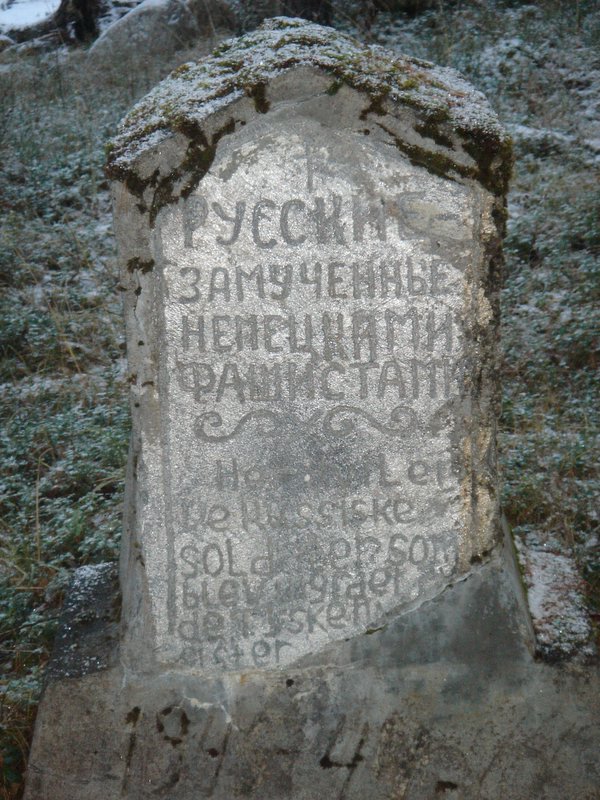 When I was in Norway, I visited the Blood Road Museum (in German and English) in Rognan, the town where my mother was born and raised. The museum commemorates those many thousands of prisoners of war, mainly Red Army soldiers, who died working on the railroad Hitler hoped to build through northern Norway. The railroad never materialized (it fell just short of Rognan, well short of Kirkenes, the launching point into Murmansk) but the Germans kept their captives working even when they realized their initial plans, to complete the project in three years, were overly ambitious.
One of the worst camps in Norway was in Botn, a beautiful fjordal inlet just a couple miles from my mother's cabin. After the war, it was deemed to be an execution camp because so many prisoners there died, some from mass executions (this during the first year of operation, when the SS ran the camp) and then many later, when the Wehrmacht took over, from drinking water that was allowed to mix with raw sewage (this is what gave the camp its legal definition as an "execution camp," like Dachau or Auschwitz, because securing clean drinking water should not be a problem in Norway, where the streams run clean).
The picture above is of a headstone from a former Russian graveyard located at the edge of my mother's cabin's property line. The graveyard and camp were just up the road from her, though the former was moved, as were the graves of all but a few Red Army soldiers, when the Cold War came around (the graves were moved to a cold Norwegian island where Soviet visitors could be more easily contained and surveyed).
Anyways, all of this is a sort of quick look at the subject; I'm working on an essay that goes into it in greater depth. Because here's the thing, and I hope she doesn't mind my saying so (if so, I'll take this down): My girlfriend's great-great grandfather was in one of these camps, but we don't know which one. I probably want to find out more than her; if I don't know something, I want to know it. Call it a form of autism, or mental retardation, or just plain curiosity -- I don't know. Anyways, what I do know is this: that one-third of all Soviet soldiers were held in Saltdal, the county where my mother was born and raised; beyond that it's like grabbing at the fog. In the final days of the war, the Germans did a good job of destroying their scrupulously-kept records, while after the Cold War, Moscow was mum on who was where or when. So: I'd like to write about all this, and it seems logical that my search be part of the essay.
Anyone know how I can find more information? How I might match a name to a camp?
Sunday, November 27, 2005
New Photos
I posted some new photos in the Flickr sidebar (after finally discovering a way to get them through my dial-up connection). The bottom three are a series of Lenins. You know me and my Lenins. Can't get enough. But these are more layered than the usual statuary shots, as they're set against a carnival that has been set up on Svobody Square for far longer than I care to remember -- it is Europe's biggest square, I'm now convinced, and I'd like to see the clean spatial scope of it, an unbroken horizon of bricks and agoraphobia, some damn pigeons scattering you know? But instead it's bumper cars and don't-puke-on-me rides. But apparently you shouldn't get me started.
The other shots are from Norway, where I recently went to see to a family affair. The second shot was taken from inside my mother's boathouse, just down from my mother's cabin; the next is one of several photos I'll be posting from my visit to the Blood Road Museum, which is located in Rognan, where my mother was born and raised. The museum is dedicated to the Russian prisoners who were used as slave laborers by the Nazis. In four years, Hitler wanted to construct a railroad through North Norway and on up to Kirkennes, so he might be better prepared to attack the Soviet Union from the North, near Murmansk. The railroad didn't materialize (it reached just shy of my mother's town, above the Arctic Circle) but thousands of prisoners still lost their lives to the effort.
Wednesday, November 23, 2005
An Honest Woman, a Hospitalized Man: The Story of a Man from Idaho and a Woman from Kherson
Bill Fields’ second wife spent $30,000 on Beanie Babies. But it was what she bought for only a couple hundred dollars – a urinal – that all but ended their marriage. “She wanted me to hang it in the garage," he said, "so I didn’t track dirt into the house when I worked in the yard. I thought, 'Hey, I’m not a dog living here.'”
Not long after this, the lead-in to Bill's second divorce, one of the middle school teacher's friends, himself married to a Muscovite going on ten years, handed him a catalogue advertising "mail-order brides" from the Former Soviet Union. "I took it just kind of like a joke," Bill said. "But finally I decided to join."
The trip he took to Ukraine in early 2005 won’t be found in any marriage agency’s promotional literature. That he felt a strong connection between him and Oksana, the first woman he dated, is front-page copy, but his mugging outside the Odessa Opera House, a grand baroque building designed by Viennese architects in the late 19th century, that's not something shadow-boxed beside a smiling wedding photo on a testimonials page.
But despite all the trouble he experienced, the bad didn't erase the good. When Bill found himself in bed with broken femur, looking at six weeks of hospitalization at $450 a day if his insurance didn't come through and get him out of there, he “found out what kind of woman" his new girlfriend was.
His second wife, he said, would’ve “come in and said, ‘You’re breathing, I’m going shopping.’” But Oksana stayed with him the whole time, bargaining with the hospital, raising her voice when needed, getting their prices down from outrageous to maybe just bad. He was already infatuated, now he was impressed.
“She’s not a drop-dead ‘ten,’” he said when first describing her, “but she’s pretty and she’s honest.”
That honesty was such that Bill trusted her with all the money he’d brought over, and the money his family wired from the United States to cover his initial hospital bills. In all, $3,500 passed through her hands before his insurers, Blue Cross and Blue Shield, agreed to send in a Lear Jet to transport Bill to their nearest participating hospital, in Wellington, England.
“It was one of the saddest moments in my life,” he said. “They wouldn’t let her (Oksana) ride in the ambulance with me to the plane. They physically had to pull her away, she was holding on so tight.”
It continued just like a familiar movie. As Bill was driven away from the last check-point, Oksana approached from behind, a fence swinging shut between her and the ambulance.
For Bill, who now has a plate in his right side that’s held in place by two pins and four screws, this was just more evidence that there was “none of this you-have-to-chase-them-down” with Ukrainian women. “She’s with me, and I’m with her,” he said.
It was better than what he remembered with his second wife, that’s for sure, who was a bit of a “women’s libber,” as naturally aggressive as Oksana was polite. “The part I couldn’t accept,” he said, “was her always saying I couldn’t do right.”
So yes, everything about Oksana was a wonder and a revelation – even how she’d traipse around his apartment in barely anything at all, not flaunting her body, he said, but not showing it any shame either.
While Bill recovered from his injuries near his family in rural North Carolina, the phone calls and emails continued to Ukraine, so much so that he even checked with the local community college to see if it might be able to arrange for Oksana’s 18-year-old son to come to the country on a student visa, if and when he and her mother got married.
As for why she didn’t meet him in Odessa when he came back for his second visit in November 2005, that he can’t explain. But that’s not to say he didn’t enjoy himself again, in however a round-a-bout way. He’d rented a cell-phone, after all, and in Ukraine, perhaps moreso than in any other country in the world, love or something like it can start with something as simple as a misdialed call.Bill’s story continues here.
Saturday, November 19, 2005
News in Brief
I weighed myself in Norway. Have lost twelve pounds since leaving California ten weeks ago.
Read More......


