Thursday, August 03, 2006

Heading South (and west)

While watching BBC World a few weeks back, I caught an interview with Charlotte Rampling that touched on the dynamics of the "mail-order bride" industry, however obliquely. Rampling stars in the French movie Vers la Sud (Heading South), which tells the story of three women who visit Haiti and use their first-world money to acquire third-world dates. In other words, they're sex tourists. The women wouldn't explicitly pay for sex, but they'd go to bars and pay for their dates' drinks and dinners, they'd buy gifts, and they'd maybe leave some money hanging around on the counter. When asked about this, Rampling called this relationship "a coming together of needs ... quite pleasant for both (parties) often." Tom Brook, her balding and almost eagerly British interviewer, just nodded along when he heard this, not challenging it with a word. But while I listened, I thought, "My god, a man couldn't dare say such a thing about going to Ukraine." Maybe it's because Rampling has such a lovely English accent and everything from her sounds so dignified. Be a dear, would you, and find me a hooker for the evening. That's a good man, James.
 
Anyways, I found my notes for the above while packing up my suitcase and getting ready to leave for Kharkov -- and then Kiev -- and then Munich -- and then Washington D.C. -- and then San Francisco. The first leg of my journey, a two-hour ride from Belgorod, begins in the morning. Then I spend the day in Kharkov (long enough to get all the pictures I forgot to take) and continue down to Kiev on the express train the following morning. My journey home, by air, begins the next day. So, come Monday, I'll be experiencing the culture shock of my return to the United States. Look for a few reports on it here, along with some more posts commenting on the last of my research -- there's still much I have to say (I've had so little computer time). 

Read More......

Monday, July 10, 2006

Countdown

I am a short-timer in Kharkov, leaving for Belgorod on Friday. I may not return to Ukraine again until I leave on August Sixth -- at least, I'll do that if I am able to file some immigration paperwork in Moscow. The papers deal with my fiancee getting her green card and following me over to the states, and though you're allowed to file this paperwork with a US Embassy if you live abroad, I'm in a bit of a catch-22 situation. I have been living in Ukraine, so I thought to file in Kiev. But my Fiancee lives in Russia, so the people in Kiev, after accepting my appointment request on one day, said on a second day that I really should go to Moscow, because that's where the final interview, involving only my wife, will take place. "She's a Russian," they said. "We can only process Ukrainians." The problem is, Moscow only accepts paperwork from Americans living in Russia, and I ... well, no one is set-up to take us, a bi-national, living-overseas, border-town relationship kind of couple. As a result, I'll go to Moscow after my marriage, on the 21st of July, and see if the Moscow Department of Homeland Security will take me -- I will be a resident of Russia at that point, and certainly not of the US, having not set foot in the states in a year. But if they refuse me, it's back to Kiev on the first of August. A quick interview is conducted when I present my paper-work and I'm given an opportunity to authenticate my relationship with my wife. Maybe three or five out of every ten marriages between a US national and a foreigner are cases of immigration fraud, I'm told, so if on first glance your relationship is viewed as legitimate, you want the person receiving your paperwork to be around to conduct the second interview with your wife. If I drop my paperwork at Kiev, the second interview will be in Moscow -- with a person who hasn't seen my wife at the first interview. Confused yet? And there may be paper-work delays routing everything from one place to the other. But it will be a lot better than doing all this in the states, as then you just throw your paperwork into the slush pile, located for Californians in Laguan Niguel, and hope for the better, everything sight unseen. If you do it that way, it can take up to a year or a year and a half for your wife to follow you over to the states -- so long as you cross all t's correctly and dot the necessary number of i's. If you do it at an embassy, the process might only take three months. If you do it at two embassies ... I don't know. More to come on this.

Read More......

Saturday, July 01, 2006

West Ukraine


I knew going into my travels last week that there is less marriage agency activity in western Ukraine, but I'm still not exactly sure why. One entrepreneur I met in Kolomiya said it's because the women are more religious, and I certainly did pick up on the fact that religion plays a much more visible part in the lives of western Ukrainians. Each farm I passed had its own little cross surrounded by a wrought-iron fence, a Jesus on the cross, a statue of Mary, or an enclosed altar in which a candle could be lit. Many of the enclosures that I saw included a date over their door, invariably from the early 90s, when the Soviet Union ceased to be an atheist state. The Kolomiya entrepreneur I met crossed himself each time he passed the enclosed altar near his bed and breakfast, which is well worth recommending. This young man said both religions in western Ukraine, both the Uniate and the Orthodox, are now competing to build bigger, bolder churches, almost absurdly trying to one-up one another. I certainly saw the proof of this. Every town seemed to have a church going up or recently finished or refurbished. The one pictured is from Rakhiv, in the Carpathian Mountains region, only a few kilometers from the Romanian border. It was built in 1991.

Another person I know echoed something this man said as well -- that western Ukrainians are more likely to leave the country for work, often illegal, in "Europe," a destination that starts somewhere near Germany and continues on until you reach Ireland. ("We may be in Europe geographically," a waitress recently told me, "but not in our minds.") Anyways, these western Ukrainians send the money back to their families from their jobs in construction or the service industry, and with these funds large houses are going up in the villages. Ukraine is a country just waiting to be a conspicuous consumer, like every other country in the west. The only reason they're called villages in this country, rather than suburbs, is because there's not a Blockbuster video on the corner and the roads into the next big city aren't flat and straight and true.

Read More......

Thursday, June 29, 2006

My Adidas

I arrived in Odessa this morning, after traveling through the night from western Ukraine in a train compartment that included one friend, one veteran of the Red Army, and one muscular young man in black Adidas sweat-pants, the last of which, I'm told, is the apparel of choice for Ukraine and Russia's young Mafioso set. (It is also pronounced Oddy-dos, the last like the computer language, which completely, you know, ruins the Run DMC song.)

Anyways, maybe an hour or two into our journey, after my friend had stepped out into the hall, the Army veteran tapped me on the shoe and asked if I could leave him and Mr. Adidas alone for five minutes. It took me a moment to process the words in Russian, but then I was nodding and slightly afraid, wondering what in the hell they'd be doing alone and how I might have insulted them earlier. There had been one inappropriate laugh, when I'd thought I'd heard Mr. Adidas tell a joke, only to have him turn a stern and stoney face in my direction to suggest otherwise. I got up and went into the corridor.

My friend was looking out a window, watching the green fields of western Ukraine blur by. I told him what had just transpired. We discussed our concerns and analyzed various scenarios. Were our bags in danger? I had some valuables, some cash, some electronics. What could they be doing? "My passport's in there," my friend said. "Did you see he's wearing Adidas?" I said. "What does that mean?" he said. I told him. "Is that right?" he said. I said it was.

The provodnitsa, whose job it is to take tickets and hand out linens and clean the wagon's toilet, came by and opened our compartment's door, looking to give someone their change for a cup of coffee or tea. Before realizing her mistake -- wrong compartment -- and closing the door, I saw the army veteran standing with his back to us, Mr. Adidas hidden behind his body. What were they doing? Going through my bags?

Maybe three minutes later, my friend said it was five minutes. I stepped toward the far window. "Open the door if you want," I told him, "but I'm not with you. You work alone."

He gave the door another look, then turned his face back to me. "Five minutes has got to be up, hasn't it?"

I shrugged. "What is time?" I said. "What are minutes?" I asked.

We waited. The fields blurred by, cows and peasants. The sun moved in a downward direction. Then the door opened and Mr. Adidas stepped out of the compartment and stuck his hand out the window, to the side of my friend. Whatever he'd been holding inside was soon scattering out over the green fields near the Moldovan border.

Minutes later, all four of us were again back in the compartment, with me and my friend sitting there silently like people who didn't quite get the joke. With no parting statement, Mr. Adidas got up and went with the Army Veteran to a compartment at the end of the wagon, to which the provodnitsa, a young woman in modest heels and a crisp blue cap tilted jauntily atop her head, soon followed with a plate of fried eggs and cut tomatoes.

Have you ever seen a catered meal on a Ukrainian train? My friend, after four years in the country, had not. After almost a year, neither had I. The same for the empty compartment at the end of the wagon being used as a private dining room. But then Mr. Adidas, who was journeying to Odessa, Ukraine's capital of Shady ... well, maybe he had some kind of relationship already built up. What's your name? he'd asked the provodnitsa when she'd come to take our tickets. "Lena," she'd said. "Pleased to meet you, Lena," he'd answered, and now she was giving him eggs?

Mr. Adidas was the last to make his bed that night. He kept going in and out of the hall. I slept with one eye open, waiting for him to jump up to his bunk. He didn't. He made his bed at last, but he then left ... and remained gone ... for a very long time. In fact, I never saw him asleep. And he was on his feet, first one up, when I awoke to the sound of his and the Army veteran's banter.

The provodnitsa, usually a solid middle-aged woman with all the charm of Brezhnev, had her own compartment at the end of the hall, the four beds made up with fancy sheets to give her and the train's other attendants a place to catch some sleep, if necessary. I have heard stories. Of provodnitsas who sell more than coffee or tea. "Coffee, tea or me?" the old saying goes.

In the morning, my friend asked for tea and coffee, the first for him, the latter for me. But after maybe twenty minutes, still nothing. I said enough's enough at that point, I can stand many things but not missing coffee, and left to see the provodnitsa, a rather touchy-feeling young woman come to think of it who'd reached for my hip-bone, and then another time my forearm, while sliding past me in the hall.

The provodnitsa followed me back to the compartment a minute or two later to ask more specifics about my order -- one sugar or two? -- and then, with a look that lingered just a beat too long, she asked Mr. Adidas what he wanted.

"Tea, Lena," he said. "Thank you, Lena."

I had coffee.

Read More......

Tuesday, June 27, 2006

Western Ukraine

I've been traveling enough of late to not only have seen The Worst Toilet in Ukraine (on the train to Kherson), but also its closest challenger. Today, I took a picture of the latter, a pit toilet out back of a bus station in the Carpathian town of Yaremche. Perhaps I'll post the photo later, with a disclaimer like those voiced before the more especially disturbing segments on the evening news: I must warn you, these images are graphic and may not be suitable for young children.

In other news, after almost a year of hesitation, I braved my first squatter last Friday after arriving to the Kyiv train station with what can only politely be described as some small degree of gastrointestinal urgency. Like most things long avoided, it wasn't as bad as I'd imagined. But I won't go into the details here. That sort of writing requires, and I believe I'm paraphrasing Wordsworth here, a period of quiet contemplation more appropriate to a book than a blog.

Tonight, I'm in very comfortable surroundings, at the On The Corner bed and breakfast in Kolomyia, a town nestled amidst the Carpathian Mountains in western Ukraine. Why am I in western Ukraine? I'm not really sure. I haven't quite scared up a marriage agency connection yet, though I have found great accommodations – the best I've yet seen in Ukraine. After checking into On The Corner this afternoon, I was almost immediately served a home-style Ukrainian dinner. Last night, in Rakhiv, another Carpathian town, my host was no less accommodating, giving me the best room I've yet rented in Ukraine – and for a price of only $10. I should write more about these places later, when I have time and computer access (both have been scarce of late).

Read More......

Sunday, June 04, 2006

The Norwegians Are Coming! The Norwegians Are Coming!


When you come to Ukraine, you visit another country and another time. Inside the bus that regularly travels between Belgorod and Kharkov, you’ll find a map of Hamelin-Pyrmont, a burg in the German state of Saxony, and all the usual warnings and instructions plastered about in the language of the country Russia defeated on the battlefield sixty-one years ago. When I left Lugansk Tuesday I found a more familiar tongue staring back at me from the front of the bus: Utgang bak. My mother’s Norwegian.

It was fitting that this long yellow “regionbuss” came from Norway, because a great number of Norwegians are coming to Eastern Ukraine -- and in particular Lugansk, an industrial city hundreds of kilometers from anything a tour book might rightly call a “sight.”

“This is the new frontier for Norway,” said the owner of a Lugansk introduction agency that I interviewed last week. “Most of our clients are from Norway.”

I was surprised to hear that for three years this American expatriate had seen such a steady stream of business coming from one slender country in Northern Europe. I asked him if he knew Norway’s population. He didn’t. I told him the number: about four million. He laughed and said, “Then one-third of’em know about us.”

"Hundreds come," he said. "Hundreds."

And like his other clients, the Norwegians aren’t here for the city of Lugansk or any of the locomotives, steel pipes, chemicals and mining equipment that it produces. As President Clinton might have put it, “It’s the girls, stupid.”

Some of the Norwegians come on holiday, this American said, and find a wife through his agency (he spoke to me of a marriage that was less than a month old); others keep a girlfriend here, he said -- and perhaps a wife at home.

Money was of course the reason behind it all. Norway’s capital is perhaps the most expensive city in Europe, with goods and services generally costing twice what they might run in the United Kingdom. But if in Norway a .4l bottle of local beer will cost you $10, in Ukraine it'll run about 50 cents.

Prices are so good for a non-Ukrainian, this agency owner said, that he believes foreigners will soon begin to buy property in the country – something he’s already done, buying two unfinished homes in the newly privatized town of Vidne. Here, in the nineties, houses often got abandoned before completion because the economy turned or people, so long accustomed to living in a cramped apartment supplied by the state, built according to their dreams and not the realities of a utility bill that would sky-rocket in the post-Soviet period.

Looking out his kitchen window in Vidne, this American can see several such buildings -- some mere foundations, others homes that were left all but complete, the plastic covering the windows now broken and blowing in across an unfinished interior. Ocassionally, he said, these houses shrink. They return toward the earth after men come in the night to chip away at what's been built and try to salvage a few good bricks.

Read More......

Wednesday, May 31, 2006

Lugansk: Working for a living


When I arrived by train in Lugansk Monday morning, I was met by a Fulbright Scholar who was nearing the end of his ten-month stay at that city’s medical university.

“Any other Fulbrighters been out this way to visit?” I asked.

My Man in Lugansk, a southerner with a warm Kentucky accent, smiled shyly and admitted I was the first. “If you’re here, you’re here for a reason,” he said, “because it’s not on the way to anywhere.”

Located at the far eastern edge of Ukraine, a good eighteen hours by train from the capital, Lugansk is indeed isolated, a city of some 400,000 that has long served as a center of heavy industry.

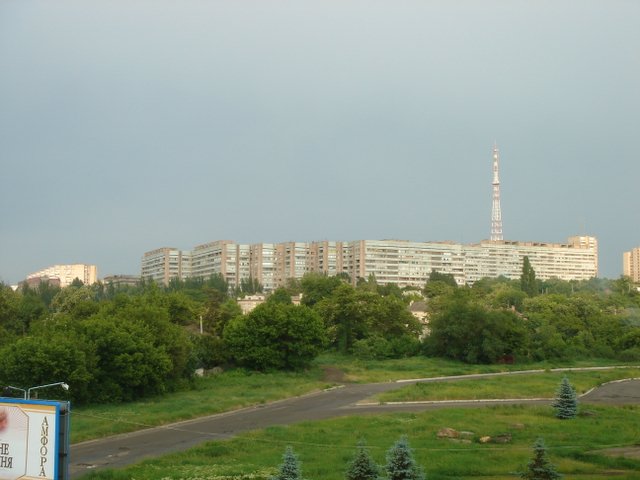
On the drive away from the train station, my fellow Fulbrighter pointed to two apartment complexes facing the vokzal – one a massive, meandering Soviet-era structure dubbed The China Wall (picture above) for its resemblance to the Great Wall, the other a new apartment tower going up across from it. Units in the latter were being advertised as “elite apartments,” My Man in Lugansk said, making quotation marks in the air, and the price was 900 Griven a square meter unfinished (or approximately $180) which puts Lugansk well ahead of where it was a few years ago, when you could have expected to pay $300 per square meter for a place to live, but well below the prices in Kyiv, which are apparently on a rocket ship to the moon, perhaps three times the level in Lugansk.

With jobs in the region scarce, average monthly salaries closer to $150 than $600, and a value added tax of twenty-percent at the newly open Metro – a sort of Ukrainian Costco – I had to wonder just who could afford such a place. My man in Lugansk nodded knowingly and followed all the rules of southern nicety by putting it this way, “There’s lots of money out here, it’s just not well distributed.”

In other words, you wouldn’t surprise anyone on the streets of Lugansk if you said there was corruption in the halls of government or mafia money behind the tinted windows of that black BMW racing down Sovietskaya Street.
I find it ironic. When it was a republic of the Soviet Union, Ukraine was, in essence, a union, but now the gap between rich and poor is wider than ever, the poor are more economically disenfranchised than before, and the wealthy, while once simply well off, are now filthy with it.

The man I’d come to meet, a northern Californian with a dating agency based in Lugansk, told me he had to warn his customers not to expect a quick reply to ever e-mail.

“These women sometimes work six days a week, ten or more hours a day, and when they come home they don’t necessarily have the energy to write an email.”

It was a familiar story. A banker once told me she joined a bank hoping for banking hours only to learn her office was often as full at nine a.m. as it was at nine p.m. and that an announcement came over the PA system every night at ten: “You must go home now.” There was no one forcing you to stay long enough to hear that message, but if the guy next to you is, and the girl on the street gladly would, it’s kind of hard to leave that chair.

Maybe this is the reason, while walking the streets of Lugansk, I saw Lenin still standing and flowers at the base of the statue honoring Felix Dzherzinsky, the founder of the KGB. With numerous other monuments still standing to the glories of Communism and its leaders – to say less of the tall grass along the city center’s walkways and the scarcity of new construction – this city was more visibly Soviet than any other I’ve yet visited in Russia and Ukraine.

This story will continue. When and how I don't know. Been having all sorts of trouble with Blogger. Can't access it at home or the usual internet cafe. So I'm here, where all the young Neos hang out and the foreigners are viewed as an amusing oddity. Seems to work here, though now I can only add one photo. We'll see. It's been like this for two weeks or more, so that's why there've been fewer posts than envisioned.

Read More......

Tuesday, May 23, 2006

"Stiven kak Stephan"

I spent the weekend in Russia, experiencing the best of the culture there. First some great home-made Georgian lamb-vegetable soup Saturday night (Kharcho), then some shashlik (Russian shiskabob) cooked the next afternoon at the dacha. To top this off, I spent Sunday evening at the banya, a Russian sauna (wet, not dry).

The banya treatment included a good beating with venik, dried branches, to improve circulation. This was delivered after two stints in the wooden room heated to ninety-degrees Celsius or so. I wasn’t sure what to expect, so naturally I expected the worst. I imagined a sort of Birch branch torn from a tree (a switch, a Texan might call it) and then a lashing not unlike the one applied by religious fanatics trying to atone for the death of Christ. The reality was a little different. Leafy oak branches were used (while some leafy birch was supplied for a pillow). The branches were applied on both sides of the body, from toe to shoulders, by a man who claimed to be a Walrus, a health nut (there was no vodka drinking here, just lots of tea) who’d even jumped into an icy cold river on the day of his marriage (and appeared on Channel One for the effort). He smothered my skin with heat at times, trapped it on the backs of my feet, up my spine, against my neck. Then, after instructing me to flip over a second time, he gave me a couple of good whacks, the hardest hits saved for last. A great experience -- and enough, a friend of a friend said, to complete my “extreme Russia” tour – banya and dacha.

But then the next morning, this tour unexpectedly continued – at the border with Ukraine.

Usually, the Russian passport control agents have been professional and more often than not very friendly ("You're a writer?" one asked when I arrived Saturday. "Kak Hemingway?" "Yes," I laughed, "Like Hemingway.") In comparison, the Ukrainians have been more demanding, more questioning, either puzzling over my visa (given a special cultural affairs mark) or wondering why I have it (you don’t need one if you stay in the country less than six months) or just running my address through their Palm Pilot one more time. But today there was a problem on the Russian side, and for a time I feared I might find myself locked away behind a fence, given a shovel, assigned a bunk.

On my immigration card, I had written my name as “Stephan,” just as it reads in my passport. But my Russian visa reads “Stiven” (unlike my Ukrainian visa which reads “Stephen.”)

This proved problematic.

After punching a number of buttons, staring at the screen, not looking my way for a good two or three minutes, the middle-aged woman behind the Plexi-Glass finally asked a question. “Your name?” I told her. She explained the discrepancy. I nodded, sighed, made every effort to show that I had been having this problem my whole life – in Little League, I could have said, the guy announcing the next batter always called me Stephen. I thought she was commiserating. Then I realized this to her was more than a minor frustration; it was a major clerical mistake.

She called for the control agent one line over. The two women started talking. I was the last one left from my bus of fifty or so passengers. A third woman drifted over. I asked if the bus was still there. It was. I reiterated that the difference between the two names was small. Look at my first Russian visa, two years ago, I said. Yes, there; that one has the name correct. Isn't that all that matters? That someone got it right, once? “Every time it’s different,” I said.

She stared at me as if I were speaking Greek, but it wasn't because my Russian failed me. I've been practicing. I can get some things right. This was a bureaucratic stare.

Another agent was summoned, a man in his late forties. The phone rang. He took the call, spoke with someone in Moscow for all I know. Then he hung up and asked me something in a stand-up straight voice. I answered him, suddenly six foot tall. Kharkov, I said. That's where I'm going. And because his voice commanded such respect, I gave him some more information too. I live there. I'm an English professor. (Sure, I'm not teaching anymore, but I've found this phrase opens door, hastens stamps). But he didn't listen, just looked between me and my picture, seeing a clean-shaven man in the flesh but a goateed one in the passport. He studied me again. I stood straighter somehow. Now, my whole identity was apparently in doubt.

The bus driver came in. What’s going? There’s a problem! I’ve got fifty people waiting! The customs agent tore away with my passport, striding outside, the bus driver talking at his side the whole way, me reluctantly wondering if I'd missed the command to follow him. Should I? He barked something. I stopped. The bus driver did too. The man walked away.

Didn't the State Department recommend you not give up your passport? Isn't that a bad thing? Not comfortable, that's for sure. What was he doing? How long would he be gone? Is there a complaint box? I feared a back-room, questions about the number of stamps in my passport, the back and forth between this country and that. Are you a spy? Comrade Wolf eats without listening.
Then people spilled off my bus, some smoking, others cursing, and I returned inside, where a new busload of people were filing through the two check-points.

I quickly sent text messages to someone in Russia. “Check on me in twenty minutes.” Because what if they took my phone? And really, I’m trying to leave Russia, not enter it! Is this how they fight the country’s population decline? Keep me behind for spelling practice? “They’ve taken my passport,” I wrote. “I don’t know where or for what.” Call the embassy in Moscow – I was ready to write it. But then maybe 25 or 30 minutes after it’d started with a simple shake of the head, back the man came, breezing by me to the woman in the booth who’d initially attempted to process me.

“Stiven kak Stephan,” he said.

Steven like Stephan.

The man handed me my passport. I took it and left silently for the bus, explaining to a grinning man between me and the door that it was all because of a single misplaced letter. Maybe it was really three or four misplaced letters, but he understood the point. "Extreme Russia," he said. I fell into in my seat, directly behind three new vacancies (some women had apparently walked or opted for a taxi). The bus shook to a start and we moved on to the Ukrainian side, where the control agent would tell me I'd signed my name in the wrong place on the card. "Well at least I spelled it right," I should have said.

Read More......

Wednesday, May 17, 2006

Dom Pavlova

A final report from Volgograd:

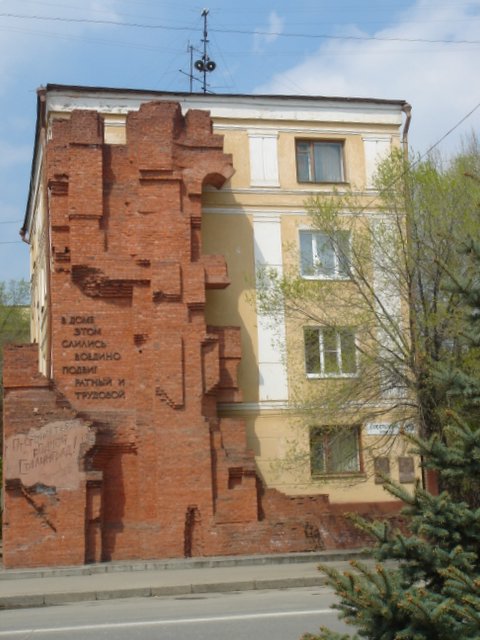
Dom Pavlova "was a four-story building in the city centre of Stalingrad, built parallel to the embankment of the river Volga and overseeing a large square, the '9th of January Square'. The house was attacked by the German invaders in September 1942. A platoon of the 13th Guards Division was ordered to seize and defend it. The platoon was commanded by Yakov Pavlov, a junior commander replacing his wounded superior. They were successful, although only four men survived the combat. Together they went on defending the building on their own." (from NationMaster.com)


Dom Pavlova today

The Germans attacked the building several times a day. Each time German infantry or tanks tried to cross the square and to close in on the house, Pavlov's men took them under heavy fire from within the basement, from the windows and from the roof top. Leaving behind a square covered with corpses and steel, the Germans had to retreat again.

Eventually the defenders, as well as the Russian civilians who kept living in the basement all that time, held out during intensive fighting from 23 September until 25 November 1942, when they were relieved by counter-attacking Soviet forces.


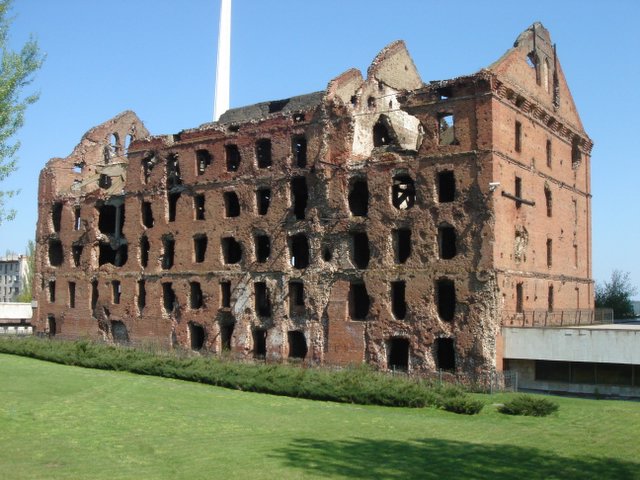
The warehouse facing the apartment building remains preserved today on the grounds of a museum that includes panoramas of the Battle of Stalingrad.

Read More......

Thursday, May 11, 2006

Mamayev Kurgan, Volgograd


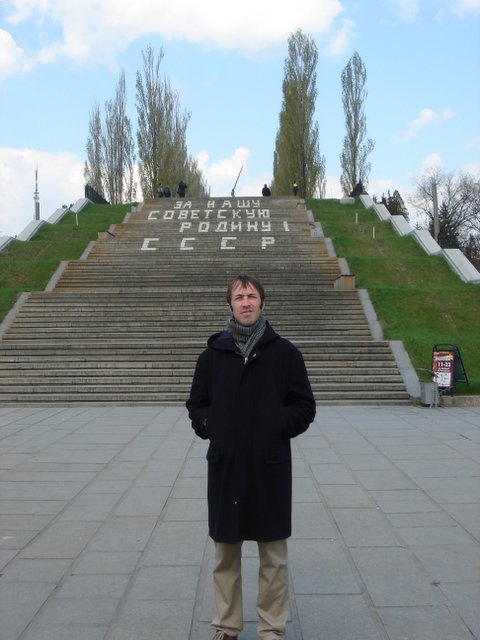
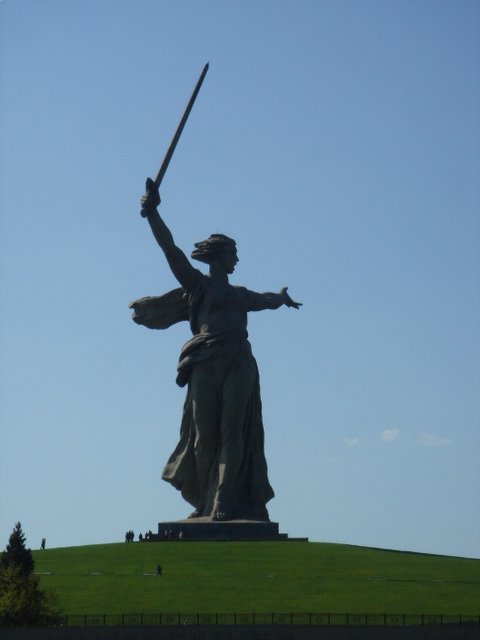
Above you'll see the entrance to the Mamayev Kurgan, the giant statue in Volgograd commemorating the sacrifices made during the Battle of Stalingrad. On the steps you'll see the words, "For our Soviet Homeland, USSR." The paint is a fresh coat, and the look on my face decidedly disturbed.

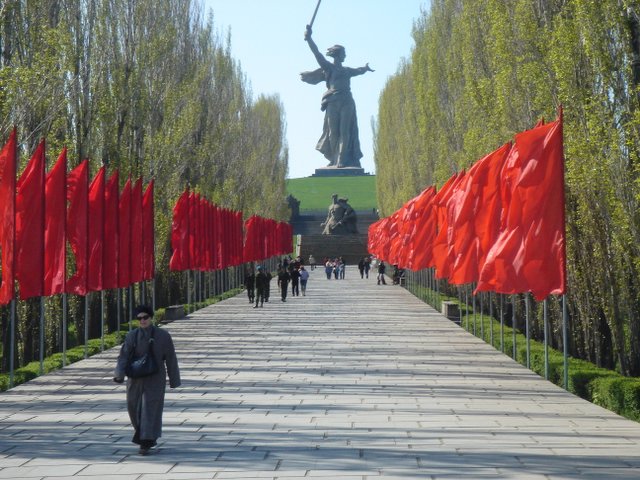
Once you get to the top of the steps, you see the statue in the distance.


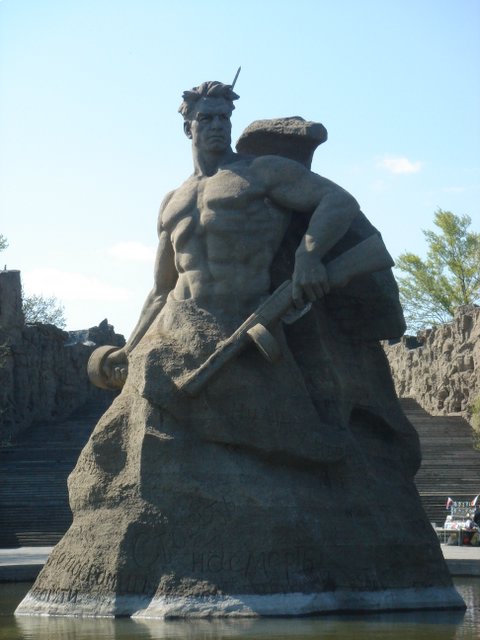
The next thing you reach is this massive soldier, who rises up to block the view of the statue, which represents Mother Russia. Hence, he's rising up in her defense, keeping you from her. In the second photo, you can see he's just a tiny figure at the end of the column of red flags.


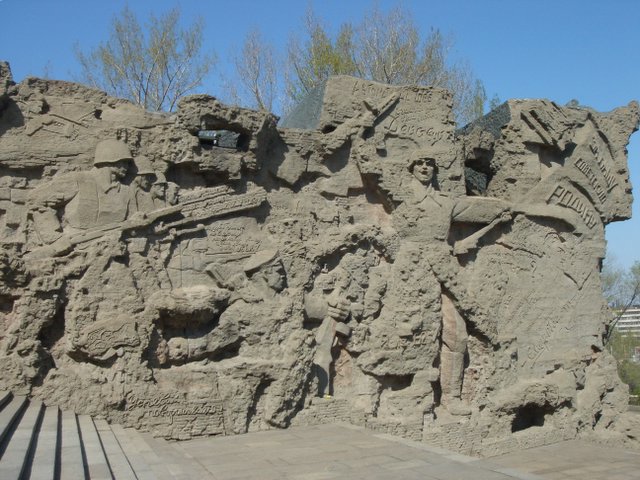
Pass the above and you enter a corridor that depicts the defense of Stalingrad and then the move to drive the Nazis out. The walls -- one static, one active -- are covered with Russian sayings made famous during the war. Here, some rather ghostly music begins to play.


After that, you move out onto a reflecting pool like at the Washington Mall.


Then, inside a cavern of sorts and up some stairs, an eternal flame, with the names of fallen soldiers on the walls around it (only one percent of those who died at Stalingrad; many weren't known, owing to a lack of the equivalent of a "dog tag"). In the below photo, you'll see the hourly changing of the honor guard.


And then you reemerge onto a hill that leads up to the statue, passing, along the way, a memorial to Vasily Zaitsev, the sniper made famous by the movie Enemy at the Gates.

Read More......

Thursday, May 04, 2006

Volgograd


I mean to write a few words about my trip to Volgograd, which I returned from on Tuesday. But for now I've only added a few photos (of a May Day rally) to the Flickr sidebar. Until I post more, I'll leave you with this photo and let you wonder what it is.

Read More......

Sunday, January 22, 2006

Feminine Virtues


This article in the New York Times should be of interest to Ukraina-philes, as it comments on the rise to power of two women to the top political post in their respective lands:

For Ellen Johnson Sirleaf (of Liberia), an economist and banker who was inaugurated Monday and is the first woman elected president in Africa, and for Michelle Bachelet (of Chile), a general's daughter who was elected as Chile's first female president, a key to victory was the power of maternal symbolism - the hope that a woman could best close wounds left on their societies by war and dictatorship.

Unlike Margaret Thatcher and Golda Meir, the strong women of the previous generation, Ms. Bachelet and Ms. Johnson Sirleaf have embraced what they have both called feminine virtues and offered them as precisely what countries emerging from the heartbreak of tyranny and strife need.


All this reminded me of something I saw a couple weeks ago (and should have photographed) when I took a ride on Kyiv's funicular, a closed-car that descends on cables down the hill overlooking the Podil district. The driver's compartment sits at the front of the car, the passengers sit behind this in segmented compartments that have five or six seats running from one side to the other. Nastia and I thought to sit in front to get the best view, but when we got to the lead passenger compartment, we saw the view from one of the seats blocked by a 2006 calendar (this was only a few days into the new year) that was beautifully designed, if blatantly manipulative.

There was Yulia Timoshenko wearing all white against a white backdrop, with the edges of her top so blurred, so vaguely ethereal, that she looked more angelic than terrestrial. Before her beatific smile, in the cup of her hands, was a small pile of dirt, so dark and rich, from which grew the first seedling of a green plant.

The calendar didn't need any campaign slogans for the March election; it was all there in the image. Vote for me. I am white and pure. I can mother you. I will help Ukraine grow.

I couldn't find an image of that calendar online, and I didn't think to take a picture, but there's another strong image above, the heart in the form of a check-mark that is being used by Block Yulia -- the coalition headed by the braided one.

Read More......

Monday, December 19, 2005

The Baltic States, an unlikely tour


I found myself needing this information today to acknowledge some research for a magazine bio, so I thought to post these links here. You may not be in the area to visit, but you can at least have a click and see. It's important that everyone does, I'd say. The lessons of history and all that, don't know them they repeat today; you know the routine. Anyways:

Two summers ago, I visited Moscow with my girlfriend, who was kind enough to take me, with my interest in the Cold War and 20th century history, to the Lubyanka Building, in the heart of the Russian capital. Here, in a beautiful yellow building, the KGB used to do not so beautiful things in the basement. Isaac Babel is believed to have been killed here, caught up in one of Stalin's purges. His last words: "Let me finish my work!"

From there, I left alone by train for a tour of the Baltic states, and a tour, I'm sure, few travel agents would book. The Museums were located in each of the capitals: Tallinn, Latvia, Vilnius. By the end, I thought to get a faux-rock concert shirt printed: Stephan Clark's Tour of Oppression and Repression, Summer 2004.

In Tallinn, I visited the Occupation Museum, which tells Estonia's history from 1940 until the end of Communist rule in 1991. Located in a modern building on the edge of the city's beautiful Old Town, you'll find lots of video here documenting the period, from the initial Nazi occupation to the take-over by the Red Army and the subsequent authority of the KGB. The website offers Russian, English and Estonian versions.

Riga also has an Occupation Museum, and it too is housed in a beautiful building in the Old Town. No video that I recall, but plenty of personal items are on display here, including many, like this facemask used to fight the cold, that detail the gulag system in ways that were invaluable to my research of "Kamkov the Astronomer," a short story forthcoming in the Cincinnati Review. This website, while beautifully designed and offering a great virtual tour, does not offer a Russian version, like the following website, something I find a little peculiar. The above image was borrowed from this site.

Finally, I visited The Genocide Victims' Museum in Vilnius, which is housed in the basement of the city's former KGB headquarters. You enter it as a prisoner would, moving from the registration desk to those more chilling rooms in back, such as the Room of Inquiry and the Room of Execution. All the while, if you listen to the voice of the poncey Brit on the supplied Walkman, you learn about the many horrors that took place here. It is chilling. An experience best taken alone, on a slow day, when, if you're lucky, you might not bump into anyone with a camera swinging from their neck.

Read More......

Tuesday, December 13, 2005

Notes from Kyiv


Before giving my presentation on American fiction workshops Monday at Kyiv-Mohylo, my Fulbright coordinator said other deans had learned of my talk and asked if I might bring it to their university as well. Then she told me the names of the two cities where these universities were located, and Vinnytsya I knew, but the second gave me pause, because surely there wasn't an administration building so near a concrete sarcophagus and the memories of 1986.

“Where is that?” I asked.

“Ternopil?”

And here I brought in a breath and nodded -- yes, Ternopil -- as she went on to describe its position on the map, a non-irradiated point far from the imagined Chernobyl.

~

My presentation ended up being half a discussion of fiction and half a talk about how to run a writing workshop. It was attended not by post-graduates, but mostly professors from Kyiv-Mohylo and other area colleges. Many of them taught literature, at least one was in the sciences, a few were just English speakers interested in discussing the stories (see post below) and hearing a native speaker. There were even two budding writers, each of whom proved themselves to be writers in different ways. The first had very strong opinions, the second, after slipping me a note saying she’d like me to read a story, got up and left halfway through my talk.

~

I thought I’d have several hours to kill after the discussion ended at 5:30 (my train left at half past ten), but I was taken out to dinner by a cultural affairs officer from the US Embassy and her assistant, a native Ukrainian. We dined at a posh sushi restaurant on Shevchenko Street, if only because I didn't relent -- sushi, I thought, it has been months since I've had sushi. The food was good, and let's hope here that it was a product of globalization, as the fish from the Dnepro are closer to Chornobyl, just a short boat ride upstream, than than are to Ternopil.

But the menu, that was a little confusing. It had pictures of the sushi and sashimi and shasliki, and then alongside this three names: the bottom one in English, the middle, in parentheses, in Russian, and the one above it in Ukrainian. I asked the only Ukrainian at the table. “This is Ukrainian, isn’t it?” For while I hadn’t found any of the tell-tale umlauted i’s that give the language away, I had found myself unable to understand any of the words. Like here was salmon, (лосось), and that word on top was just gibberish. But no, it wasn’t Ukrainian, however much Ukrainian is gibberish to me. It was Japanese, transliterated into Russian. Just more confusion in a city that blends Russian and Ukrainian like those in Calexico blend English and Spanish.

~

I found it interesting that the cultural affairs officer, who wore a furry shapka that for some reason brought to mind Dan Akroyd and Spies Like Us, was persuaded by the State Department (okay, told) to learn Ukrainian rather than Russian. Learning the language is like many noble gestures: wasted. The latest example of this was shown to me when she was assured by her assistant that the waitress at our restaurant would no doubt understand Ukrainian, though she might answer in Russian. This Russian, she went on to say, has incorporated so many English words in the last decade that she wonders how people her parents' or grandparents’ age can still understand thelanguage.

Sometimes I wonder if we'd all just be better off acting like the least sophisticated of tourists, grunting and pointing, ocassionally thrusting the point of one finger into the glass.

~

The television at the restaurant was tuned to Fashion TV, not a rarity in Ukraine. It is one of four channels with English programming delivered by my cable provider (and when I say English, perhaps I'm being too particular; if you take away the music played over the images of the models strutting down the catwalk, Fashion TV is for the most part mute). The other English-friendly channels are BBC World (which cedes half the day to the German-language Deutsche Welle), the Discovery/History channels (which are two channels, but together offer a few hours of English TV a day) and then Extreme Sports (which is all-English, all skate-rad, all day). More often than not, and more frequently each day, I opt for Fashion TV. Want to talk about Fashion Week Portugal?

Read More......

Monday, November 28, 2005

The Blood Road

When I was in Norway, I visited the Blood Road Museum (in German and English) in Rognan, the town where my mother was born and raised. The museum commemorates those many thousands of prisoners of war, mainly Red Army soldiers, who died working on the railroad Hitler hoped to build through northern Norway. The railroad never materialized (it fell just short of Rognan, well short of Kirkenes, the launching point into Murmansk) but the Germans kept their captives working even when they realized their initial plans, to complete the project in three years, were overly ambitious.

One of the worst camps in Norway was in Botn, a beautiful fjordal inlet just a couple miles from my mother's cabin. After the war, it was deemed to be an execution camp because so many prisoners there died, some from mass executions (this during the first year of operation, when the SS ran the camp) and then many later, when the Wehrmacht took over, from drinking water that was allowed to mix with raw sewage (this is what gave the camp its legal definition as an "execution camp," like Dachau or Auschwitz, because securing clean drinking water should not be a problem in Norway, where the streams run clean).

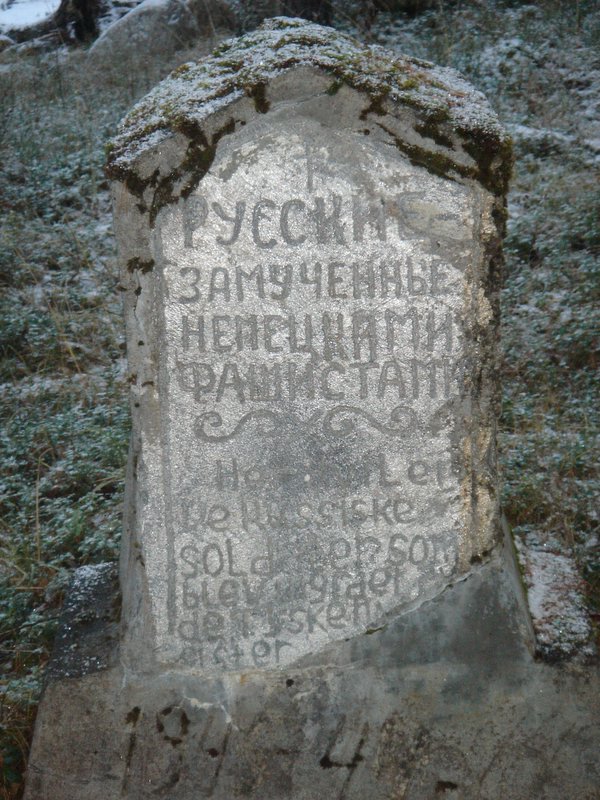
The picture above is of a headstone from a former Russian graveyard located at the edge of my mother's cabin's property line. The graveyard and camp were just up the road from her, though the former was moved, as were the graves of all but a few Red Army soldiers, when the Cold War came around (the graves were moved to a cold Norwegian island where Soviet visitors could be more easily contained and surveyed).

Anyways, all of this is a sort of quick look at the subject; I'm working on an essay that goes into it in greater depth. Because here's the thing, and I hope she doesn't mind my saying so (if so, I'll take this down): My girlfriend's great-great grandfather was in one of these camps, but we don't know which one. I probably want to find out more than her; if I don't know something, I want to know it. Call it a form of autism, or mental retardation, or just plain curiosity -- I don't know. Anyways, what I do know is this: that one-third of all Soviet soldiers were held in Saltdal, the county where my mother was born and raised; beyond that it's like grabbing at the fog. In the final days of the war, the Germans did a good job of destroying their scrupulously-kept records, while after the Cold War, Moscow was mum on who was where or when. So: I'd like to write about all this, and it seems logical that my search be part of the essay.

Anyone know how I can find more information? How I might match a name to a camp?

Read More......

Wednesday, November 16, 2005

Ukraine is "more better"

When I was a teenager, my fantasies were largely unvaried. Some days I imagined the girls from the annual USC Cheerleaders calendar, others I called upon the image of an archetypal Swede -- a blonde-haired, blue-eyed beauty who was quick to lose her top and knew all the words to "Dancing Queen." I wasn't alone in this regard -- California and Sweden, it was the Mecca to which many men turned their lust. And why not? The Beach Boys sang about California Girls (before David Lee Roth did the same to greater visual effect), and innumerable Hollywood movies brought in a bouncy blonde with a sing-song accent whenever the plot grew too dull. There was nothing more coveted.

But today at 12:35 p.m. local time I learned there had been a revolution and that men the globe over now followed a New World Order. I discovered this in Sundsvall, Sweden, a three-hour train ride up the coast from Stockholm, after being dropped here with a two-hour lay-over en route to my mother’s Norway. At the buffet restaurant inside the train station, opera music played from the speakers, and my fellow stranded passengers sat chattering in Swedish and Norwegian at their tables. The food in the metal tubs was decidedly Scandinavian: sliced roast beef, creamed salmon so soft it fell apart at the touch of your fork, and bite-sized boiled potatoes served whole and skinless. But the restaurant’s staff was not – Middle Eastern, I thought.

The guy who approached me from behind the register was in his late-twenties. He wore blue jeans and a tight black t-shirt that didn’t fully cover the tribal tattoos on both of his arms. His hair was short and black and showed signs of styling products and a good deal of personal care. He was quick with a smile, quick with a bounce of his chin. When he said something in Swedish, I asked in English for the buffet. He rang me up without hesitation, English coming freely and easily to him, and gave me the change from my hundred Kroner bill.

“Where are you from?” he asked.

“California,” I told him, though underneath this I heard something else – an echo familiar to anyone who has lived in a country trying to learn its language: Ya iz Californiyi. “But these days I’m actually living in Ukraine,” I added.

His smile grew bigger here. He bounced his chin and lifted one hand, rubbing the fingers together as if demanding money or worrying over some prayer beads. “It’s more better,” he said. “The women.”

I nodded and grinned and said something in the affirmative – always the agreeable idiot – and then took my tray and went off for my food. But as I sat down to my meal, I couldn’t help but consider this more deeply. I was a Californian, he was living in Sweden, and Ukraine was “more better?”

When he came back out with a stack of porcelain plates for the buffet, I walked up and asked how he’d heard about Ukrainian women.

“My brother,” he said, “two, three times he's brought one over. Always he thinks he’ll marry,” he said, “but always he finds another one more beautiful than before.”

They stayed a few weeks and then were gone, their visas soon to be expired anyway, and then the brother went off again to the marriage agencies of Kiev. After a little more prodding, my new friend told me he’d done the same, though only once. He loved Ukraine.

“But Swedish women,” I told him. “Some men would say they’re the most beautiful in the world.”

His face took on a new look; he recoiled as if insulted. “Swedish women are hell,” he said, “like in Afghanistan. They have money”—he slapped his hand against a back pocket—“and so they’re all”—and now he lifted his nose to the wood beams criss-crossing the ceiling.

“Maybe on the weekends,” he said, “when they have some vodka, maybe then,” he said, but then he was shaking his head as if even this weren’t redemption enough. “Where are you in Ukraine?” he asked.

I told him and explained what little I knew of the city, saying it was very large, more than a million and a half people, and just as beautiful as Kiev -- in every respect -- though certainly poorer.

“So the girls are easier,” he said, again with that smile.

I shrugged a shoulder, dropped my head to one side. Deep Throat said, "Follow the money," but he could have just as easily said, "Follow the women?" So much was economics. This guy had taken his passport, which bore Holland’s name, to Sweden on a four-year work visa, and now he was only saving up his Kroner and planning his next geographical exchange. Who was safe from all of this? Perhaps only the Swedish woman and Californian man.

“And if I”—he pantomimed typing on a keyboard.

“Plenty of sites pop up,” I said.

He asked that I write it down – Kharkov – and so I did in both English and Russian, before at last giving him my card and telling him to call should he ever find himself in town.

Read More......