
I was in a very shee-shee part of Beverly Hills today, and across the street from the building where I had a meeting, I saw a line, stretching out the door of what appeared to be a bakery. A bread line, I thought. In the United States of America? But then, it didn't look right, certainly not soviet. The people standing in line all had on sunglasses and designer blue jeans.
They were waiting in line for cupcakes. The bakery sold only cupcakes, and people were waiting longer than an hour or more, standing out under the sun, in the harsh February heat of an indifferent Southern California winter.
Cupcakes.
I told the guy I was meeting, "I gotta my tell my Russian friends about this."
Wednesday, February 14, 2007
Bread Lines


Thursday, December 14, 2006
Blue Cross of California
Doesn't suck.
Apparently.
On the advice of my insurance agent, my wife enrolled in a short-term insurance plan -- one with fewer benefits than any of the plans I would have liked -- in order to generate some "medical records," which she can then use, at the conclusion of her plan, to enroll in long-term, individual coverage.
We hope she'll have other coverage by that time, supplied by her employer. In fact, she goes on her first job interview of sorts tomorrow -- a meet and greet set up by my sister -- an event which was preceded by at least one unpleasant surprise: the United States government guarantees its citizens no paid vacation.
In France, you can expect no less than five weeks vacation a year. In Russia, my wife got four weeks off per year. "It's the law," she said. The same for every other worker, no matter the position. And when I told her there were no such laws here, that the U.S. was the only advanced country to offer no such assurances, that it was at the very bottom of the list, she said, "It's like slavery." To which I had to agree. With most U.S. companies, she'd have to work 15 or 20 years before she could enjoy four weeks of paid vacation each year.
Enough to make us both wish we'd kept at our French lessons, and think of other places: Montreal, the Swiss Alps, St. Petersburg, Belgorod.
Tuesday, November 14, 2006
The Notary

Few people in Ukraine or Russia hold a position of greater authority than the notary. Even a mafia boss might not believe an underling has performed a hit if he doesn't report back with the proper documentation.
When I was living in Kharkov, a professor at the university where I taught was trying to start a marriage agency with a lawyer he knew. He approached me when he learned I was an American, and asked if I would write a letter on his behalf to the owner of an American-owned agency. He was seeking a business relationship, maybe a little advice, and so I dashed off a letter, thinking that would be the end of it. But my Russian-speaking Ukrainian friend received it, he said, "Should we get it notarized, do you think?" This was a man out of a Kafka novel. Slight and thin, mousey face, chain smoker, a nervous laugh and bureaucratic voice. "No," I told him, I didn't think we needed to get it notarized. But he was quietly persistent, sure it would probably be best if a notary was present to see me sign beneath my printed name. "The guy we're writing is from Houston," I tried. "He's not going to know the difference."
But it was a losing proposition. A few nights later, I met my friend on the corner of Pushkinskaya and Bazhanova, piled into a cab with him, and was driven deep into the night to a part of town I didn't yet know. When we arrived, we stood outside in the cold, waiting for his partner to arrive. My friend smoked cigarettes, apologizing for the delay. Then his future partner, the lawyer, was pulling up in a chauffered Lada, and the three of us were moving inside.
The notary was not yet available. Either she wasn't here or she was in a back room. A secretary showed us to a waiting area. Plush leather furniture. Magazines on a glass coffee table. Flowers everywhere. A TV going. We waited. My Ukrainian friend held the documents in a plastic folder: one copy in Russian, another in English. "We'll need them both notarized," he said.
Then the notary appeared, a regal woman in her fifties with chamber of commerce hair and flecks of gold on her neck, wrists and lobes. She looked at our paperwork. Spoke with the two people I'd come with, looked at me not once. No, no, no, she said. This was the jist of it. No, no, no -- she couldn't possibly notarize this, as it was a personal letter. My friends argued. They stated their case. This letter was supposed to initiate a business relationship. It was very much not personal business which was being conducted on this page. But no, I was an individual, not a business, she and they and even I could very clearly see that, and so she could not give us her stamp. "Tell her I'm a professional writer," I said, liking the sound of that. "Would that help? Say the letter is part of my work." But no, it didn't matter. The lady stood. The court was cleared. We had to go.
My Ukrainian friend and the lawyer were crushed. They took me apologizing back to the cab, and it was only a week or two later, at the lawyer's office, that we met with a second notary to try again. This time, tea was served all around, and the notary was offered chocolates. Everyone wore black leather but me. The notary looked at the documents. He had required that the letter be in Ukrainian, not my friend's native Russian. "This is an official document," he had explained over the phone. But now in the office he pointed out mistakes in my friend's use of the Ukrainian language. He could not stamp the letter until this was fixed, and this, and this here. My friend worked hurriedly on the computer, trying to rectify the mistakes. I sat with the pen, waiting to give my signature. More tea was served. The lawyer begged my patience. The notary said he would be back. I was given more chocolate. And then fifteen, thirty minutes later, the new sheet was printed out and the notary was back and I was moving my pen across the page. The notary observed it all, then moved his ledger book before my face. He pointed his finger here, then here; my signature followed.
~
I was reminded of this the other morning, when my wife asked if she should get a letter of recommendation notarized. I said her boss' signature would be enough, but after sending the SMS message I felt a shudder of anxiety -- my god, she's right, that needs to be notarized. Evidence I've lived in Ukraine.
Then this evening, while browsing the Russian Women Discussion message board, I came across this, a list of things a poor man must do in order to have his divorce certificate recognized by the Uzbek government:
1. Have a local notary public notarize the document (divorce certificate).
2. Have the county clerk certify the notary's authority.
3. Have the Secretary of State of the appropriate state certify the county's authority.
4. Have the State Department's Certification Division certify the State's authority.
5. Have the Uzbek Embassy or U.S. Embassy in Tashkent certify the State Department's authority.
As the man cannot legally marry in Uzbekistan until he proves that he is free and unencumbered by any previous marriage, number six in this list could very well read, "Marry a woman from Tennessee. It'd be easier."
And number seven? "Couldn't hurt if she's a notary."
Wednesday, October 18, 2006
A Simple Way to Make the World a Better Place?
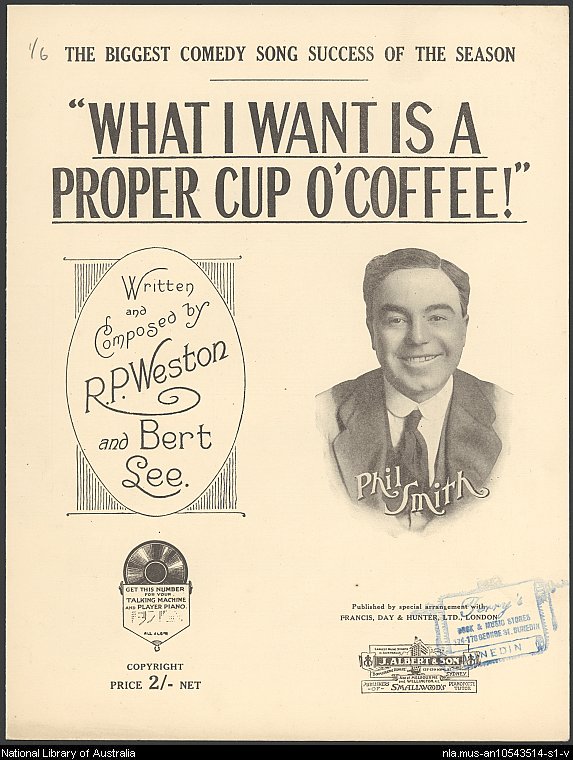
Give me a cup. A proper cup. That's all. When I order a cup of coffee, place it in a cup made out of porcelain, something sturdy and firm and with a little thing on the side, you know, to hold onto. Because in a world of paper cups, I do need something to hold onto.
"Is that for here or to go?"
"For here," I said.
And still, not three minutes later, after I'd taken my seat, what do I get? A paper-cup. The guy sets down a paper-cup in front of me, along with a plastic top, and a cardboard sleeve (complete with advertisement) to keep me from burning my hand. Why did I think it would've been different?
"Am I going somewhere? Would you like me to leave?"
I thought to look around for a sign, some modern equivalent of WHITES ONLY, but with me on the wrong side of the prejudicial divide.
"Because I did say 'for here,' didn't I?"
I had come to one of two independent coffee shops on my strech of Ventura Boulevard, which rougly runs from Tujunga Boulevard to maybe a half-mile past Coldwater Canyon. Between these two points there are three or four Starbucks, two or three Coffee Bean and Tealeafs, and one Peet's Coffee, all corporate chains that care greatly about maximizing earnings potential. But this was Lulu's Bee Hive. A one of a kind place where customers sit at kitchen tables that have four chairs. It's very communal and inviting. Can I sit here? Please, go ahead. You don't fall into your own seat and turn your back to someone else. It's nice. But still, these damn paper cups. Why, Lulu? Why you too?
I ordered an espresso and a fruit tart the other day at the Starbuck's at USC. The espresso was placed in a 8 or 10 ounce paper cup.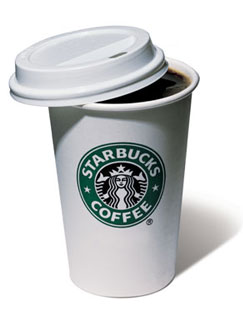
The fruit tart was served in a flip-top plastic container. My utensil? A plastic fork.
When the lady gave me all this, I wanted to say, "Have you heard the phrase 'environmental footprint'? Because all I wanted was a little coffee, maybe something sweet to keep my blood sugar up during class, but now you've got me thinking about how there are hammer-head sharks swimming off the coast of Cornwall and these massive chunks of ice floating toward Jupiter, Florida. All you wanted was a Pepsi? I wanted a cup, just a proper cup."
At least I'm not alone.
But is there any place where there are more than a few of us? The Paper Cup Syndrome is sweeping across Europe, because so much of Europe believes in so much of America, namely, the economy above all else. You're either with us or against us and goddammit don't forget your cup, because we're on the move here, going through the drive-through next, and honey, grab my cel-phone, one of us should call the kids, I think I left Little Jenny with the toaster and little Steve in the tub, and damn this coffee's hot! Someone shoulda put a warning on my cup.
But there are parts of Europe not yet in Europe, Europeans who don't even consider themselves European -- Ukrainians, say -- and they, they most definitely do not drink out of a paper cup, they still believe in the dessert cart -- okay, I'm making that part up -- but they do still believe in the cup, complete with saucer. The proper cup. I know. I used to drink out of one just like this.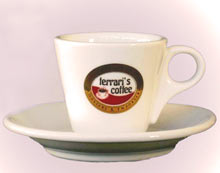
Did America ever drink out of a proper cup? If so, it must've been so long ago I don't remember. And how do little girls even have a tea party these days? Do they set down a tiny little paper cup before their doll? What size? Venti? Grande? Is this really the world you want to leave your children? Or is it all just nonsense?

Wednesday, October 11, 2006
European Numbers
Almost immediatley after returning from Ukraine, I began to see a new doctor, which in America means creating a new pile of paperwork -- forms, releases, notices indicating who to contact in case of emergency (i.e, death), the usual stuff of the medical-industrial complex.
I ran into trouble because I got to this paperwork too soon after living in Europe for a year, where, like the true Zelig that I am, I adopted the use of European numbers. I'd always had a tendency to slash my sevens mid-stem, but now I began to draw my 1 not like a straight up and down line, in the American style, but like a one with a bit of a hooked barb on top. Imagine an arrow with only half a tip. Or better yet, just look at the digit as it stands on the screen. Call it Euro-trash. Throw a beret on it if you must. But don't deny this: It is a Continental one, not an American.
The Europeans draw their ones like this because it comes natural, I suppose, but as the hooked tops sometimes float out to one side, thereby making a 1 appear to be a 7, they give their sevens a slash to avoid the confusion.
Only in America, sevens are not slashed, and ones are straight lines, so when the doctor saw me, I must've come off as that classic male character, the one who refuses to seek medical attention until the pain is unbearable and it's all but too late.
"And you've been experiencing this pain for seven years?" he asked.
"No, no," I said. "Seven? God no. Just one."
He looked at the Patient History form I'd filled out. Made a face. "But it says here"--he shook his head, corrected it with a squiggle, moved on.
The receptionist was no different the next time I came in. While trying to arrange my next visit, she paused over her keyboard, unable to pull up my file. "What was the birthdate again?" I told her. Still nothing. "You're sure?"
"Fairly well, yes."
She rose, not quite convinced herself, and went to get the hard copy from the massive filing cabinet in back. She returned reading from it. "I have here that you were born in 1977."
"No, no," I said. "That's seventy-one." She sat down and laid the file out before her. I leaned in through the little window. "Don't you see the slash?"
"It looks like a seven."
"Well that one does because it is -- don't you see the slash? -- but the other is most clearly a one. If that weren't the case, I would've been born on the 77th day, not the eleventh, and that most certainly isn't the case now, is it?"
She hit a few keys on her keyboard. "So is October 23rd good?"
It sounded very good indeed. The twenty-third? No confusion at all. A two, a three -- the same no matter where you go.
Monday, April 10, 2006
Euro Sport
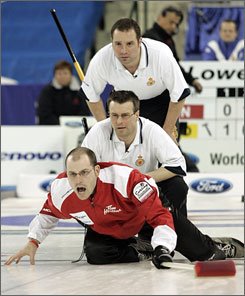
While golf fans in America (and much of Western Europe) were watching Phil Mickleson win the Masters on Sunday, I was flipping through my 50-some channels, hoping to find an azaela bush, a green jacket, maybe a cut-away to Hootie Johnson's face. Instead, I got live Euro Sport coverage of The World Curling Championship, held in Lowell, Massachusetts. Scotland beat Canada, apparently avenging a blow-out loss at the worlds last year. I tried to get into it. Picked Scotland early, taunted the Canadians every time they appeared on the screen. But I don't know. Even if I were involved in the World Curling Championships, I'd still probably rather watch the Masters.
Photo by Ryan Remiorz, AP/CP
Sunday, April 02, 2006
Fireworks
During the run-up to the New Year, I determined that Kharkov has more fireworks displays than any other city in the world. Entirely unscientific of course, but this is how I determine things. Just about every night, sometimes two or three times an evening, I'd hear loud booming crashes that'd send me scrambling to my window. Sometimes it'd just be a faint illumination over the tops of apartment buildings, a flash and then gone. Street to street fighting -- that's what it reminded me of, especially when the latest pwoo-pwoo-pwoo coincided with a car racing by beneath my window. But slowly I began to realize it was just fireworks. A splatter of light would spread across the sky, a red burst, a green one, maybe blue, and then it'd be gone. Sometimes full fireworks shows would be heard and seen in the periphery, coming from Svobody Square or Karl Marx -- something I'd see out my bedroom or living room window.
Last night, I caught one at Svobody Square, formerly Dzherzinsky Square, where Lenin still stands, of course, as I've shown in many photographs before. The show caught me and my friend off-guard. We were just walking through Schevchenko Park, thinking there really was quite a crowd. It was the first weekend of spring, we decided, so we figured everyone was just glad to have the opportunity to be out and about. There was light drizzle in the air, puddles on the ground, mud beneath the feet -- but all but a few dirt-blackened piles of snow were cleared, and the weather was plus 7 or plus 8.
This thinking began to change a little when we got to the square and saw a huge crowd of people standing around enjoying the music. I looked for some tents, some sign of a carnival or a bazaar, maybe a stage, but nothing. Just people standing, drinking, talking, everyone vaguely facing in the direction of Lenin and the music. A pony passed, a child in the saddle. I looked more closely for the source of the Russian pop songs: a small blue bus bearing the name of the state telephone monopoly, Ukretelecom. It had four old-style speakers mounted on top. On the side of the bus, a neat painted message: Zbukova Reklama. Essentially, radio commercials.
A few minutes later, the fireworks filled the sky, majestic burst of every color you could mate with a pile of gunpowders. Reds, yellows, blues, greens. The crowd ooh'd and ah'd as the fireworks shot up, spread out, seems to come raining down right on top of us like the special effects for warp speed in some science-fiction movie. I began to revert to US-thinking, insurance hazards, municipal codes, because these fireworks were shooting up into the air from right behind Lenin and going off low in the skies. Some fireworks sent a line of five or six glowing dots floating through the air on the hold of a little parachute. They drifted toward the Kharkov Hotel, the old Military University. They came down in trees and onto buildings, these and other fireworks, the lights streaming down still afire as they hit the ground.
It seemed to go on forever, one percussive boom after another. The woman with the pony calmed her animal, stroking its face, and then all eyes went to a hanging display of sparkling fireworks that were drawn out against a wire background and kept aloft by a crane. It lit up in front of Lenin, while a voice from the old propaganda bus announced the name of the political party now sparkling lit up in the sky for all to see, spelled out in sparkling yellow and blue: Party of Regions. And then lighting up above, Victory, as the bus announced the same, and the crowd continued to ooh and ahh.
Wednesday, March 08, 2006
The WBC & The Evil Empire
They're playing a World Cup-style tournament over in the Americas and Asia, the World Baseball Classic. With only sixteen teams, it's not yet worldly (the Italians are comprised almost entirely of Italian-Americans) and it's certainly not yet a classic, but all the same it's the first thing that's made me really miss ESPN.
What do I miss? Comments like this from Team Canada Coach Ernie Whitt, describing his club's feelings after almost losing to South Africa, the weakest team in the tournament, on Monday:
"We felt we were kicked in the stomach last night playing South Africa," Whitt said.
Why do I miss something so banal? Because in the same NY Times article detailing Canada's 8-6 victory over the US on Tuesday -- a big upset -- Team USA Coach Buck Martinez describes his club's reaction by saying:
"It's a very quiet clubhouse," Martinez said after the game. "Guys feel like they got kicked in the stomach."
It reminds me of the Presidential debates, circa 2000, when the only guy with anything different to say wasn't invited on stage.
This is why I went back to baseball after the strike. I need something simple and warm, an intellectual cup of cocoa. "How you feeling?" "Like I just got kicked in the stomach." "Boy howdy, you and me both."
I'm so pleased with the NY Times' reporting, I might even starting going there regularly for my sports news (or my sport news as the BBC World would have it). ESPN only had one kicked-in-the-stomach reference, showing it cares nothing for words and the deeper meaning of things. Though their story on the game did include this reference:
The World Baseball Classic -- (Commissioner Bud) Selig's baby -- could lead to some wonderful marketing opportunities and global talent development down the road. But before Beijing produces a shortstop with Yao Ming-caliber appeal or Yankees T-shirts become the rage in Moscow, life goes on as usual here in the states.
Thing is, I see so much Yankees merchandise over here it makes me sick. You go to Barabashova Market, where you can get anything and everything at one of the hundreds of little stalls and stands, and there are all sorts of NY Yankee caps for sale -- the pull-down kind you wear in the winter. I wouldn't invoke President Reagan's rhetoric and call this The Evil Empire, but you can't find any other baseball merchandise over here. No Sox caps, no Giants shirts. Just Yankees gear.
I miss baseball.
(An excerpt from Reagan's Evil Empire Speech before going: "Regimes planted by bayonets do not take root." For those who remember.) Read More......
Sunday, March 05, 2006
Pancake Week

When I went to visit my language tutor on Wednesday (see below), I made my usual left from the front door, toward the sitting room, only to be turned back around and shown to a seat in the kitchen. Here, I was served two thick bliny, one of which I ate with sour cream, the other with homemade jam. It was the first day of spring and, I learned, time to celebrate maslenitsa -- the week-long Orthodox version of the Roman Catholic Carnival.
Raisa Dmitrievna told me the holiday dates back to pre-Christian times, when people cooked bliny, or pancakes, as a way to celebrate the end of winter and the approach of spring. The round, gold pancake is the same shape and color of the sun, she said. I looked out the window, where a wall of white was coming down. It had been snowing for a day and wasn't scheduled to let up any through the writing of this on Sunday. Some first day of spring, I thought. My tutor must've seen this on my face. She said the weather followed the old calendar. It'd start warming up on the fourteenth, she said.
This weekend, someone else told me that Maslenitsa is the last chance for people to have much fun, because it represents the last week before the onset of the Great Lent -- or fast.
From the wikipedia:
During the Lent itself meat, fish, dairy products and eggs will be forbidden. Furthermore, the Lent also excludes parties, secular music, dancing and other distractions from the spiritual life. Thus, Maslenitsa represents the last chance to meet with the worldly delights.
Today on Svobody Square, President Victor Yushenko's Our Ukraine party was on display, handing out free bliny to all comers (picture above). I think political parties must rent out the square -- the Greens were there on Friday night (less expensive, I'm sure, than the last day of Maslenitsa Week).
After seeing plenty of people eating a complimentary bliny, and then kids getting pony rides and walking around with free balloons, I was reminded of that great American political tradition, the parking lot hot-dog give-away. "My name's Jim Williams and I'm running for mayor. Can I get you a hot dog? How you take that? Extra mustard? Yeah, that's what I like to hear. Have you a Pepsi. Vote for me. I'm pro-jobs and anti-crime."
The political rhetoric is really heating up around here -- or at least the visibility of the approaching parliamentary elections, which are at the end of the month. Billboards, TV spots, the rallies on Svobody Square -- it should be quite a spectacle, though sadly one I won't be able to watch backstage. I had meant to monitor the elections (an offer was made to people connected in some way with the Department of State, the monitoring to be done by a European NGO) but I forgot to get my request in by Friday. I've been writing a lot. Maybe I'll just stumble around town looking for flash riots or protests, the first hint of revolution, men arguing or drunk, women selling potatoes and carrots and panty-hose, because life doesn't stop just for this -- I don't know, I'll think of something. Read More......
Wednesday, March 01, 2006
My Russian Teacher
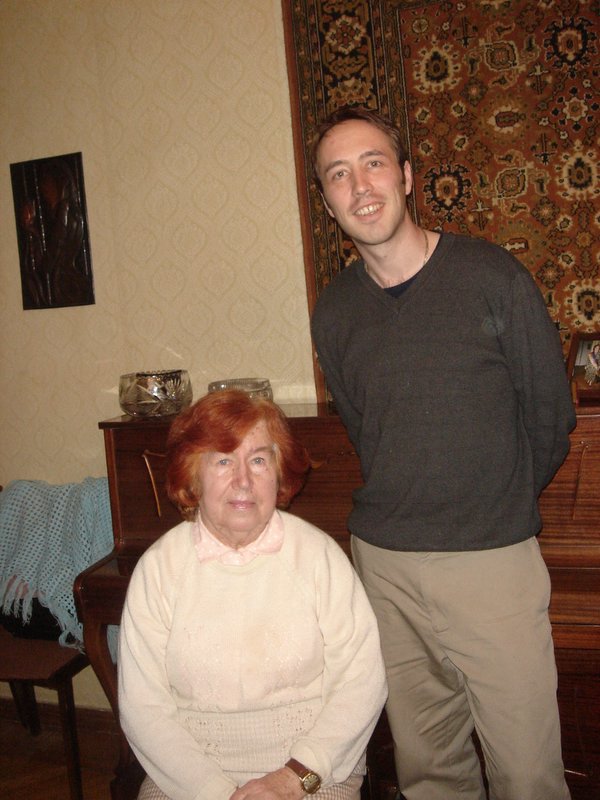
I couldn’t ask for a better language instructor than Raisa Dmitrievna. She taught Russian to foreign students at Kharkov National University and co-authored the textbook I'm using. It's a new experience for me. Many of her students were Arabic, so I often find myself reading exercises like this: "My name is Achmed. I am from Lebanon. My grandparents live in the village." Sometimes, I imagine this as a kind of post-9/11 sensitivity training seminar, wherein I learn that Arabic people are no different than me. Then I suffer a setback and hear a familiar voice in my ear: “My name is Achmed. I am Evil Doer. I come from an Evil Place. I am on the internets now. It can be Evil too.”
I met Raisa Dmitrievna through a Peace Corps Volunteer who has since left town and have since been seeing her three times a week for about two hours a day. At least in my presence, she has never spoken more than two words in English in a row (she maxed out with "Buckingham Palace" a few weeks ago). And becuase I still have trouble getting many Russian words to peacefully assemble together, we often have to reach for a third language to understand each other: French. "'D'accord?'" she might say. "You know 'd'accord?'" "Agreed?" "Da, 'agreed!'" I know even less French than Russian, so when I'm not writing, I'm doing my homework for Raisa Dmitrievna.
Tuesday, February 07, 2006
The Lock, Part Two
Nikolai came back over right on time, just as the maestro was lifting his baton on Shostakovich's 15th, and got the lock assembled and operating in no time. My girlfriend was over, so when Nikolai finished up he talked to her, saying there was a form to fill out that essentially said I, State Your Name, have paid X Griven and received five keys. Also, there was the matter of payment: 392 Griven, almost $80.
"That's too much," Nastia said.
I nodded, I bounced my head from side to side, but Nikolai was a good man and apparently there was some work he'd had to do in the shop.
"I'll just call Lena," I said.
Within moments, my landlord was on the phone and I was telling her about the form and the total.
"Do you want me to pay? It's 392 Griven -- minus the 50 I paid the night before."
Hearing the number, she asked to speak to Nikolai. They communicated briskly in Russian. I understood what was being said. There was an offense and a defense involved. The price was the football. It was being moved up and down the field. Nikolai handed the phone back and picked up the mug of tea I'd made for him. I returned to my conversation with Lena.
"Because if I pay now," I said, "you can just deduct it from my rent."
"What?"
She speaks English very well, but in the past she has shown an ability to lose her proficiency in the language when she does not want to understand.
"Do you want me to pay this," I said, "and then pay less rent because of it?"
"Shto-shto?" What-what?
"I said"--was deduct the word she didn't understand?--"do you want me to--oh here, let me put my girlfriend on."
I put my girlfriend on. Nastia spoke, she paced, she shook her head. At one point, she covered the phone and whispered that Lena, after feigning a lack of understanding even in Russian now, had handed the phone to her husband. I'd seen this man twice before. The first time, he'd been installing my washing machine in the kitchen while wearing black jeans and a black shirt. Because of the color scheme, I'd only made out his holster and handgun after several minutes. "Is that normal?" I asked my translator when we were walking away (I'd gone to pick up the key and pay the first month's rent). My translator assured me it was.
Nastia asked the man with the gun about the fridge. She was firm and director, a hero of mine. "And if the refrigerator breaks," she said, "will he have to pay for that too?" I nodded. I showed her my approval. This is what you needed to say. They were being ridiculous! All I had done was tried to enter and exit my lawfully rented apartment!
But it was all for naught. Details went back and forth, scenarios and warranties were discussed, and in the end it was determined that I had broken the lock, or that I at least must pay. After all, the lock had been installed just a few months before, and so it was all but brand new. Why would they have to replace a new lock?
"Because it's brand new and broken?"
Nastia shook her head.
"So I have to pay for it?" I said.
She nodded.
I pocketed the phone and turned back to Nikolai. This was unfair. This was unjust. This would never happen in America. I wanted satisfaction, to write a letter to the editor, to do their business harm. I thought of refusing to give the landlord a key if ever she asked for one. I thought of writing the State Department to demand a full investigation if ever I went missing, along with $77. But in the end I reached for my wallet and paid.
Nikolai gave me change, returned his wallet to his back pocket, then raised his mug. Hot tea, thank you. He was a good man. If nothing else, I liked him. Maybe he needed the money.
"Do you still have the broken lock?" I asked.
He appeared confused.
"The one from yesterday," I said.
He nodded, he pointed down at the box the new lock had come in; the old one was inside.
"And how much will it cost to put it back in?" I asked.
He shrugged, though he was quick with a number. "Fifty Griven." Maybe ten bucks.
Now I nodded. "Good. Because when I move out," I said, "I think I'd like to see you again."
He gave me his card.
Sunday, February 05, 2006
Friday Night's Not All Right For Locking
I buy groceries only two bags at a time (one for the left arm, another for the right) so every fourth or five day I'm stepping out of the Marshala Zhukova Metro stop and heading into Target, Kharkiv's food-and-electronics super-store, for a needed tour of its well-stocked aisles. But last Friday, after working all of the week on my novel from my morning coffee to my midnight snack, I looked into my fridge and realized I must've missed a trip, maybe two. Wasn't much of anything left. Gathering together the sum of my cupboards and produce bins, I needed a mathmetician's imagination to see a meal. X + Y = It'll see me through the night. When at last I didn't even have any more drinking water (the novelist's war for oil wouldn't stray from the equator's coffee-growing regions) I stepped away from the keyboard long enough to dash off to the corner store.
But I didn't get any water, and I didn't even get down the steps and away from the fourth floor. When I was trying to lock the door to my apartment behind me, the key wouldn't turn -- not easily at least. I used both hands to move the dead bolt into place, only to stop about halfway there after two minutes, having realized if it's this hard to get the dead bolt into place, it might be even more difficult to slide it out. Now I used both hands and a shoulder to turn the key in the other direction, though if the first thing was like walking downhill in the snow, this one was going up. Twenty minutes later, with the dead-dolt stuck half out and the skin of my hands reddened from the effort to get it that far, I did something much easier. Called the landlord and expressed my displeasure -- didn't complain, just expressed my displeasure.
Lena, it turned out, was en route to a birthday party -- it was 8:30 on a Friday night. But I tried to make it known that this was one of the services I had expected to be covered by my rent, the right to enter and exit my apartment both freely and (here is the word I stressed) easily. "I can't close my door right now," I said. No accusation in my voice, just stating the facts. I almost become British at moments like this. "If it weren't for the draft, you understand, it'd be fine. But being January and all, I was hoping you might be a sport and pop over. Mmm?"
Lena agreed, somewhat reluctantly; she said she'd be here in thirty minutes and that she'd bring the original key to the original lock. I had asked for this three times before, but always she'd said I didn't need it, as it was a Soviet-era thing that had possibly been copied by any number of people since my Stalinki, or Stalin-era apartment, went up. Still, I'd wanted it. When you turned it in its mechanism, four metal bars slid out the side of the door and into the wall. Incredibly reassuring, even if it is a mirage.
While I waited for my landlord, I text-messaged my girlfriend and heard back that the locksmiths didn't work 24 hours in Kharkov. I wanted to get back to my novel, but then too I wanted to sleep. And how could I do either with a door open to all the crime and distraction of the outside world? Ten minutes passed. My apartment got colder from the stairwell air coming in. Twenty minutes passed. Then the landlord phoned. She wouldn't be over -- a birthday, she reminded me, once a year and all -- but a locksmith would.
I thanked her. "Thank you," I said. Most pleasant. And then Nikolai appeared, just as she said he would, forty minutes later. It was good. My command of the Russian language didn't get in our way. See the door ajar, letting in the cold. Note the key in the lock, unable to turn. Nods, short phrases, a nice man. "Can I get you something to drink?" I asked. "Some coffee or tea?" He was a tea drinker. "If you need sugar," I said. But no, he took it straight.
Nikolai wore a spelunker's head-light as he worked. While speaking with him about the situation (every idle conversation here seems imbued with international significance) I learned the words for "lock" and "broken," and dared the phrase, "Can you fix it?" Nikolai inspired confidence. My girlfriend called, I laughed and said everything was fine, he was replacing the lock as we speak -- and then I hung up and the ordeal was all but over.
The new lock was secured in its casing. Nikolai took one key off a ring that held five, handed me the rest, then reached for his tea -- Hot tea, thank you -- and bid me inside to test his work.
I closed the door behind me and inserted the key. I turned it one way and jiggled the handle (I always get this wrong) then went back in the other direction and jiggled the handle. Again, nothing. "Nikolai?" I said. I pumped at the handle. "Nikolai?" He set down his tea and helped get me out.
Nikolai, to his credit, was a perfectionist. He shook his head. He studied the dead bolt as it slid in and out and said it was snagging on the casing. I looked to the bag behind him. He'd brought with him three different locks, but I didn't see anything else. He answered my question before it was asked. He said he'd need to get a part from his shop but that he'd be back tomorrow.
"Tomorrow?"
He nodded. "Zaftra."
I asked what time. The Philharmonic was doing Shostakovich's Fifteenth. It started at six. "What time?" I asked.
He did this thing with his head and his shoulders. He tried to express his uncertainty. But at last he said a number. "Six."
"Six?" I said.
He handed me the mug and thanked me for the tea.In tomorrow's installment, Stephan will learn the phrase, "And how much will that run me?" Lena will come over at 1 a.m. from her birthday party. And The Girlfriend will appear as a guest star to ask what happens if the refrigerator stops running, does he pay for that too? Will the door close? Will it lock? Will the drunk neighbors from upstairs mistakenly go to sleep on the fourth floor instead of the fifth? Be sure to watch the next episode of Soap when it airs tomorrow at the same time.
Friday, December 23, 2005
Cook's Corner: A discovery is made

I now know how Columbus must have felt when he first saw land on the western horizon, or what must have been going through Balboa's mind when he climbed the crest of a mountain and spotted the glimmering Pacific beneath his feet. I have joined the ranks of the world’s great explorers, because this evening I stopped dumbfounded in a Ukrainian super-market and raised to my eyes a jar of classic American peanut butter -- peanut butter, in the wilds of Eastern Europe!
I wasn’t prepared for this. Just last week, a public affairs officer with the State Department told me of a bazaar held each year at the US Embassy in Kyiv for the benefit of the ex-pat community. “Next year sell peanut butter” – this was what they'd heard again and again. “We can’t find peanut butter anywhere.”
Nor could I, though certainly I'd tried. This very same week, at a market just north of Kharkov National University, I’d thought I’d come across some. It was a small plastic tub, like the type you might see used to sell cottage cheese in the states. On the lid was a picture of a rabbit (related to Bugs Bunny from the looks of him) who was poking up out of a small circle (again, very reminiscent of the opening of any Looney Tunes cartoon -- you quickly get the idea that a copyright attorney would have a field day here). Beneath this (and a word I didn't understand) was a bold amber word, “Maca,” which I took to be the Ukrainian equivalent of the Russian word for butter, “Maclo.” This by itself wasn’t exciting, but the cartoon peanuts that were scattered all around the lid were. I was the holder of a Master’s degree in English, after all -- a linguist you could say, capable of connecting meanings and tracing roots, and here was a word that meant butter and there were pictures that meant peanuts. Synthesize the two and you had peanut butter.
So yes, I put the tub in my basket and walked proudly to the front check-out. And of course it wasn’t the right thing. Opening the lid, I found something inside that was thick, spreadable and white -- certainly nothing resembling the peanut. And instead of nuts, the concoction was spotted by the stray yellow raisin. I tested it out on a corner of bread. It wasn’t bad, but it wouldn’t go with jelly. If anything, it belonged inside a bliny. I put it away, resenting once again, in this city that speaks only slightly more Ukrainian than Vietnamese, the lack of bi-lingual packaging. (And say what you will about Ukraine’s need to assert its independence and establish a national identity, but know too that it’s more than frustrating to leave the pharmacy, as I’ve done on more than one ocassion, with three or four things that include instructions only in a language that’s all but impossible to learn in the American university system. Maybe when Ukrainian politicians don’t need coaching on their country's official language, maybe then I’ll say Ukraine's ready to be mono-lingual. But until then, for the sake of my sanity and the simple health of any Russian-speaking tourist industry that might develop …)
Back to the peanut butter, though, and fast-forward to this evening. That’s when I entered the Target super-market just off the Marshal Zhukova Metro stop. I’d been here before, I’d seen the massive blue and yellow building taking up half a city block and heard it spoken of as the Ukrainian Wal-Mart. But I’d never seen peanut butter inside its concrete walls, and I no longer expected to. Like all dreamers, I’d learned the futility of unrealized potential. I was hoping to buy some eggs, some lavash, maybe a can of peas. I was happy to make-do. But then there it was, arranged neatly on a little island display away from the shelves. A flag planted, as if planted into the soil of a new world, rose from between the many plastic jars: Oreshka Peanut Butter, it read.
The contents of the jar were concealed by a plastic halter on which a striped and amber cat offered a wide grin, looking vaguely like a cousin of Tony the Tiger’s (though with a poofy white hat borrowed from Chef Boy Ardee). Running off to the sides of his cartoon face were pictures of peanuts.
I flipped it over to look through the clear plastic bottom: a thick brown paste. Like gold, Texas tea, most definitely peanut butter. I looked again at the label, which offered up a loving combination of Ukrainian and Russian, belying its origins in the eastern city of Lugansk. Oreshka, it read, classic peanut butter, No. 1 in Ukraine.
Here was the national dish of America, and even the marketing reminded me of home. It was awash in bullshit. Number one in Ukraine? Of course! Because there is no number two! Still, who cared?
I write to you three sandwiches later, content to my very core. This comes one day after cooking home-made, curry-flavored tofu burgers, the blocks of bean curd found at the sprawling Barabashova Market, hidden away from the outdoor vendors and located in the Asian market behind the handful of walk-up Vietnamese lunch counters.
If you’re looking for bok choy, I’ve got a guy who can score me some of that too. Anything else, let's talk.
Friday, December 16, 2005
I’m nobody’s vich
From my kitchen window I can see a school playground. Usually I pay the noise no mind; it’s just a murmur at a certain time of the day. But this afternoon I looked while waiting for my eggs to boil. There were maybe twenty children out on the blacktop, a little after twelve noon on a gray day. Recess, I thought. Lunch time. Then I noticed what seemed to be a beating-in-progress. Four boys were playing at this game, ten or twelve-year-olds all, and one of these had been assigned the role of victim. Poor chap, I thought. Getting a bit of a rough end of it. A fist or two here, another there, maybe a flying foot every now and then. Nothing too dreadful – these blows didn’t pack enough punch to send anyone down – but then I looked up from this group and saw another duo of boys at the far end of the playground, back behind the trees that’ve gone leafless with the winter. Here was another boy getting beat, mittens on a string flying up in the air with each punch. Two other children came in from the left side. I didn’t even have time to hope that they might be the peace-makers. One of the advancing boys got in on the fun, and then the two aggressors were lining up their victims against a wall, an ominous move that touches on the worst of history. I told myself to look away, I had to watch. Nothing too serious, I guess. Just Ukrainian boys having fun. The girls were mostly playing hop-scotch, some of the boys too, but otherwise there were no more options: no jungle gyms over beds of soft tanbark, no four square courts and bouncy red balls, no tetherball poles, no benches on which children were gathered around books of D&D. Just the most natural toys: the stick and the boot, the fist and the elbow, the concrete wall.
In other news, I realized yesterday that I’m nobody’s vich. You know, my neighbor is Yuri Grigorovich. Such-and-such at the university is So-and-So Nikolayovich. But me, I have no patronymic. I’m nobody’s vich.
Tuesday, September 20, 2005
Eyes, Smiles, and Candles
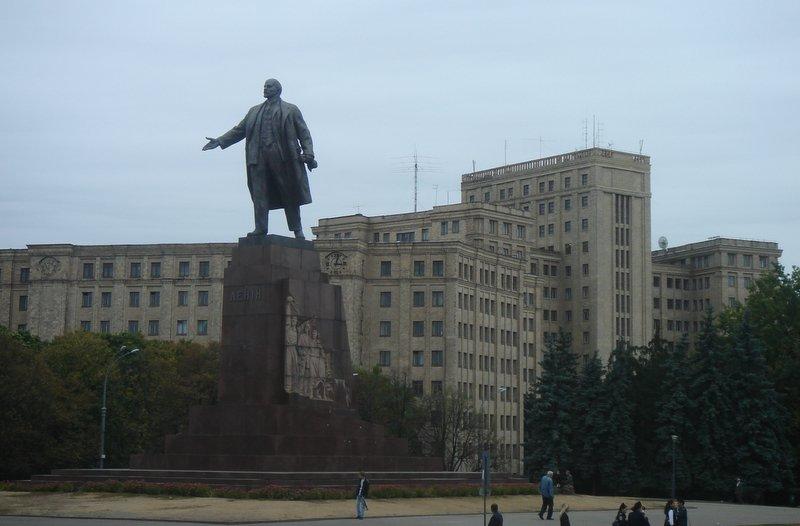
The picture above shows Kharkiv National University, where I'll be teaching three classes (the first in a couple of hours).
Some details from my journey so far.
While boarding my flight to Kyiv in Chicago, an airport employee – the type of guy who waves the plane home with those neon orange paddles – slipped in front of me on the gangway and into the cockpit. When he emerged, he was holding a cardboard box with a bright orange sticker: Human eyes for transplant.
In Kharkiv, while posing for a passport photo I needed for a university pass, the camera person told my interpreter to have me stop smiling, which only made me – and them – smile all the more. “In our country,” my translator said, “we look very serious for such photos.”
I have already been ill (a good thing, I think; the quicker Ukraine gets into my system the better) and so I was lucky enough to see a doctor and have this exchange with my interpreter as the doctor sat slumped behind his desk:
“And he will give you something for the pain, a powder,” G. said, “and some candles.”
“Candles?”
He nodded. “For the anus.”
A look of sheer terror. “Candles for the anus?” I’d been told of the three medical traditions: oral, injection, and suppository. But what was this, a fourth? I pictured something like ear candles used to melt the wax, but they weren’t stuck in the ear and I didn’t know what they were doing there.
“You stick them up and”—my interpreter must have finally seen my expression—“how do you call them?” he said.
I call them not in my ass. “Suppository?” I said.
The doctor eyes lit up. He nodded. “Suh-pah-zuh-toe-rhee,” he said.
G. smiled. He shrugged. “We call them candles,” he said.
“Okay, then. Candles.”
Monday, September 05, 2005
Туалеты
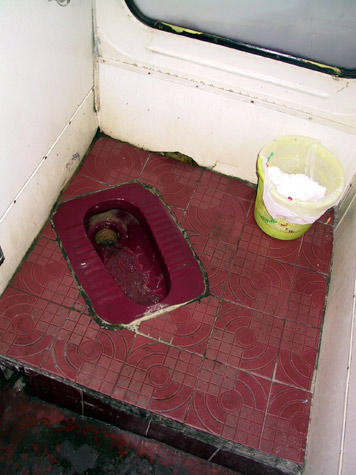
When I visited St. Petersburg last summer, I was told to bring toilet paper, nice soft American toilet paper, especially if I planned on using a public loo. Now, I don't like using the public facilities in America, so I avoided any problems in Russia by keeping my problems at home. There, in the room I rented at the Herzen University dorm, I had not only a toilet bowl but a toilet seat. Private too. This, I learned, was a luxury not to be taken for granted, for while touring St. Petersburg and its environs I saw so many seatless toilets I thought the Kappa Alphas must've followed me over and committed a rash of pranks. But no, it was more devious than that, though I learned of this only upon my return home, when my first Russian professor told me of his year studying at a Russian college. "The students stole the seats from the dormitory toilets before the first class even began," he said. These seats were then spirited away and hidden beneath a bed or inside a closet, guaranteeing the owner's bum a warm welcome on a cold winter's day.
The head may be a Communist, I thought. But the bottom is always a capitalist.
All this, I'm afraid, proved to be only half of the problem, and the less troubling half at that. For then I came upon Leningradsky Station, where Lenin first emerged from his sealed boxcar to lead the Reds in revolution. It was here that I found my first squatter, which looked only slightly better than this one from China. Now, Leningradsky Station is a place of deep historical significance, a place akin to our own Bunker Hill, and though I've never been to Bunker Hill, never even been to Boston, I think it safe to say that the Senior Senator from Massachusetts wouldn't have me setting my feet against the tread marks of even the fanciest squatter and steadying myself over its hole.
How is it that more than ten years after the fall of Communism the toilets at Leningradsky haven't been improved? And for that matter, how could they have remained that way even in the 80s? I imagine President Reagan arriving at the station and being met by Gorbachev, the Gipper saying he just needed to duck into the little boy's room, and then Gorby saying he'd do the same. And then what would happen? What would you see? Gorby and The Gip squatting over two adjacent squatters, with nary a door nor a Secret Serviceman to shield them from view.
These toilets, I'll tell ya: Few things have instilled such fear in me. This is a device that belongs in Tora Bora, hidden in a cave as it speaks calmly into the camera and describes the death and mayhem it will bring to men and women and children and small dogs. I didn't dare use it, if only because I didn't know how to use it. Was it broken? Were my hamstrings strong enough? Had someone stolen the throne? And what was that brush and bucket doing in the corner? Was that there in place of toilet paper, because I sure as hell didn't see a roll hangin yay-high with the paper facing down, rather than up. You asked the question first Lenin, now let me give it to you. What's to be done?
I'll tell ya, these toilets: Few things have left such a lasting impression on me, and so it is now, less than a week before I arrive in Ukraine, that I must confess to all and sundry: I may just hold it.



Sunday, August 28, 2005
Californians, and "mail-order bride" as slur

"From the sound of it, had I stayed in California I might have joined a cult or at the very least practicing some weird dietary restriction."
I read this memorable line more than a decade go, when Donna Tartt's wonderful novel The Secret History first came out, and I'm sure it came to mind again earlier this summer, when an old friend from Los Angeles arrived at a St. Helena spa to prove that he was indeed a Californian. I mean no disrespect to my friend. I'm no different. I bit into the offered peach and lit a stick of incense at the Transcendental Meditation Center in Malibu. I dabbled in veganism and learned to prefer buffalo meat and wild salmon to store-bought chicken and beef, considered food combining, cured the sugar blues, and to this day refuse to eat any and all artificial flavors and colorings.
I say all this to introduce an anecdote. While picking up my friend from the Hoffman Institute, I was introduced to another young man who'd been through the same program of self-improvement -- a Hungarian spoken-word artist/poet who'd recently put out a CD of songs made on some four-track that spoke to our need to save the environment and find God, if I recall correctly. Anyways, this spoken-word artist/poet/singer/environmental-evangelist wanted to know a little something about the Fulbright Program, as my friend had told him I was going to Ukraine -- and why Ukraine? he asked, at which point my friend laughed and said something about my having a mail-order bride over there. I must've looked at him as if he'd just said he planned to shoot my mother, because his next words were quick and sputtering and apologetic. "What? You've got a girl over there, don't you?" At which point I said yes, there was a girl over there, but we had met in Davis -- while she was here on a business internship -- and then seen each other again in Moscow the previous summer. I didn't know what she was. Friend didn't seem the right word, though the alternative didn't either. "But she's not a mail-order bride," I said. That much I knew.
There's something awful about the term. I even tried to remove any reference to it while writing my grant application. Internationally-brokered marriages. Internet marriage agencies. Modern-day matchmaking. But no matter how I try to disguise it, I end up bringing it out in the end, again and again. "Oh, you mean you're going to be writing about mail-order brides?" "Yes," I say. "Mail-order brides."
Some words do heavy-lifting, others look right only on the front page of a congressional report.
Anyways, I thought of all this again, how it's so easy to consider the "mail-order bride" tag a slur, when I read the following this afternoon:
An Australian state Opposition leader has got into trouble for calling the premier's wife a mail-order bride. (She happens to be from Malaysia - actually highly unlikely to be a source of women using paid online marriage arrangement services, since it is far too wealthy.) It left me wondering why "mail-order bride" should be considered, as it undoubtedly is, a nasty term of abuse?
Perhaps the suggestion is that anyone who is a "mail-order bride" is little better than a prostitute (an uncomfortably obvious exposure of the traditional economics of marriage) and anyone who marries them can't get a "proper" woman - a slur on his manhood indeed. I wonder, if you called such women "economic refugees", would they get better treated?
More on the story that inspired the above quote can be found here. Read More......
Friday, July 29, 2005
Top 50 Russian Verbs

There are 555 fully conjugated verbs in my Big Silver Book of Russian Verbs, including enough variants of "to go" to keep Rain Man occupied for much of the next decade. But it's the Top 50 verbs that caught my interest today, particularly a run of these most popular verbs at the back of the book. In a row, I found убирать(to kill), ударять (to strike or hit), умирать (to die), and then, if you haven't gotten the job done yet, уничтожать (to destroy or annihilate). These are top 50 verbs, I'm told. Up there with "to read," "to buy" and "to work." Pretty amazing. I wonder if any other language on the planet can stand toe-to-toe, or toe-tag to toe-tag, with Russian, because that's quite a run, even without throwing in the next two: устраивать(ся) (to place -- as in to place in a coffin) and finally, уходить(to leave -- as in to walk away from said coffin after lowering it into the melted tundra).


Subscribe to:
Posts (Atom)